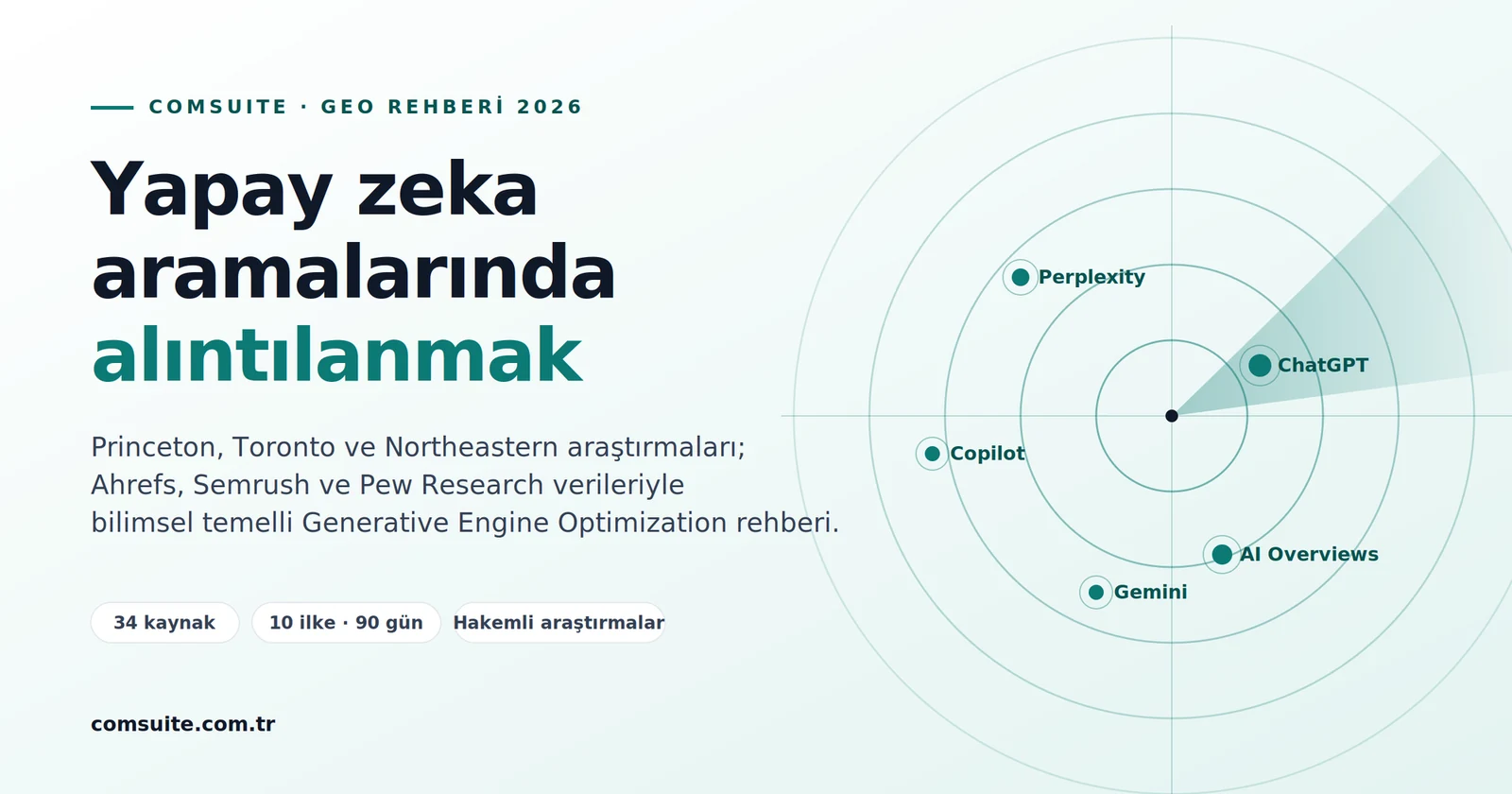
ChatGPT, Perplexity, Google AI Overviews, and AI Mode now decide "which source to trust" on the user's behalf. This guide explains how that decision is made, drawing on peer-reviewed academic studies and large-scale data research covering millions of citations. It then walks you step by step through making your website citable in AI answers.
Published: August 2026 · Reading time: ~28 minutes · 30+ academic and industry studies · Prepared by: ComSuite Research Team
Quick Summary
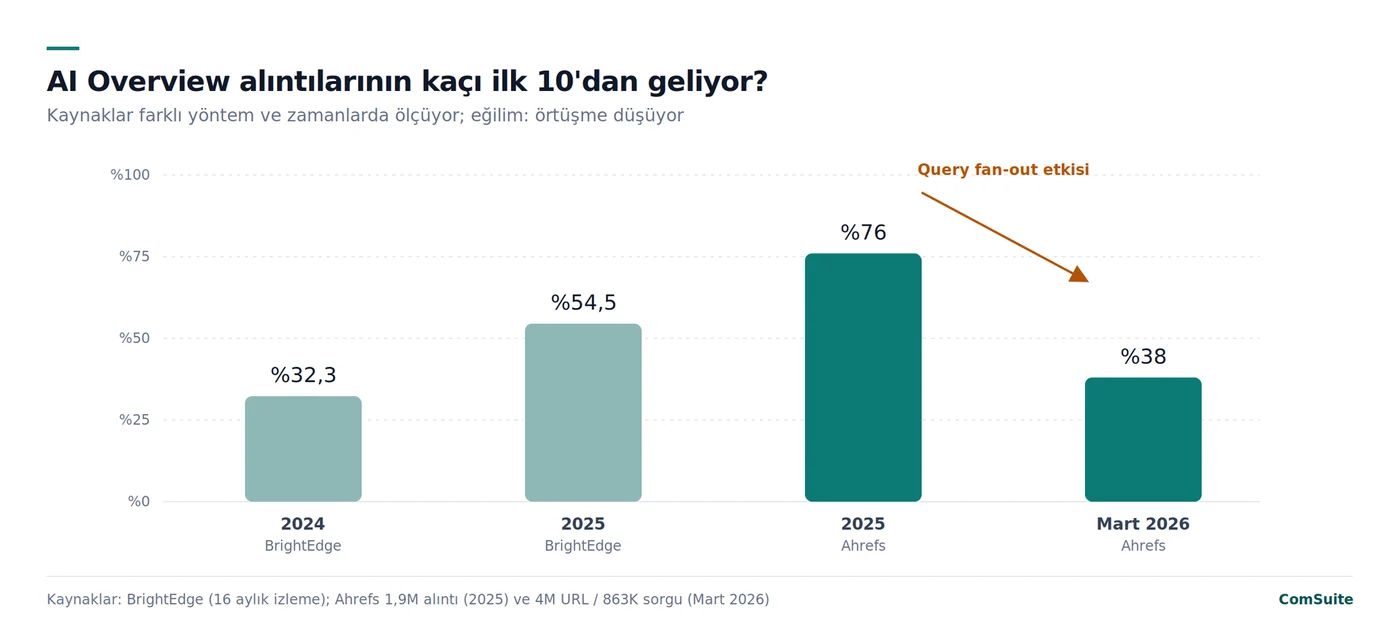
- GEO doesn't replace SEO; it builds on top of it. According to Google's official guidance, there is no separate requirement for AI Overviews and AI Mode, and most citations still overlap with organic rankings. But that overlap is shrinking fast: in Ahrefs' study of 4 million citations, only 38% of AI Overview sources come from the top 10 results for the same query.
- The strongest academic evidence: The Princeton-led GEO paper, published at ACM KDD 2024, showed that adding statistics, quotations, and source attribution to content can boost visibility in generative engines by up to 40%. Keyword stuffing, on the other hand, did not work.
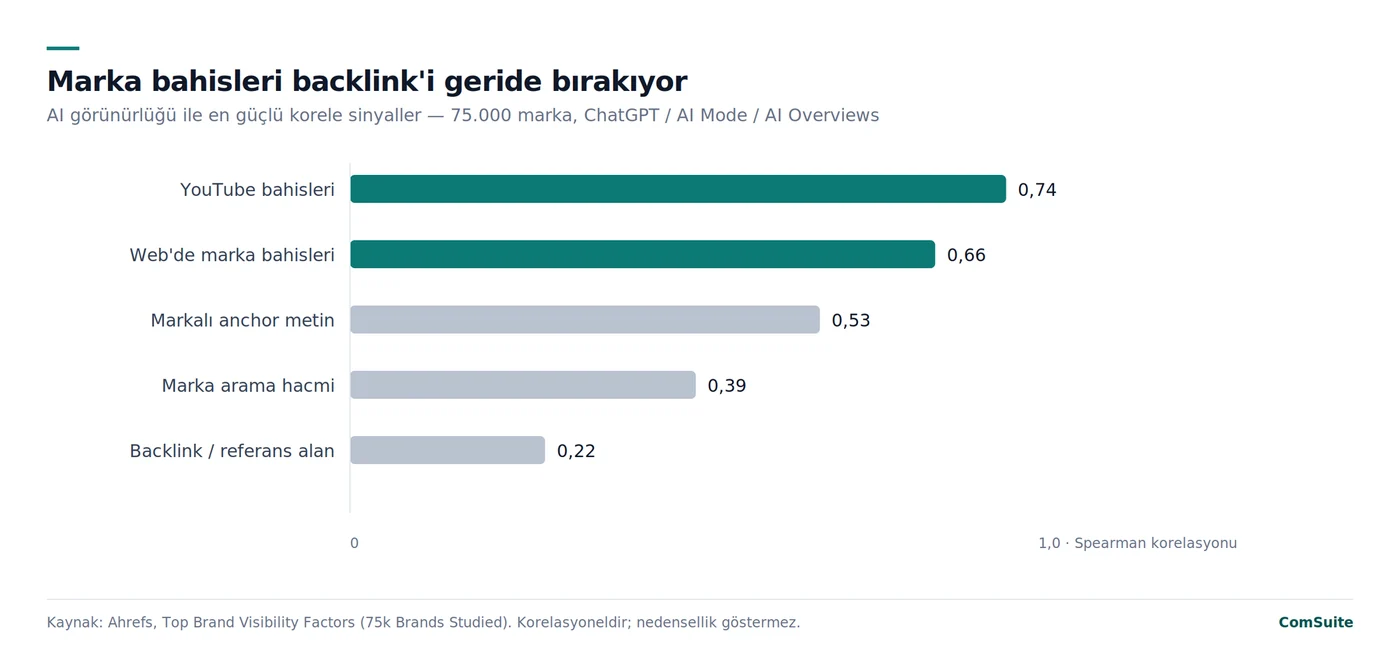
- Brand mentions beat backlinks. In Ahrefs' study of 75,000 brands, the highest correlations with AI visibility were web brand mentions (0.66) and YouTube mentions (0.74); the correlation for backlinks was only 0.22.
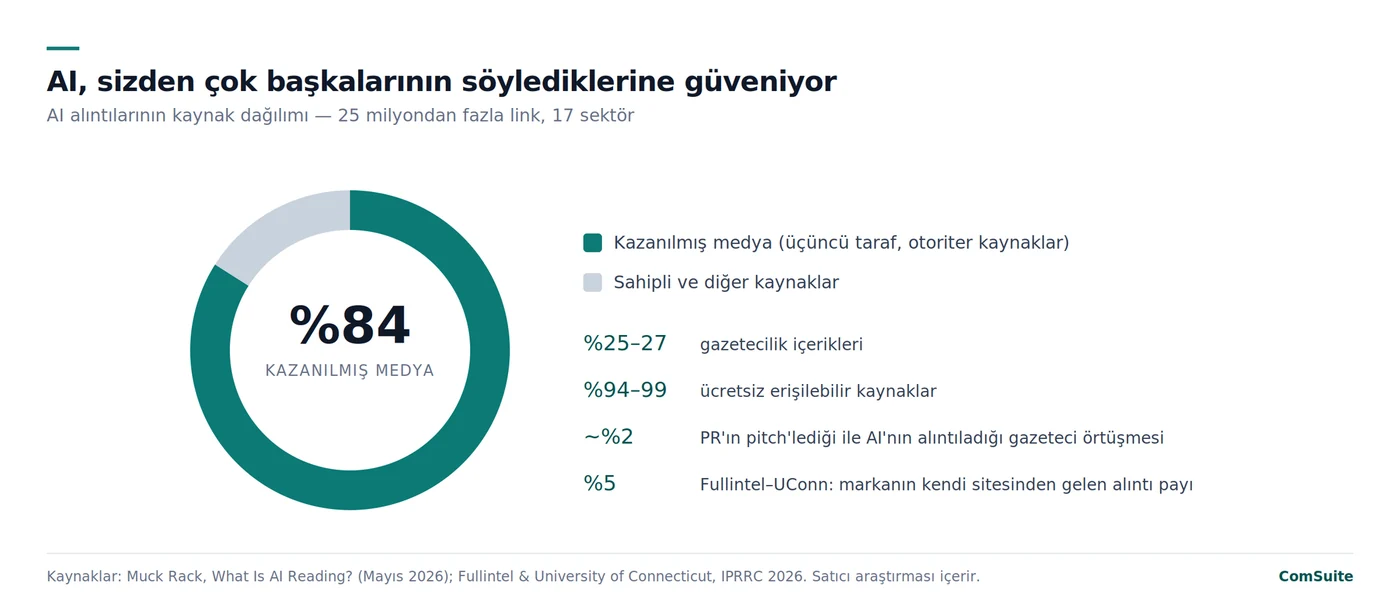
- Earned media dominates. The University of Toronto's experimental study and Muck Rack's analysis of 25 million links show that AI engines cite authoritative third-party sources far more than brand-owned sites (roughly 84% of citations come from earned media).
- Clicks are falling, and decisions are made inside the AI answer. According to Pew Research, users who see an AI summary click on results 8% of the time, compared with 15% for those who don't. The metric that matters is no longer "clicks" but "share of citations and mentions."
1. What is GEO, and how does it differ from SEO?
Generative Engine Optimization (GEO) is the discipline of optimizing a website's content so that generative AI-based search systems (ChatGPT Search, Perplexity, Google AI Overviews / AI Mode, Gemini, Microsoft Copilot, Claude) select it as a source, cite it, and mention the brand when generating answers. The work that brought the term into academic literature is the paper "GEO: Generative Engine Optimization," published at ACM KDD 2024 by researchers from Princeton University, IIT Delhi, Georgia Tech, and the Allen Institute.[1]
The same field goes by several other names: AEO (Answer Engine Optimization), LLMO (LLM Optimization), AI Search Optimization, and AI Visibility. They all try to answer the same question: when a user asks an AI a question, why does the generated answer cite some sites and recommend some brands over others? If you're new to the topic, we explain the core concepts in simpler terms in our What is GEO guide.
Key differences from classic SEO
| Dimension | Classic SEO | GEO |
|---|---|---|
| Output | A list of 10 blue links; the user chooses | A single synthesized answer; the engine chooses, and users mostly don't click |
| Unit | Page and keyword | Passage (section), entity, and topic cluster |
| Query | One query → one results page | One query → 5–15 background sub-queries (query fan-out) |
| Success metric | Rankings, clicks, traffic | Citation share, brand mention share, position within the answer |
| Authority signal | Backlinks | Brand mentions, earned media, YouTube, communities |
| Freshness | Varies by topic | Noticeably more important (especially for ChatGPT and Perplexity) |
Despite these differences, Google's official guidance is clear: there is no additional requirement or special optimization for appearing in AI Overviews or AI Mode, and core SEO principles still apply.[7] In other words, GEO is a layer built on top of a solid SEO foundation. Without the foundation, there is no layer.
2. How does AI search work? RAG and query fan-out
To understand GEO, you need to understand how the engine generates its answer. Modern AI search systems use a RAG (Retrieval-Augmented Generation) architecture. In simplified form, the flow works like this:
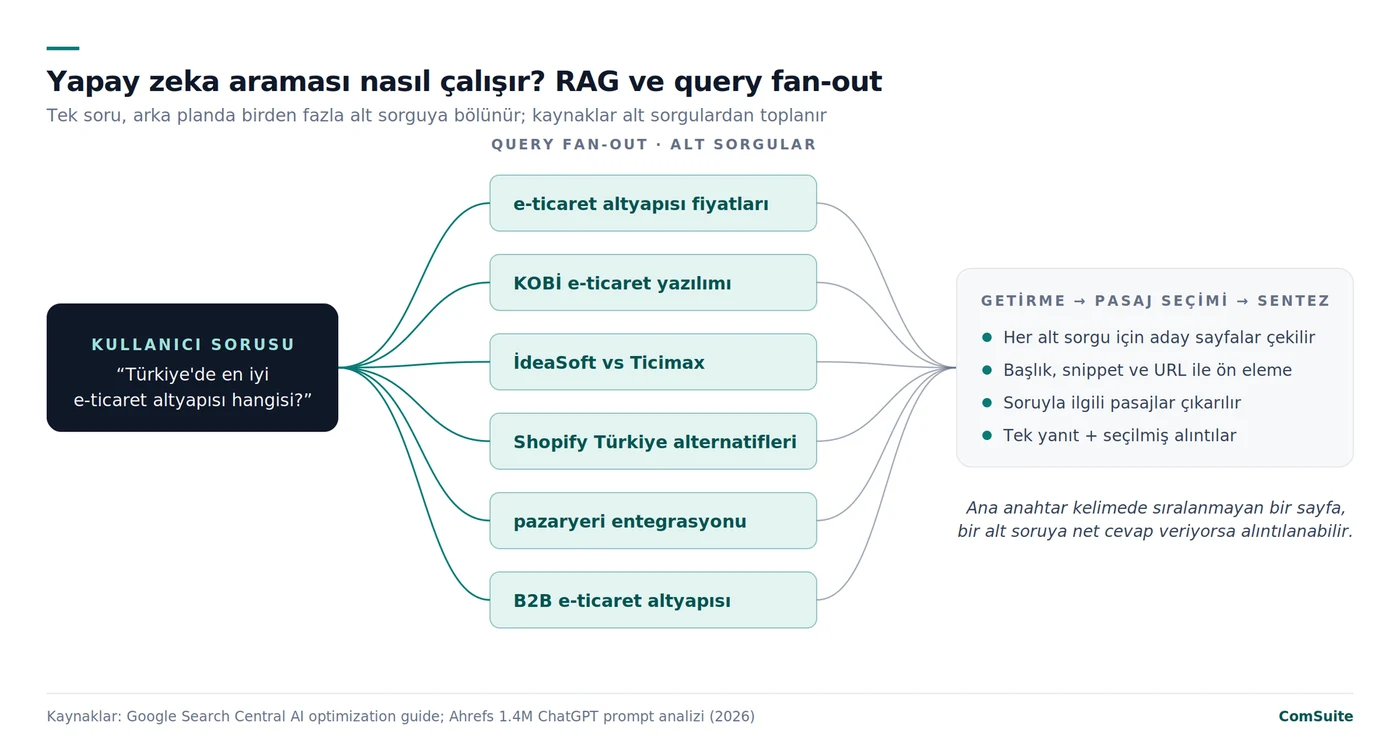
- Query expansion (query fan-out): A user's single question is split into multiple sub-queries behind the scenes. Google has officially stated that AI Mode uses this technique.[8]
- Retrieval: For each sub-query, candidate pages are pulled from the search index or the live web. Ahrefs' analysis of 1.4 million ChatGPT prompts suggests that at this stage, before reading the full page, the engine decides "can this page answer the question?" based on the title, snippet, and URL.[13]
- Passage selection: The sections most relevant to the question are extracted from the candidate pages. It's not the whole page that competes, but specific passages.
- Synthesis and citation: The language model turns the selected passages into a single answer and displays some of the sources as citations.
Google Search Central · Official documentation
AI Mode and AI Overviews break a query down into subtopics, run many searches, and combine the results. Google warns that trying to produce separate content for each sub-query may violate its "scaled content abuse" spam policy.
The practical consequence of query fan-out is this: for a user asking "What is the best e-commerce platform in Turkey?", the engine may generate sub-queries behind the scenes such as "e-commerce platform prices", "SMB e-commerce software", "İdeaSoft vs Ticimax", and "Shopify Turkey alternatives". Ranking first for the main keyword alone isn't enough; you need trustworthy content across the entire topic cluster. This finding forms the backbone of the strategy recommendations below.
Every engine picks different sources
A study by Kai-Cheng Yang of Northeastern University, which examined 366,087 citations across OpenAI, Perplexity, and Google systems, found that citations are concentrated in a small cluster of publishers and that citation overlap between engines is low.[3] Profound's observational data on roughly 12 billion citations likewise shows source overlap between ChatGPT and Google at only around 39%.[24] A 2025 study from the Max Planck Institute reports that the degree to which engines rely on external sources varies widely, with some systems producing 82% of their answers without citing any external source at all (using parametric knowledge).[4]
The lesson that emerges from reading these three findings together: "visibility in AI" isn't one thing; it's a goal that must be measured separately for each engine.
3. Academic evidence: those who tested what works in the lab
The GEO field is full of marketing claims. That's why we first look at findings tested through controlled experiments.
3.1 The Princeton GEO paper (KDD 2024): The cornerstone of the field
Pranjal Aggarwal, Vishvak Murahari, Karthik Narasimhan, Ameet Deshpande, and colleagues built the GEO-bench dataset, containing 10,000 queries from 8 different domains, and tested 9 different content strategies on generative engines.[1] The results are misreported in most GEO discussions, so let's give the correct figures:
Aggarwal et al. · Princeton, IIT Delhi, Georgia Tech, Allen AI · ACM KDD 2024
Adding source citations (Cite Sources), quotations (Quotation Addition), and statistics (Statistics Addition) to content increased source visibility in generative engine responses by up to 40% across various queries. Keyword stuffing, on the other hand, did not improve visibility and in some cases reduced it. (Sample: 10,000 queries, 8 domains · Controlled experiment · Peer-reviewed: Yes)
The paper has two more findings that are often overlooked. First, the effect varies by domain: for example, an authoritative tone works better for debate and history topics, while citations and statistics stand out for scientific topics. Second, generative engines can give more visibility to lower-ranked sources than classic search does, which opens a door for niche sites against big brands.
3.2 University of Toronto (2025): Earned media bias
Controlled multi-vertical, multilingual experiments by Mahe Chen, Xiaoxuan Wang, Kaiwen Chen, and Nick Koudas showed that ChatGPT, Perplexity, and Gemini display a systematic and strong bias toward authoritative third-party sources (earned media) over brand-owned content, while Google uses a more balanced mix.[2] The authors' recommendations: engineer content to be machine-scannable, establish dominance in earned media, develop engine- and language-specific strategies, and, for niche players, look for ways to overcome "big brand bias."
Accuracy note: The statistic "earned media is cited 325% more" that circulates online and is attributed to this paper does not come from the Toronto study; it comes from a vendor's research. In this guide, we use only figures whose primary source can be verified.
3.3 SIGIR 2026: "What Gets Cited" and C-SEO Bench as counter-evidence
"What Gets Cited: Competitive GEO in AI Answer Engines," presented at SIGIR 2026, is one of the most methodologically rigorous citation experiments: in a controlled two-document RAG test environment, 252,000 trials were run across 6 different language models; 1,440 paired scenarios differing in only one of 18 content factors were tested, position bias was balanced, and brands were anonymized.[5] Studies like this seek to answer the question "which content feature actually increases citation?" at the level of causation, not correlation.
On the other hand, the C-SEO Bench study by Parameter Lab and TU Darmstadt found that most of the GEO tactics marketed in the industry are largely ineffective in a competitive environment, and some even cause harm.[6] Together, these two studies remind us of an important reality: content-level micro-tactics aren't decisive on their own; the real difference comes from the source's authority and its presence across the web.
4. Big Data Studies: What Do Millions of Citations Tell Us?
Academic experiments explain the mechanism; big data studies show who actually gets cited in the real world. Most of the studies below were conducted by SEO tool companies, so they are correlational and carry vendor interest. Even so, their sample sizes and mutually reinforcing results make them worth taking seriously.
4.1 Brand Mentions Outperform Backlinks
Ahrefs · 75,000 brands · ChatGPT, AI Mode, AI Overviews
The strongest correlations with AI visibility: YouTube mentions (0.74), followed by brand mentions on the web (0.66), branded anchor text (0.53), and branded search volume (0.39). Backlinks and referring domains came in at only 0.22. The top quartile of brands by mentions is mentioned 10 times more often in AI Overviews than the second quartile.
This finding overturns fifteen years of backlink-focused SEO thinking. AI models learn about a brand from "who is talking about it on the web"; whether a link exists is secondary. Instead of a thousand mediocre blog posts, a hundred strong sources plus YouTube and third-party mentions are worth more.
4.2 Earned Media Makes Up the Bulk of Citations
Muck Rack · "What Is AI Reading?" · More than 25 million links, 17 industries (May 2026)
Roughly 84% of AI citations come from earned media (in the range of 82–89% across three editions); journalistic content accounts for 25–27%; freely accessible sources make up 94–99%. The overlap between the journalists PR teams pitch and the journalists AI cites is only around 2%.
A study presented by Fullintel and the University of Connecticut at IPRRC 2026 points in the same direction: in the health queries examined, 47% of citations came from third-party news and trusted sources, 48% from non-brand corporate, university, and health sites, and only 5% from the brand's own website.[20] The takeaway: the strategy of "I'll write great content on my own site and AI will cite me" is not enough on its own. Others need to be talking about you.
4.3 The Overlap Between AI Citations and Organic Rankings Is Shrinking
Sources report different figures on this because measurement timing and methodology vary. In chronological order:
| Study | Date | Sample | Share of citations from the top 10 |
|---|---|---|---|
| BrightEdge[18] | 2024 → 2025 (16 months) | Continuous monitoring | 32.3% → 54.5% |
| Ahrefs (first study)[11] | 2025 | 1.9 million citations | 76% (median position 2) |
| Ahrefs (update)[11] | March 2026 | 4 million URLs, 863K queries | 38% |
The main reason for the sharp drop in Ahrefs' 2026 update is query fan-out: the engine now gathers sources not from the results of the main query, but from those of sub-queries. In other words, even if a page doesn't rank for the main keyword today, it can still be cited if it answers a sub-question clearly. This is the data-backed proof of why a topic cluster strategy has become essential.
4.4 Which Domains Are Cited the Most?
In Semrush's study analyzing more than 150,000 citations across 5,000 keywords, the most-cited domains were Reddit (40.1%), Wikipedia (26.3%), YouTube (23.5%), Yelp (21%), Facebook (20%), and Amazon (18.7%).[14] However, these shares are highly volatile: in Semrush's 13-week tracking, ChatGPT's rate of citing Reddit was close to 60% in early August but dropped to around 10% by mid-September.[15] The same study found that in ChatGPT's "Thinking" (reasoning) mode, the share of user-generated content declined while official and academic sources rose, and that only 25% of cited sources overlapped across different reasoning modes.
Semrush's separate study of 89,000 LinkedIn URLs revealed that LinkedIn is the second most-cited domain across ChatGPT, AI Mode, and Perplexity, appearing in roughly 11% of responses.[16] For B2B brands, this means LinkedIn should be managed not as a social network, but as a citation source.
4.5 What Do Cited Pages Do Differently?
Surfer's analysis of more than 57,000 URLs showed that pages cited in AI Overviews contain a median of 62% more verifiable "facts."[21] Ahrefs' freshness study of 17 million citations found that AI assistants favor more recent content than classic search results do, a trend that is especially pronounced in ChatGPT.[17] Princeton's lab-based principle of "add statistics and sources" is confirmed in the real world as well.
4.6 Being Cited Is Not the Same as Being Mentioned
Semrush · "Ghost Citations" study · 2026
Roughly 62% of AI citations are "ghost citations": the engine uses the page as a source but doesn't mention the brand's name in the response. Comparison content ("X vs Y," "best X") generates 2.4 times more brand mentions than informational content.
Kevin Indig's study, which examined more than 400 AI Overview interactions with 70 users and a click stream of 846,000 sessions, shows why this distinction is critical: 74% of users choose the most-mentioned brand, not the most-cited one.[23] Meanwhile, Semrush's July 2026 study with Kevin Indig, covering 50,000 brands and 1,094 topic categories, found that only 15.2% of the topics examined had a clear leading brand, meaning roughly 85% of topics are still up for grabs.[25]
AI visibility isn't a keyword game; it's a game of topical authority. And in most of the market, no one has built that authority yet.
5. Traffic impact: Is "Google Zero" real?
Before investing in GEO, you need to gauge the size of the threat accurately. The most reliable independent data on this comes from Pew Research Center.
Pew Research Center · 900 U.S. adults · 68,879 Google queries · July 2025
Users who encountered an AI summary clicked on traditional results in 8% of visits; those who didn't see an AI summary clicked in 15%. The click rate on source links inside the summary was only 1%. Users who saw an AI summary ended their session 26% of the time (16% for those who didn't). 88% of summaries cite three or more sources.
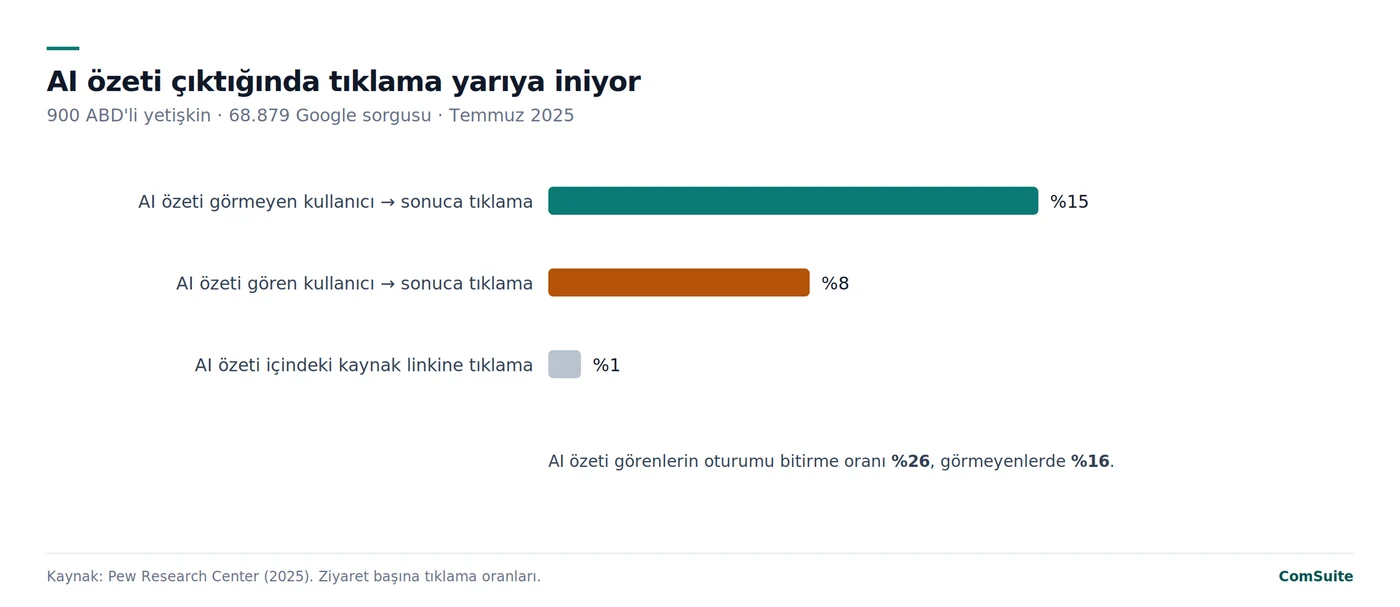
Ahrefs' study of 300,000 keywords found that the presence of an AI Overview reduced the click-through rate of the top-ranking result by 34.5%; in its 2026 update, that figure rose to 58%.[27] According to early-2026 data from SparkToro and Similarweb, 68% of Google searches end without a click (zero-click).[28] According to Nieman Lab's July 2026 report, some publishers saw search traffic drops of more than 40% in a single year.[29]
That said, it's important to keep a balanced view. Gartner's February 2024 forecast that "traditional search volume will drop 25% by 2026" did not materialize; Google adapted with AI Overviews and held on to its market share.[30] According to BrightEdge data, although referral traffic from AI searches is growing quickly, it still accounts for less than 1% of total referral traffic.[18] In short: search isn't going away, but the click is shifting to a later stage of the buying journey, and decisions are increasingly being made inside the AI answer. If you're not in that answer, you're excluded from the decision.
6. GEO Strategy: 10 Principles the Research Agrees On
When we put the academic and industry sources above side by side, a pattern emerges that independent studies all agree on. AI visibility rests on three pillars: Retrieval, Trust, and Entity.
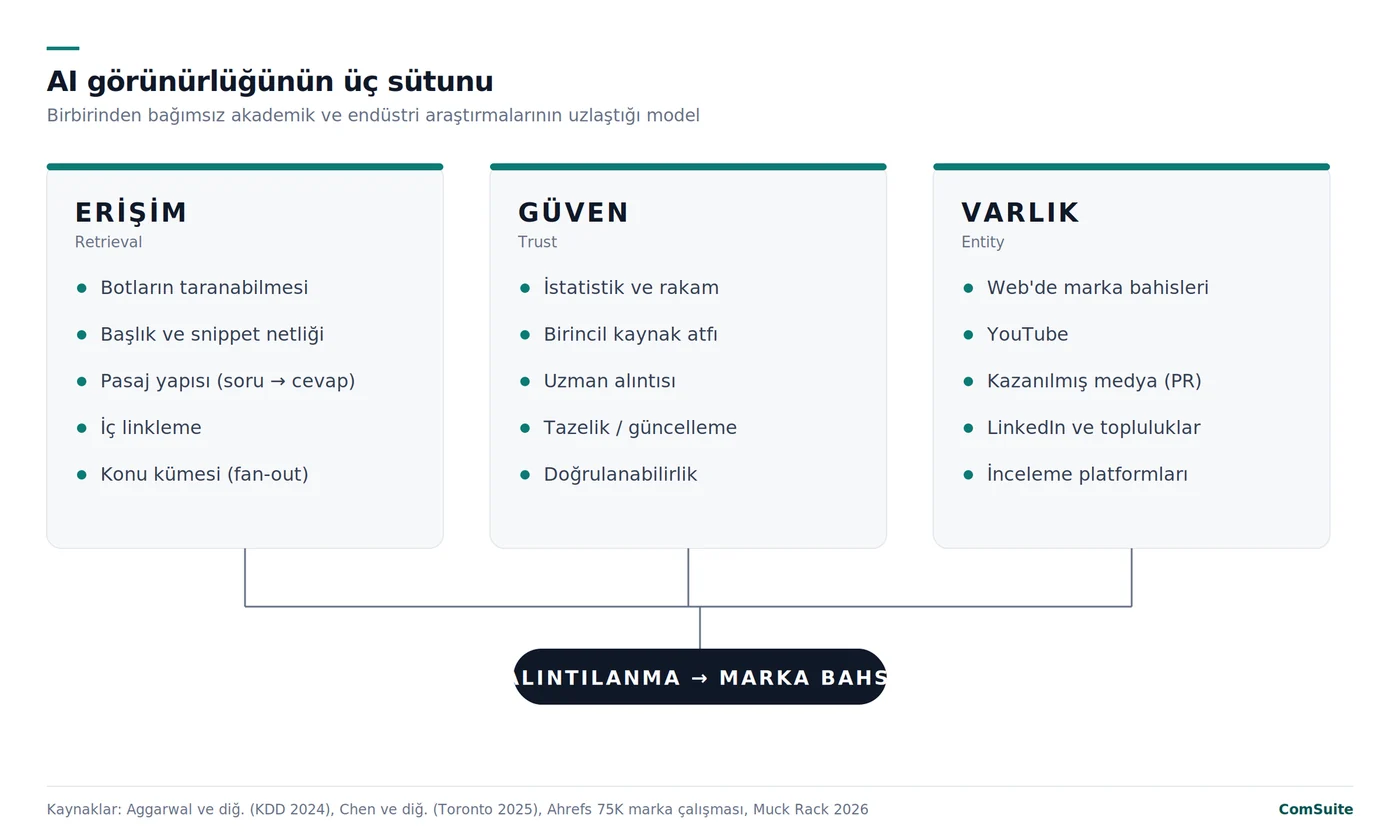
Principle 1 — Make sure bots can reach your content
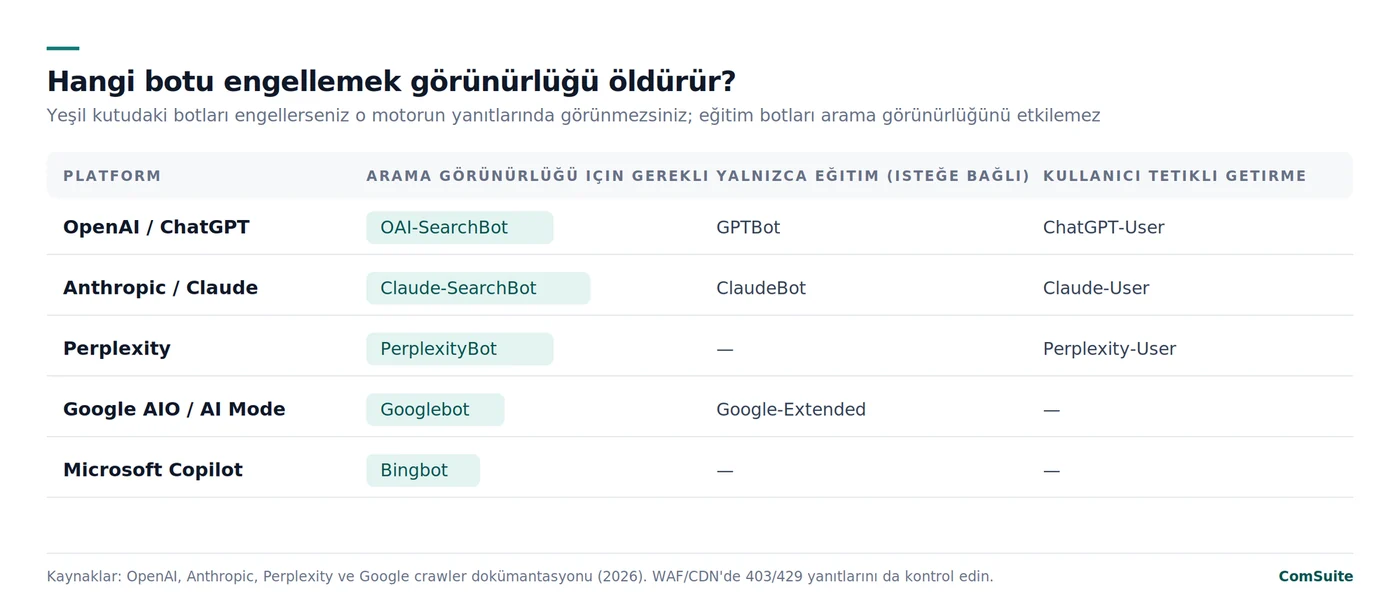
The most common and easiest mistake to fix: unknowingly blocking AI search bots. According to OpenAI's official documentation, you need to allow OAI-SearchBot to appear in ChatGPT search results; blocking GPTBot only affects model training, not search visibility.[9] The same logic applies to Anthropic: the bot that matters for the search index is Claude-SearchBot, while ClaudeBot is used for training.[10]
| Platform | Bot required for search visibility | Training only | User-triggered fetch |
|---|---|---|---|
| OpenAI / ChatGPT | OAI-SearchBot | GPTBot | ChatGPT-User |
| Anthropic / Claude | Claude-SearchBot | ClaudeBot | Claude-User |
| Perplexity | PerplexityBot | — | Perplexity-User |
| Google AIO / AI Mode | Googlebot | Google-Extended | — |
| Microsoft Copilot | Bingbot | — | — |
A sample robots.txt block:
User-agent: OAI-SearchBot
Allow: /

User-agent: Claude-SearchBot
Allow: /

User-agent: PerplexityBot
Allow: /

User-agent: Googlebot
Allow: /
robots.txt isn't enough: if your CDN, WAF, or Cloudflare rules return 429 or 403 to these bots, you'll still be invisible. Check your server logs to confirm these user agents are receiving successful (200) responses. The "AI Performance" report Microsoft added to Bing Webmaster Tools in February 2026 is the first official dashboard showing your Copilot and Bing AI citations; it also recommends using IndexNow as a freshness signal.[31]
Principle 2 — Aim for topic ownership, not keywords
Query fan-out and Semrush's topic authority study point to the same conclusion: targeting a single query with a single page isn't enough. Build a "pillar page" and surround it with "cluster pages" that answer each sub-question one by one. For a brand that wants to own the topic of "e-commerce infrastructure," that cluster should cover subtopics like "what is it," "how to choose," "pricing," "comparison," "for SMBs," "for B2B," and "integrations." Keep Google's warning in mind: this doesn't mean duplicating the same content for every variation, but writing an original, useful answer for each sub-question.
Principle 3 — Give the answer in the first sentence of every section
Engines select passages, not pages, and they make their first decision by looking at the heading and snippet. That's why you should:
- Write H2 and H3 headings like the user's real question ("What is GEO?", "Do backlinks affect AI visibility?").
- Give a clear, self-contained answer in the 1–2 sentences right below each heading, then go into detail.
- Make your page title specific enough that the engine can say "this page answers the question." "E-Commerce Solutions | Brand" is a much weaker signal than "Guide to Choosing an E-Commerce Platform in 2026: Comparing 7 Platforms."
- Use short paragraphs, definition sentences, tables, and lists; they make passage extraction easier.
Principle 4 — Add statistics, quotes, and sources
This is the most robust content tactic: Princeton found up to a 40% effect in the lab, and Surfer confirmed it in the real world. Back every important claim with a number, and every number with a primary source: official statistics, academic papers, industry reports, your own anonymized data. Quote expert opinions with the person's name and title. This guide itself was written following this principle. Setting up structured data (schema) correctly supports entity clarity; for details, see our Schema Markup guide.
Principle 5 — Create comparison and "best X" content
Semrush's ghost citations data shows that comparison content generates 2.4x more brand mentions. Users ask AI "which one should I choose?", and the engine crawls comparison pages to answer that question. Prepare criteria-based, up-to-date comparison pages that honestly include your competitors too. Name your own brand clearly on the page and describe what it does in a single sentence; a brand that isn't mentioned can't be recommended.
Principle 6 — Invest in earned media and brand mentions
Ahrefs, Muck Rack, the University of Toronto, and Fullintel-UConn independently reached the same conclusion: AI engines trust what others say about you. This puts digital PR at the center of GEO:
- Publish original data and research that will be featured in industry publications and news sites; journalists and AI engines love original data.
- Position your experts as guest authors and podcast guests.
- Build an accurate, well-sourced presence on Wikipedia (especially important for ChatGPT) and in industry directories.
- Keep your profiles on review platforms like G2, Capterra, and Trustpilot up to date and complete.
Principle 7 — Make YouTube part of your content strategy
In Ahrefs' study of 75,000 brands, the strongest single signal was YouTube mentions (0.74), and YouTube is the third most-cited domain in Semrush's data. Product demos, comparisons, and "how-to" videos, along with their titles, descriptions, and transcripts, are sources that AI engines can read.
Principle 8 — Be authentic on Reddit, LinkedIn, and communities
Reddit and LinkedIn are among the most-cited domains, but Reddit's share can drop from 60% to 10% within weeks. So approach these platforms not as a "manipulation arena" but as a "place to demonstrate expertise": real answers to real questions, expert content shared under employees' real names, and no fake accounts or bulk comments. Short-term manipulation is the first thing to disappear in platform clean-ups.
Principle 9 — Keep your content fresh
According to Ahrefs' study of 17 million citations, AI assistants weigh freshness more heavily than traditional search does. A "write it once and leave it for three years" approach is risky for GEO. Review your pillar content at least every three months: update the year, add new statistics and sources, refresh outdated comparisons, use a visible "last updated" date and the dateModified field, and notify search engines of changes via IndexNow.
Principle 10 — Measure by engine, and track mentions instead of clicks
Source overlap between engines is only 11–39%, so "Are we visible in AI?" has no single answer. We detail the measurement framework, along with our recommended KPIs, in Section 8. You can quickly measure your current site's AI visibility with the free visibility test.
7. Where the evidence is weak: overhyped GEO tactics
This is one of the most important sections of the guide. Some of the tactics sold in the GEO market have no evidence behind them, or the evidence says the opposite.
Schema markup alone doesn't earn citations
Ahrefs · 1,885 pages · Schema experiment
When 1,885 pages that had schema markup added were monitored, no meaningful increase in AI citations was observed afterward. Google also states clearly that no special "AI schema" is needed for AI Overviews.
This doesn't mean structured data is unnecessary: Fabrice Canel from Microsoft says schema helps Copilot understand content[31], and correctly implemented Article, FAQ, Product and Organization schemas provide entity clarity. But schema is a hygiene factor, not a growth engine. Schema that doesn't match the actual content on the page, meanwhile, violates Google's policies.
llms.txt is not yet used by the major engines
The llms.txt standard, proposed by Jeremy Howard (Answer.AI) in September 2024, aims to present a site's most important pages to language models in markdown format. The idea is reasonable and cheap to implement, but there is no evidence that Google or OpenAI use this file for ranking or answer generation.[33] Adding it won't hurt, but don't expect results. For more detail, see our llms.txt guide.
Keyword stuffing and content that "looks written for AI"
The Princeton study showed that keyword stuffing doesn't work, and C-SEO Bench showed that many micro-tactics are ineffective in a competitive environment. Rather than developing an artificial language that "appeals to AI," writing content that is useful to people and verifiable is the path recommended by both Google and the research.
Unverifiable statistics
No primary source can be found for claims that circulate widely in GEO content, such as "Stanford 2024: 45% of AI citations…" or "MIT 2025: trust increased by 25%." Don't use statistics like these in your own content; for both reputation and citability, the figure has to be there when someone clicks through to the source.
8. Measurement: New KPIs and a 90-day action plan
Metrics to track
| KPI | Definition | Why it matters |
|---|---|---|
| Citation share | The share of answers in your target query set that cite your brand (by engine) | The outcome of the access and trust pillar |
| Mention share | The share of answers in which your brand name appears in the answer text | 74% of users choose the most-mentioned brand |
| In-answer position | Whether your brand is mentioned first, second or later in the answer | The Princeton study uses position-weighted measurement |
| Sentiment / context | Whether the mention is positive, neutral or negative, and which attributes it is associated with | A wrong mention can be worse than no mention at all |
| AI referral traffic | Sessions and conversions from chatgpt.com, perplexity.ai and copilot.microsoft.com | Small but high-intent; conversion rates are typically higher than organic |
| Bot access health | The share of requests from search bots that receive a 200 in your logs | Without access, nothing else matters |
You can track these metrics with AI visibility tools like Profound, Peec AI, Otterly, Ziptie and Scrunch, with Bing Webmaster Tools' AI Performance report, and with your own regular prompt set. The GEO visibility tool ComSuite developed for the Turkish market is also built around this framework.
90-day action plan
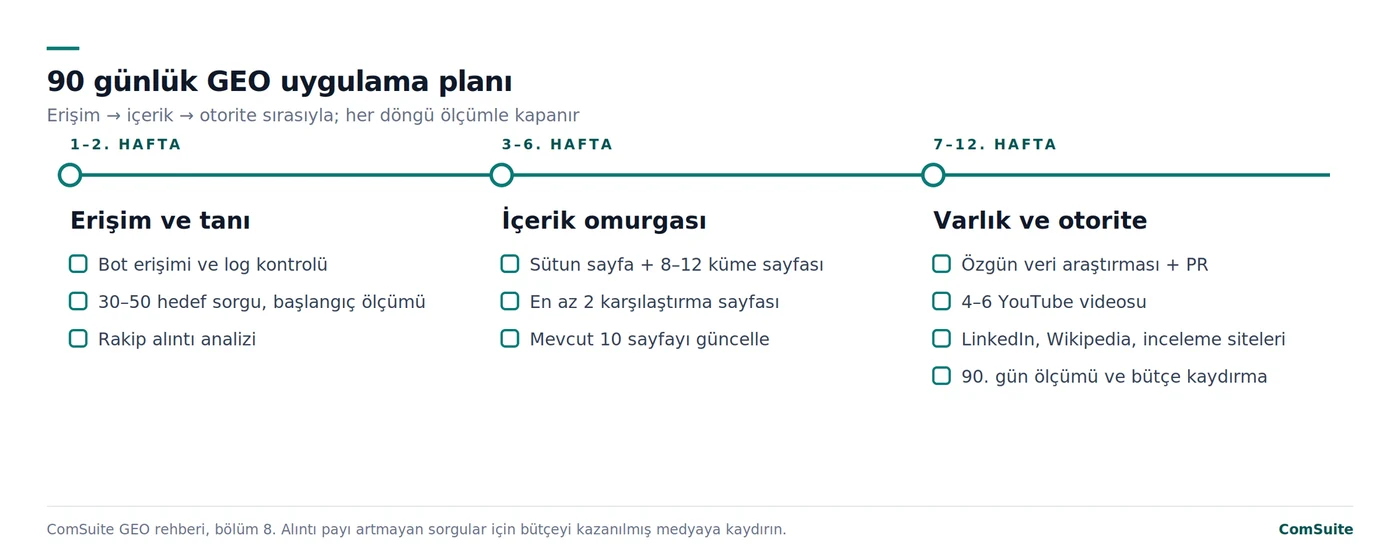
Weeks 1–2: Access and diagnosis
- Verify the five critical bots in your robots.txt, WAF and CDN rules; check for 200 responses in your logs.
- Define 30–50 target queries for your brand; take a baseline measurement in ChatGPT, Perplexity, AI Overviews and AI Mode.
- Identify which queries your competitors are cited for and which third-party sources feed them.
Weeks 3–6: Content backbone
- Write the pillar page for your main topic; structure headings as questions and give the answer in the first sentence of each section.
- Plan 8–12 cluster pages covering the fan-out sub-questions; add at least three sourced statistics to each.
- Publish at least two comparison pages that include competitors honestly.
- Update your 10 most valuable existing pages; add dateModified and a visible update date.
Weeks 7–12: Entity and authority
- Publish an original data study and pitch it to industry media.
- Publish 4–6 YouTube videos featuring product demos and comparisons; add transcripts.
- Get your company's experts to share expert content on LinkedIn every week.
- Fix and fill out your presence on Wikipedia, industry directories and review platforms.
- Repeat the measurement on day 90; for queries where citation share hasn't grown, shift budget to earned media.
9. What this means for Turkish e-commerce
Almost all the research in this guide examines the English-language web and the US market. Three differences stand out for the Turkish content ecosystem:
- The gap is bigger. Semrush's finding that "85% of topics have no clear leader" likely holds even more strongly for Turkish queries. Few brands produce sourced, up-to-date, comparative content in Turkish, so brands that move early can build topical authority at a relatively low cost.
- Earned media sources are different. Reddit carries less weight in Turkish; Ekşi Sözlük, industry news sites, tech media like Webrazzi, YouTube, and LinkedIn are more influential. This is exactly where the University of Toronto's recommendation for an "engine- and language-specific strategy" comes into play.
- Product data is critical. For e-commerce sites, Google's guidance emphasizes keeping Merchant Center and Business Profile data up to date; structured data, pricing, and stock information on product pages directly feed AI Mode's shopping answers.
For an SMB selling on platforms like İdeaSoft, Ticimax, İkas, or Shopify, the practical starting point is: one buying guide per product category ("How to choose X?"), one comparison page, and a regularly updated FAQ section; then increase the number of third-party content pieces that mention your brand.
10. Frequently asked questions
Will GEO replace SEO?
No. Google's official guidance says no special optimization is required for AI features, and a significant share of AI citations still comes from organic rankings. GEO is a layer added on top of SEO; it doesn't work without fundamentals like crawlability, internal linking, and content quality.
Do backlinks still matter?
For traditional search, yes. For AI visibility, Ahrefs' study of 75,000 brands found a backlink correlation of 0.22, versus 0.66 for brand mentions and 0.74 for YouTube mentions. The priority is to create content that talks about you, not just content that links to you.
How long does it take to build AI visibility?
Technical access fixes take effect within days (OpenAI states that robots.txt changes are reflected in roughly 24 hours). Building content and authority takes months; we recommend measuring in 90-day cycles.
If I add schema markup, will I get cited?
Not on its own. In Ahrefs' experiment with 1,885 pages, adding schema did not meaningfully change AI citations. Schema is a useful hygiene factor for entity clarity, but content quality and authority determine whether you get cited.
Should I add an llms.txt file?
You can; it does no harm. However, there is no evidence that Google or OpenAI use this file when generating answers. Spend your time first on bot access, content structure, and earned media.
Which AI engine should I prioritize?
The one your target audience uses. Perplexity currently drives the most referral traffic thanks to its visible source cards; ChatGPT has the largest user base and favors Wikipedia and freshness; Google AI Overviews/AI Mode is the channel that overlaps most with your existing organic strength. Because source overlap between them is low, measure each one separately.
How much do AI searches reduce clicks?
According to Pew Research, users who see an AI summary click on results 8% of the time, compared with 15% for those who don't. Ahrefs measured that the presence of an AI Overview reduces clicks on the top-ranked result by between 34.5% and 58%. With fewer clicks, and decisions made inside the AI answer, being "mentioned" becomes the key KPI.
Measure your brand's place in AI search. ComSuite's GEO visibility tool tracks your brand's share of citations and mentions in ChatGPT, Perplexity, and Google AI answers using Turkish query sets, and produces an action list prioritized according to the 10 principles in this guide. → Free AI visibility analysis or explore the GEO Plans.
Methodology note
This guide was prepared in August 2026. In selecting sources, we prioritized peer-reviewed academic publications and official platform documentation; industry research was included based on sample size, methodological transparency, and consistency with independent studies. Wherever industry studies are correlational or may reflect vendor interests, we have noted it. Statistics whose primary source could not be verified were deliberately left out. Because the AI search ecosystem changes quickly, the figures will be reviewed every three months.
Sources
- Aggarwal, P. et al. (2024). GEO: Generative Engine Optimization. ACM SIGKDD 2024. arxiv.org/abs/2311.09735
- Chen, M., Wang, X., Chen, K., Koudas, N. (2025). Generative Engine Optimization: How to Dominate AI Search. University of Toronto. arxiv.org/abs/2509.08919
- Yang, K.-C. (2025). News Source Citing Patterns in AI Search Systems. Northeastern University. arxiv.org/abs/2507.05301
- Kirsten, E. et al. (2025). Characterizing Web Search in the Age of Generative AI. Max Planck Institute. arxiv.org/abs/2510.11560
- What Gets Cited: Competitive GEO in AI Answer Engines (2026). SIGIR 2026.
- Puerto, H. et al. (2025). C-SEO Bench: Does Conversational SEO Work? Parameter Lab / TU Darmstadt.
- Google Search Central. AI Features and Your Website. developers.google.com
- Google Search Central. Optimizing for Generative AI Features on Google Search. developers.google.com
- OpenAI Help Center. Publishers and Developers — FAQ / Searching the web with ChatGPT. help.openai.com
- Anthropic. Anthropic crawler documentation (2026).
- Ahrefs. How to Rank in AI Overviews / 38% of AI Overview Citations Pull From The Top 10 (March 2026). ahrefs.com
- Ahrefs. Top Brand Visibility Factors in ChatGPT, AI Mode, and AI Overviews (75k Brands). ahrefs.com
- Ahrefs. Why ChatGPT Cites One Page Over Another (1.4M Prompts) (2026). ahrefs.com
- Semrush. Most-Cited Domains in AI (2025). semrush.com
- Semrush. ChatGPT reasoning modes & AI visibility. semrush.com
- Semrush. 89K LinkedIn URLs Cited in AI Search. semrush.com
- Ahrefs. AI Assistants Prefer to Cite "Fresher" Content (17M Citations). ahrefs.com
- BrightEdge. AI Overview Citations & AI Search Visits (2025–2026). brightedge.com
- Muck Rack. What Is AI Reading? (May 2026). muckrack.com
- Fullintel & University of Connecticut. AI Search Citations: Why News Websites Dominate. IPRRC 2026. fullintel.com
- Surfer. How AI Overviews Choose Sources (57,000+ URLs). surferseo.com
- Semrush. The Ghost Citations Study (2026). semrush.com
- Indig, K. State of AI Search Optimization 2026. growth-memo.com
- Profound. AI Search Optimization Research. tryprofound.com
- Semrush & Indig, K. AI visibility is a topic-level game (50,000 brands) (2026). semrush.com
- Pew Research Center (2025). Google users less likely to click when an AI summary appears. pewresearch.org
- Ahrefs. AI Overviews Reduce Clicks by 34.5% (2025–2026). ahrefs.com
- Search Engine Land. Google zero-click searches 2026 study (SparkToro / Similarweb). searchengineland.com
- Nieman Lab (July 2026). Search traffic declines push publishers to consider opting out of Google. niemanlab.org
- Gartner (2024). Search Engine Volume Will Drop 25% by 2026. gartner.com
- Microsoft Bing (February 2026). Introducing AI Performance in Bing Webmaster Tools. blogs.bing.com
- Ahrefs. We Tracked 1,885 Pages Adding Schema. AI Citations Barely Moved. ahrefs.com
- Similarweb. What Is llms.txt? Reality vs. Hype. similarweb.com
- Solis, A. Learning AI Search — GEO/AEO curriculum. learningaisearch.com