
What Is GEO?
GEO (Generative Engine Optimization) is the set of optimization practices that help content rank high in the answers of generative AI engines such as ChatGPT, Gemini, Claude, and Perplexity. Whereas traditional SEO focuses on search engine results pages (SERPs), GEO aims to get your content cited as a source, or quoted directly, in the text answers generated by AI.
In traditional SEO, the goal was to appear in Google's list of blue links; in GEO, the goal is to get AI to reference your content when it answers a question. This difference fundamentally changes your content strategy.
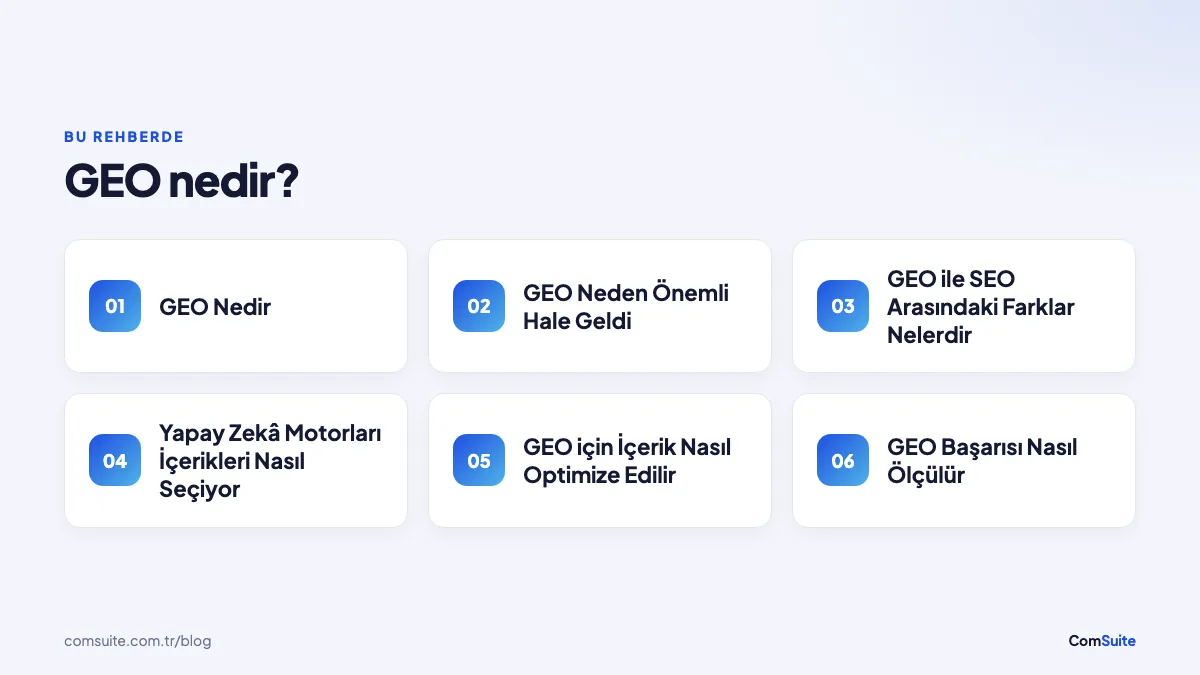
Why Has GEO Become Important?
Between 2023 and 2024, the use of AI-based search grew rapidly. Google's AI Overviews feature (formerly known as SGE) began returning direct AI answers to billions of search queries. Similarly, the web search integrations in Perplexity and ChatGPT have changed the way users find information.
The concrete result of this shift is that users ask AI questions instead of going to a search engine, and they click the sources AI recommends. As a result, content that doesn't appear in AI answers is getting a smaller and smaller share of organic traffic.
What Are the Differences Between GEO and SEO?
| Feature | SEO | GEO |
|---|---|---|
| Target platform | Google, Bing SERP | ChatGPT, Gemini, Perplexity, AI Overviews |
| Success metric | Ranking position, click-through rate | Citation frequency, source attribution |
| Core signal | Backlinks, keyword density | Authority, trustworthiness, structural clarity |
| Content format | Long-form, keyword-focused | Q&A, definition-focused, scannable |
| Update speed | Tied to algorithm updates | Tied to model training cycles and web crawls |
How Do AI Engines Choose Content?
When answering a question, generative AI models evaluate content from their training data and, if they have real-time web access, from current web pages. The key criteria in this evaluation are:
- Authority and trustworthiness: The author's expertise, institutional identity, and the sources cited.
- Direct, clear answers: Structures that answer the question in the first sentence and include a definition.
- Structural scannability: Heading hierarchy, bullet lists, and tables.
- Freshness: Publication and update dates, and references to current data.
- Originality: Content that isn't copied from other sources and offers original analysis and perspective.
A 2023 study titled "GEO: Generative Engine Optimization," published by researchers from Princeton, Georgia Tech, and IIT Delhi, showed that adding statistics and quotations can increase visibility in AI answers by up to 40 percent on average.
How Do You Optimize Content for GEO?
1. Use an Answer-First Structure
AI engines prefer content that puts the answer to a question at the very beginning. Every article or page should answer the target question in the first one or two sentences, followed by a definition sentence. This approach aligns with the "inverted pyramid" structure used in journalism.
2. Strengthen Your E-E-A-T Signals
The E-E-A-T criteria (Experience, Expertise, Authoritativeness, Trustworthiness) defined in Google's Search Quality Rater Guidelines also play a decisive role in how AI engines evaluate sources. Author bios, organizational identity details, and citations to reliable sources all strengthen these signals.
3. Add Structured Markup (Schema Markup)
FAQ, HowTo, and Article schema types make it easier for AI to parse your content. Markup that complies with Schema.org standards increases the likelihood of being cited as a source, especially in Google AI Overviews.
4. Use Concrete Data and Sources
AI places more trust in content that contains verifiable data. Paragraphs that include percentages, years, organization names, and standard references are cited more often than those with generic statements. However, making up statistics you aren't sure about permanently damages credibility; in uncertain cases, it's better to use generalizations such as "according to experts" or "in most cases."
5. Use Question-Style Subheadings
The questions users ask AI most often begin with "how," "what is," or "why." Structuring your subheadings around these question patterns increases the chances that your content matches the relevant query.
6. Update Your Content Regularly
AI engines with real-time web access (such as Perplexity and ChatGPT's web search) prefer fresh content. Clearly stating the publication date and "last updated" information helps your content be treated as a current source.
How Do You Measure GEO Success?
Unlike traditional SEO, GEO does not yet have a fully mature standard measurement framework. That said, the following methods are widely used:
- Manual query testing: Ask ChatGPT, Gemini, and Perplexity your target questions and check whether your content is cited.
- Referral traffic analysis: Monitor referral traffic from Perplexity and other AI platforms in Google Analytics or similar tools.
- Brand mention tracking: Test at regular intervals how often AI mentions your brand or content name.
Practical Steps to Get Started with a GEO Strategy
- Review your existing content and make sure the first paragraph of every page contains a clear answer and definition.
- Update your author pages and About sections with expertise information.
- Add citations to reliable institutional sources (such as TÜİK, WHO, and academic publications) in your content.
- Apply Schema.org FAQ markup to pages that contain frequently asked questions.
- Plan your content calendar not only around keyword volume, but also around the question patterns people ask AI.
GEO doesn't replace SEO; it complements it. When a strong technical SEO foundation, high-quality content, and GEO principles are applied together, your visibility is maximized in both traditional search engines and AI answers.
Frequently Asked Questions
What is GEO?
GEO is a term that refers to geographic location data, and it helps digital content become more visible in local search results.
Why does GEO matter in AI search?
GEO enables better targeting of local results in AI search, delivering content that matches users' needs.
What is the difference between GEO and SEO?
SEO refers to general search engine optimization, while GEO focuses on optimizing local search results.
How is GEO used in AI search?
In AI search, GEO provides more personalized experiences by offering content recommendations based on users' location.
How do you optimize content with GEO?
Content can be optimized for GEO by adding local keywords, location information, and local links.
How do you gain more visibility using GEO?
When using GEO, make sure your local business information is up to date and accurate, and increase your visibility by creating local content and links.