1. Why now: how has search behavior changed?
For fifteen years, the only address for digital visibility was "page one on Google." A user types a query, sees ten blue links, and clicks one. This model rested on two pillars: clicks and rankings. AI assistants have weakened both pillars at the same time.
Today, when a user asks "What is the best reservation software for a boutique hotel in Istanbul?", they often don't see a list at all; they see a single answer with three or four product names, their pros and cons, and a recommendation. If you're not in that answer, the user never hears about you. If there is a small list of sources beneath the answer and you're in it, your brand gets imprinted in their mind even if no click comes.
This shift has three practical consequences for professionals:
- Zero-click is growing. Google AI Overviews and AI Mode resolve a significant share of informational queries right on the results page. Even if traffic drops, the decision process takes shape not on your page but in the AI's answer.
- Decision-stage queries are moving to assistants. Especially for B2B and high-ticket products, research questions like "X or Y," "best …," and "which company for …" are increasingly being asked to ChatGPT, Perplexity, and Gemini.
- Visibility is no longer binary, it's probabilistic. In classic SEO, you're either ranked 3rd or you're not. In AI answers, the same question can produce three different answers on the same day; the goal is not "to be first every time" but "to be mentioned often enough and accurately."
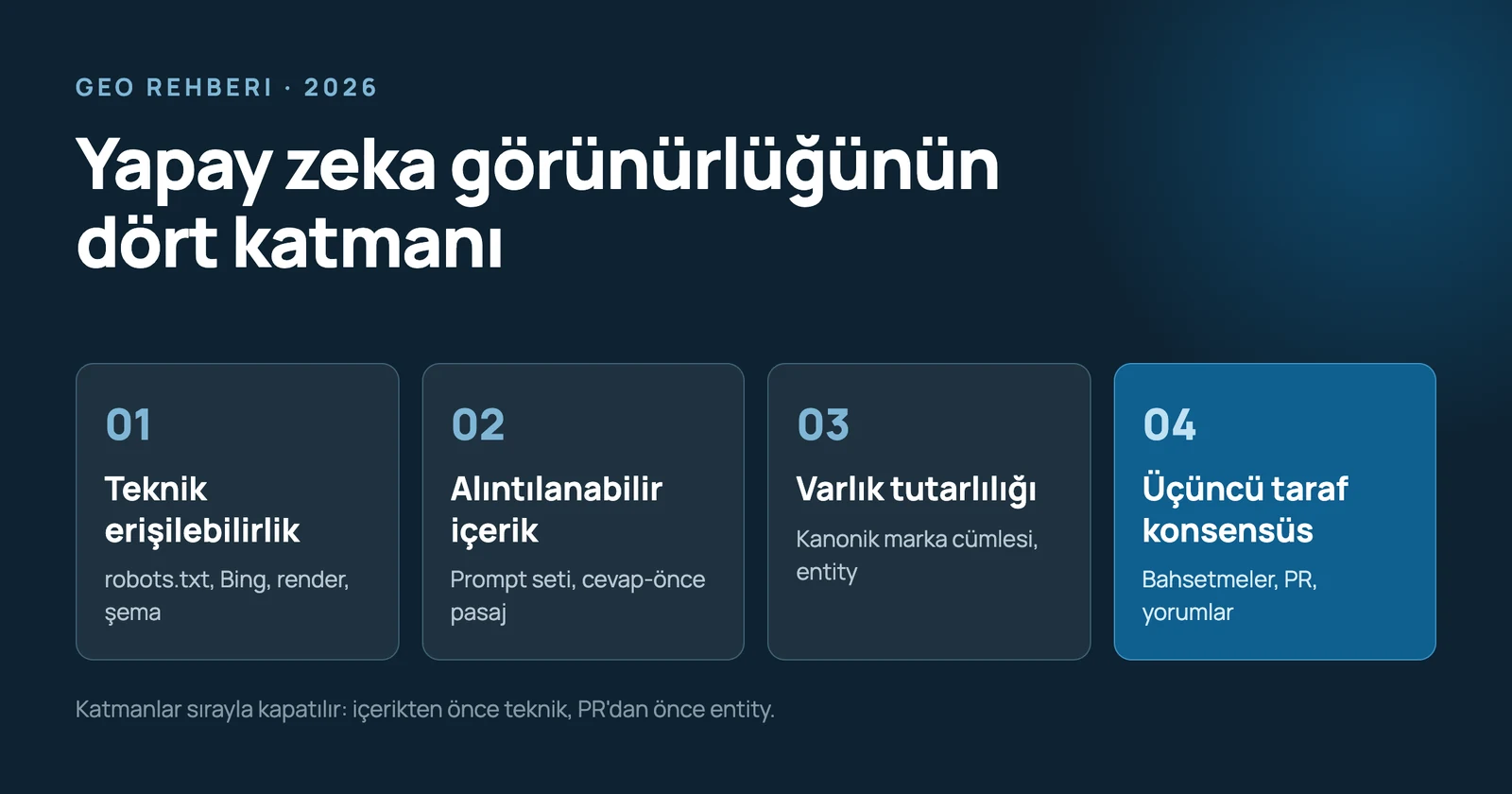
We break visibility down into four layers: (1) Technical accessibility, (2) Citable content, (3) Entity consistency, (4) Third-party mentions. The layers build on one another; you need to close the technical layer before investing in content, and the entity layer before starting third-party work.
2. Terminology: GEO, AEO, AIO, LLMO
Several acronyms describing the same work are circulating in the industry. Here is a short glossary to avoid confusion when talking to clients:
| Term | Stands for | Focus | What it means in practice |
|---|---|---|---|
| GEO | Generative Engine Optimization | Earning citations/mentions in generative AI answers | The umbrella term. The subject of this guide. |
| AEO | Answer Engine Optimization | Systems that produce direct answers (featured snippets, voice assistants, AI Overviews) | A content-structure-focused subset of GEO; the discipline of "answer the question in the first sentence." |
| AIO | AI Optimization | General usage; sometimes also used for Google AI Overviews | Ambiguous; avoid it in quotes and contracts. |
| LLMO | Large Language Model Optimization | How the brand is represented in a model's training data and knowledge base | Long-term brand presence; entity and PR work. |
| AI Visibility | — | The measurement side | "In how many prompts, on which platform, and in which position are we mentioned?" |
In this guide, we use GEO as the umbrella term, and our definition is as follows: the sum of efforts that systematically increase the likelihood of a brand, product, or piece of content being cited as a source, mentioned by name, or included as a recommendation in answers generated by AI assistants.
3. How do AI assistants choose their sources?
Applying GEO tactics without understanding why they work is like prescribing medicine without knowing the cause. Modern assistants draw on two sources of information, and each requires a different strategy.
3.1 Parametric knowledge (training data)
This is what the model "learned" during training. If a user asks ChatGPT, with internet access turned off, "Which companies provide e-commerce infrastructure in Turkey?", the model lists the names it has encountered over the years on the web, in forums, on news sites, and on Wikipedia. What matters here is:
- How often and how consistently your brand is mentioned across the web,
- In which contexts it is mentioned (which category, with which descriptors, alongside which competitors),
- The brand's digital age and its footprint in independent sources.
You can't change this layer in the short term, but over a 6–18 month horizon you can influence it significantly through PR, directory listings, industry lists, and consistent brand messaging.
3.2 Retrieved knowledge (RAG / real-time search)
Perplexity, ChatGPT's search mode, Gemini, Copilot, and Google AI Overviews pull pages from a search engine index (Bing, Google, or their own indexes) before generating an answer. They split those pages into chunks, select the chunks that best fit the question, and synthesize the answer from them. This process has three stages, and the tactical backbone of GEO maps to these three stages:
| Stage | What happens? | What you control |
|---|---|---|
| 1. Retrieval | Candidate pages are pulled based on the query. Usually the top 10–30 results of classic search rankings. | Crawlability, indexability, classic SEO strength, freshness signals. |
| 2. Chunking & Ranking | Pages are split into meaning blocks of 200–500 words; the blocks closest to the question are scored. | Heading hierarchy, making each block meaningful on its own, Q&A structure, tables. |
| 3. Synthesis & Citation | The model writes an answer from the selected blocks and assigns source numbers to some of them. | Clear, measurable, quotable sentences; statistics, definitions, expert statements; consistency without contradictions. |
Models select passages, not pages. Even if a page ranks #1 on Google, it is less likely to be cited if the passage that answers the question is buried inside a 1,200-word introductory paragraph. Conversely, a page ranking #8 on Google can become the main source of an answer if it responds to the question clearly in its first sentence. This is the most concrete point where GEO diverges from SEO.
3.3 Signals that influence source selection
Combining public research, platform documentation, and field observations, the signals that increase the likelihood of being cited fall into the following categories:
- Directness: The answer to the question appears clearly in the first 1–2 sentences of the relevant block.
- Specificity: It includes numbers, dates, units, comparisons, and named entities. Not "it's fast," but "loads in 1.8 seconds on average."
- Sourced claims: Claims are backed by a study, an official document, or a named expert.
- Structural clarity: The H2/H3 hierarchy mirrors the language of the questions; tables, definition boxes, and lists are easily parsed by machines.
- Freshness: A visible "last updated" date and references to the current year/data in the content.
- Authority and consistency: The same claim is verified across multiple independent sources; brand information is identical on every platform.
- Accessibility: Content is served without JavaScript dependency, without a login wall, and open to bots.
4. 7 key differences between SEO and GEO
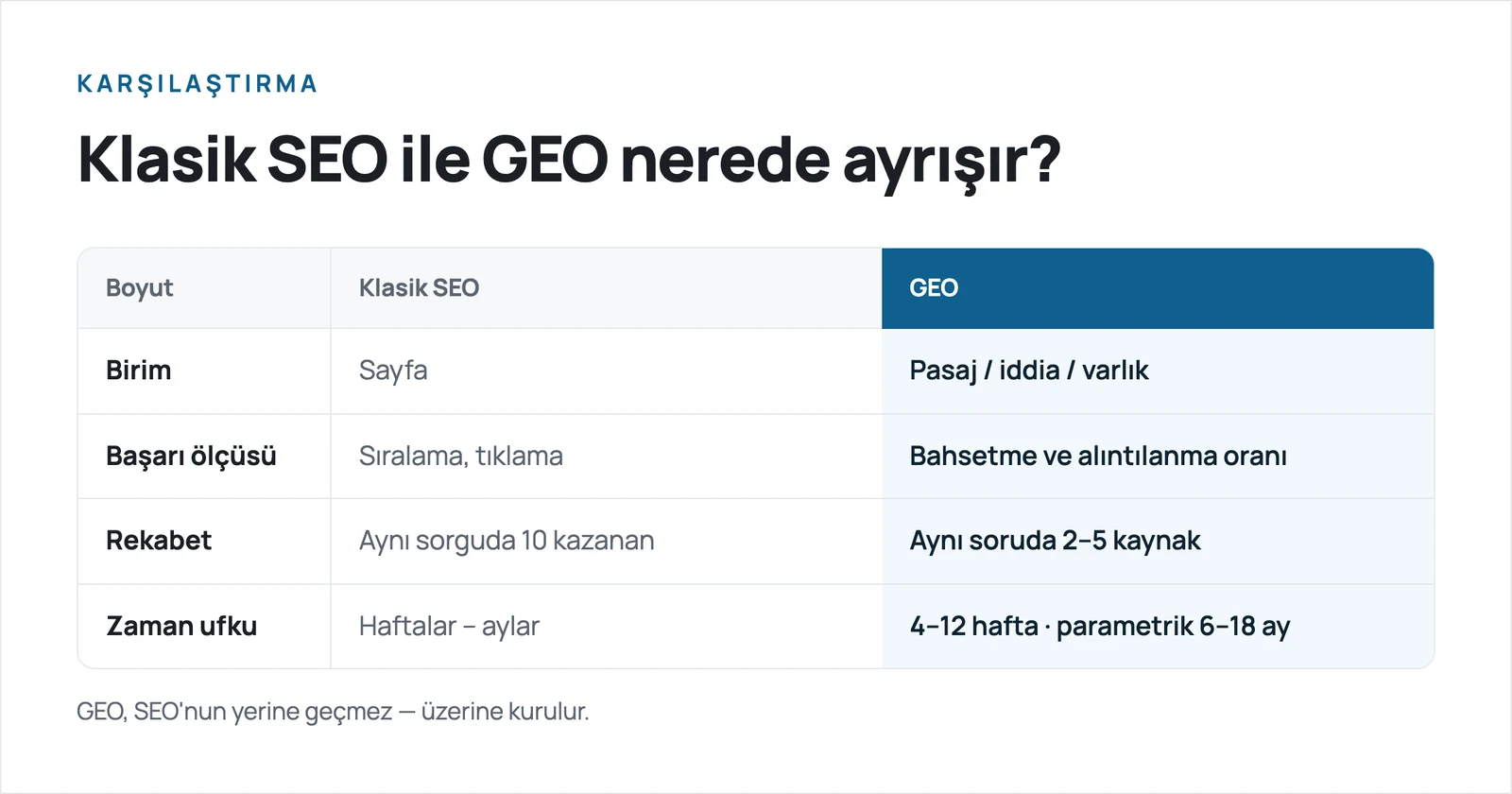
| Dimension | Classic SEO | GEO |
|---|---|---|
| Unit | Page | Passage / claim / entity |
| Success metric | Rankings, clicks, organic traffic | Citation rate, share of voice, position and tone within the answer |
| Competitive logic | 10 winners for the same query | 2–5 sources for the same question; fewer winners, and losers are even less visible |
| Keywords | Query matching | Natural-language questions and intent clusters; "prompt set" management |
| Backlinks | Ranking signal | Still important, but unlinked mentions and consensus are at least as valuable |
| Determinism | High; same query, same result | Low; the same question yields different answers. Measurement requires sampling and repetition |
| Time horizon | Weeks to months | 4–12 weeks on retrieval-based platforms; 6–18 months for parametric knowledge |
This table also carries a warning: GEO doesn't replace SEO. Because the retrieval stage relies largely on the classic search index, a site that can't be crawled or ranked won't show up in AI answers either. GEO is a layer built on top of SEO.
5. Visibility Logic by Platform
Each assistant draws on different data sources and behaves differently. Instead of optimizing for a single "AI," prioritize based on the platforms your target audience actually uses.
5.1 Google AI Overviews and AI Mode
- Draws directly from the Google index. If you're not on the first page of classic search results, you're usually not in Overviews either; exceptions are rare.
- Think of it as an expanded version of featured snippet logic: question-style headings, clear 40–60 word answer paragraphs, and tables are the most frequently pulled formats.
- E-E-A-T signals (author bios, organizational identity, citations) carry more weight here than on other platforms.
- Overviews coverage for Turkish queries is still narrower than for English, but it is expanding quickly; the growth in commercial queries matters especially for e-commerce.
5.2 ChatGPT (OpenAI)
- With search enabled, it uses the Bing index and its own crawler. Being indexed in Bing and registered with Bing Webmaster Tools is the cheapest win, and one that many Turkish sites overlook.
- For product and service recommendations, brand mention frequency, user reviews, and trust signals are decisive; forums, comparison sites, and news content carry the most weight.
- In shopping answers, structured product data (price, stock, features) and merchant feeds are used more and more.
5.3 Perplexity
- Cites its sources in every answer, making it the platform where citations can be measured most transparently.
- Highly sensitive to freshness and clarity: dated, data-rich content in the "what is X / how to / how much" format is pulled often.
- If its crawler (
PerplexityBot) is blocked, you won't appear; checking your robots.txt is a must.
5.4 Gemini (Google)
- Google index + Google's Knowledge Graph + YouTube. Your Google Business Profile, Wikipedia/Wikidata, and YouTube presence have a direct impact on this platform.
- Brand consistency (name, address, category, description) must match exactly across all Google surfaces.
5.5 Claude (Anthropic) and Copilot (Microsoft)
- Claude pulls from the web when search is on and relies on parametric knowledge when it's off. It's growing quickly in enterprise use, so B2B brands should monitor it.
- Copilot runs on Bing, so the Bing work you do for ChatGPT carries over to Copilot as well.
For B2C and local businesses: Google AI Overviews → Gemini → ChatGPT. For B2B and SaaS: ChatGPT → Perplexity → Google AI Mode → Claude. If resources are limited, start by focusing on the two platforms your target audience actually uses, then expand based on your measurement results.
6. Layer 1 — Technical Accessibility
This is the most commonly skipped layer, and the cheapest one to fix. Everything below should be taken care of before you start investing in content.
6.1 Access policy for AI crawlers
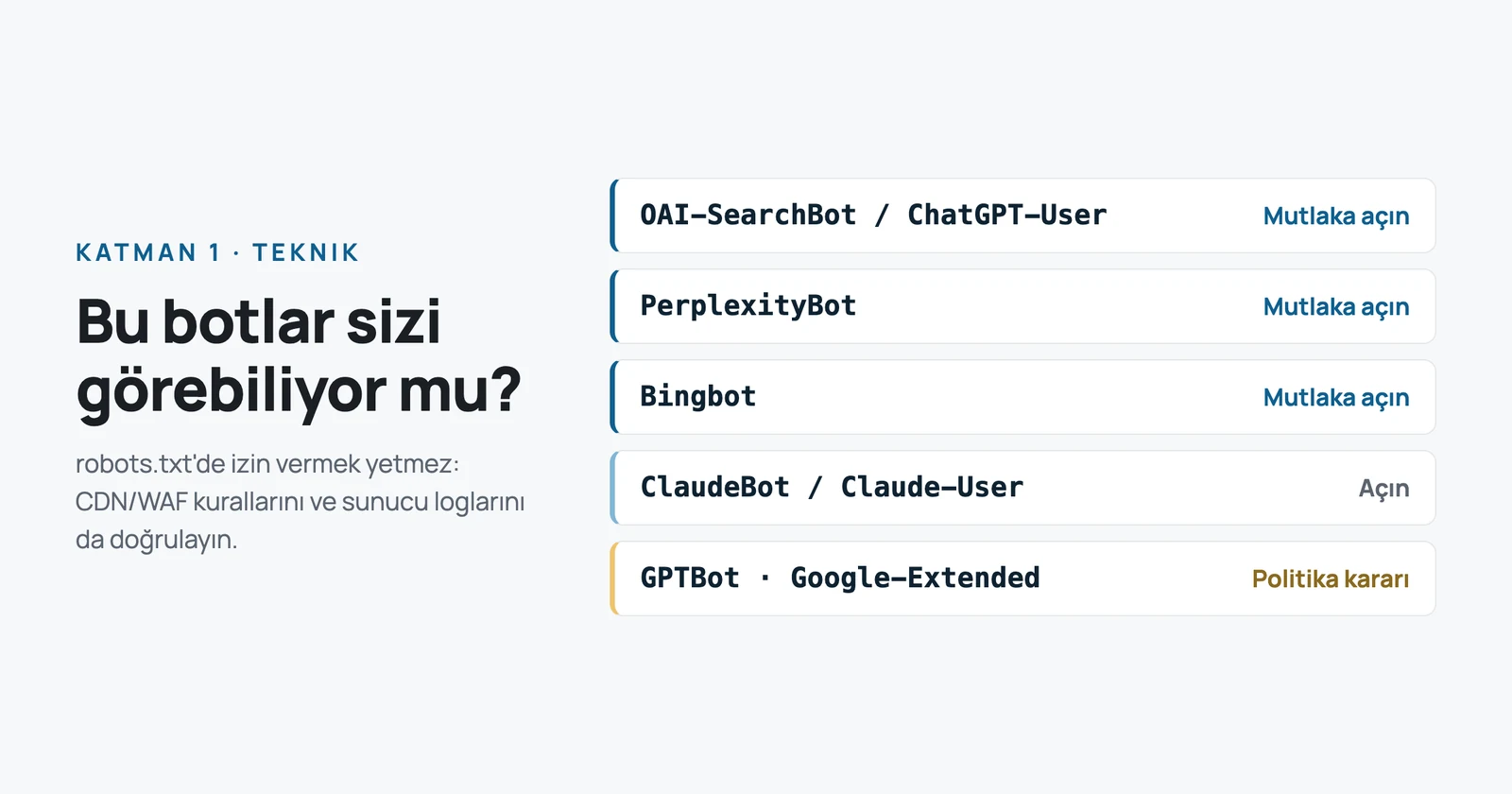
Every platform has its own crawler, and some are used for training while others fetch content in real time. Make a deliberate decision; most sites don't even realize they've inherited "block" as the default.
| Crawler | Owner | Purpose | Recommendation |
|---|---|---|---|
GPTBot | OpenAI | Model training | Allow it if you want visibility |
OAI-SearchBot / ChatGPT-User | OpenAI | Search and fetching on behalf of users | Must allow |
ClaudeBot / Claude-User | Anthropic | Training / fetching on behalf of users | Allow |
PerplexityBot | Perplexity | Indexing | Must allow |
Google-Extended | Gemini training (does not affect AI Overviews) | Your choice | |
Bingbot | Microsoft | Bing index (critical for ChatGPT and Copilot) | Must allow |
A sample robots.txt block:
User-agent: GPTBot
Allow: /
User-agent: OAI-SearchBot
Allow: /
User-agent: ClaudeBot
Allow: /
User-agent: PerplexityBot
Allow: /
User-agent: *
Disallow: /admin/
Disallow: /sepet/
Sitemap: https://www.ornek.com/sitemap.xml
Note: If bot blocking is enabled at the CDN/WAF layer (such as Cloudflare's "Bot Fight Mode"), allowing these bots in robots.txt isn't enough. Check your server logs to confirm these user agents are receiving a 200 response.
6.2 Bing Webmaster Tools and IndexNow
The ChatGPT and Copilot ecosystem relies on Bing. Add your site to Bing Webmaster Tools, submit your sitemap, and implement the IndexNow protocol so new or updated pages are reported to Bing within minutes. Many Turkish e-commerce sites are strong on Google but only partially indexed on Bing, which translates directly into lost visibility in ChatGPT.
6.3 Server-side rendering and content accessibility
- Critical content must be in the HTML; text loaded only through client-side JavaScript is not seen by many AI crawlers.
- Content behind a login wall, hidden behind a cookie consent banner, or loaded via infinite scroll is considered inaccessible.
- Page load time and crawl budget still matter; on large catalogs, keep low-value pages (filter combinations, empty categories) out of the crawl.
6.4 Structured data (schema.org)
Schema lets a model read what's on a page instead of guessing. Priority order:
- Organization — name, logo, founding year, address, and social and directory profiles via
sameAs. The technical backbone of entity consistency. - Article / BlogPosting — author, publish and update dates,
aboutandmentions. - FAQPage and HowTo — for Q&A and step-by-step content.
- Product / Offer / AggregateRating — essential for e-commerce; price, stock, currency, review count.
- LocalBusiness — for local businesses: opening hours, service area, phone number.
- Person — for expert authors: title, organization,
knowsAbout.
6.5 llms.txt: worth implementing, but don't overhype it
/llms.txt is a voluntary standard that presents your site's most important pages and short descriptions as plain text/Markdown. It's unclear how much the major platforms actually use it, but it's cheap, harmless, and read by some tools. Implement it, but don't market it as a "magic key."
6.6 Technical checklist
- ✓ A deliberate access policy for AI crawlers is defined in robots.txt
- ✓ CDN/WAF bot rules don't block these crawlers (verified through logs)
- ✓ Bing Webmaster Tools registration and sitemap submission are complete
- ✓ IndexNow is active
- ✓ Critical content is rendered server-side
- ✓ Organization + sameAs schema on every page
- ✓ Article/Product/FAQ schemas are validated (bad schema is worse than no schema)
- ✓ Visible author and date information on every piece of content
- ✓ llms.txt is live and up to date
- ✓ Canonical tags, hreflang, and redirect chains are clean
7. Layer 2 — Citable Content Architecture
This is the layer where GEO delivers the biggest impact the fastest. The goal is not to "produce" new content, but to make both your existing and new content citable at the passage level.
7.1 The Prompt Set: What Replaces the Keyword List
In classic SEO, you start with a keyword list. In GEO, you start with a list of the questions your target audience actually asks assistants: a prompt set. A good prompt set:
- Contains 30–100 questions covering category, comparison, pricing, suitability, and problem-solving intents.
- Reflects the real language of users: "best", "which one", "how many TL", "is it suitable for …", "what can I use instead of …".
- Is compiled from your sales team, support tickets, live chat logs, and question-style queries in Search Console.
- Includes a note for each prompt: "How should our brand appear in the ideal answer?"
The prompt set is the foundation of both your content plan and your measurement dashboard; manage both from the same list.
7.2 The "Answer-First" Structure
Every important section should follow this pattern:
- Question-style heading (H2/H3): language close to the user's prompt.
- Direct answer: a 40–70 word paragraph that makes sense when read on its own. This paragraph is the "candidate passage" to be cited.
- Support: data, examples, comparisons, exceptions.
- Source or evidence: research, official documents, expert opinions, your own data.
Weak: "Today, digital transformation is gaining importance in every sector. In this context, choosing an e-commerce infrastructure has also become a strategic decision for companies. Many criteria must be taken into account when choosing the right infrastructure…"
Strong: "When choosing an e-commerce infrastructure at SME scale in Turkey, five criteria are decisive: number of marketplace integrations, coverage of shipping and payment providers, total monthly cost (license + commission), API access, and local support. As of 2026, entry-level plans on SaaS platforms range from X–Y TL per month; enterprise plans go up to Z TL depending on integration depth."
The strong passage is concrete, numerical, list-based, and meaningful on its own. An assistant can cite it as is.7.3 Content Elements That Increase Citations
- Definitions: Solid one-sentence definitions in the pattern "X is a method that means …". Models often pick a single source for a category definition; make it yours.
- Numerical data: Statistics you generate yourself (anonymized summaries from your customer data, surveys, benchmarks) are the strongest citation magnets, because they exist nowhere else.
- Comparison tables: For "X vs Y" questions, tables are pulled far more often than plain text.
- Step-by-step processes: Numbered steps that begin with a verb.
- Expert quotes: Short opinions from real people with a known name, title, and organization.
- FAQ blocks: 4–8 real questions at the end of every page, marked up with FAQPage schema.
- Update note: "This article was updated in September 2026; prices are based on data dated …."
7.4 Topical Depth and Content Clusters
Models find sites that offer a connected, consistent cluster on a topic more trustworthy than those with a single long article. A practical structure:
- Pillar page: A guide of 3,000+ words covering the entire topic (like this article).
- Cluster pages: Pages of 800–1,500 words for each sub-question, each targeting a single prompt.
- Comparison and alternatives pages: "X alternatives", "X vs Y", "X pricing".
- Glossary: One-sentence definitions of industry terms; an excellent source for definition citations.
7.5 Protocol for Transforming Existing Content
Instead of writing from scratch, restructure 20–30 existing pages with traffic or conversion potential using these steps:
- Identify the 3–5 prompts the page targets.
- For each prompt, add a question-style H2 and write a 40–70 word direct answer beneath it.
- Shorten the intro paragraph; delete empty openers like "today" and "in this context".
- Add at least one table and one piece of numerical data.
- Add an author box, an update date, and a bibliography.
- Update the schema and notify search engines via IndexNow.
7.6 Things to Watch For with Turkish Content
- Because Turkish query volume is lower than English, competition is lower; brands that move early can "own" category definitions.
- Models match more reliably when they see English terms alongside their Turkish equivalents in Turkish content: "Üretken Motor Optimizasyonu (Generative Engine Optimization, GEO)".
- Regional expressions (TL, KDV, shipping, marketplace names) bring local sources to the top for locally intended queries; use them deliberately.
- Generic, unsourced Turkish content mass-produced with AI is increasingly less preferred by both Google and assistants.
8. Layer 3 — Entity and brand consistency
Models understand the world not through keywords, but through entities (people, organizations, products, places, concepts) and the relationships between them. If your brand isn't a clear entity in the model's "mind," you won't make it into recommendation lists no matter how good your content is.
8.1 Define your brand entity
Write a single "canonical brand sentence" and use the exact same one everywhere:
"[Brand] is a [category] company based in [city/country] that has offered [core product/service] for [target audience] since [founding year]."
This sentence should be word for word identical on your website's About page, in your Organization schema, on your LinkedIn company page, in your Google Business Profile, in directory listings, and in press releases. Small inconsistencies (a different category name, a different founding year) lower the model's confidence.
8.2 Entity sources in order of priority
- Wikipedia / Wikidata: The strongest signal if you meet the criteria. If you don't, don't force it; creating an accurate, well-sourced item on Wikidata is a more achievable step.
- Google Business Profile and Bing Places: Essential for local and service businesses; the category, description, and service list should match the canonical sentence.
- LinkedIn company page: In B2B, one of the corporate identity sources models consult most often.
- Industry directories and review platforms: G2, Capterra (for SaaS), Trustpilot, Şikayetvar, and industry association membership lists.
- Crunchbase and similar databases: The source for structured data such as founding date, funding, and headcount.
- Social profiles: Even if they're not active, they should be filled in with the correct name, description, and links.
8.3 Person entities: your experts are entities too
Author pages, speaker bios, LinkedIn profiles, and bylines in industry publications combine to build authority at the individual level. Models draw on these traces when answering questions like "Who are the experts on X in Turkey?" For each expert: consistent name spelling, title, organization, areas of expertise, and Person schema.
9. Layer 4 — Third-party mentions and consensus
Models don't rely on a single source; they look for consensus. When answering "Which brands are in this category?", they surface the names that appear together across multiple independent sources. What you say on your own site matters less than what others say about you.
9.1 Effective mention sources
| Source type | Impact | How to earn it |
|---|---|---|
| Industry "best X" lists | Very high | Reach out to list authors, offer data or case studies, contribute to industry reports |
| News and business media | High | Data-driven press releases, expert commentary, industry insights |
| Review platforms | High (especially for ChatGPT) | A systematic review collection program; public replies to negative reviews |
| Forums and communities (Reddit, Ekşi Sözlük, industry groups) | Medium–high | Real user experience; genuine presence, not manipulation |
| YouTube and podcasts | Medium–high (high for Gemini) | Product demos, expert interviews; entity names in titles and descriptions |
| Guest posts and industry blogs | Medium | Content offering original data and perspective; not mass-produced content |
| Wikipedia citations | High | Only with neutrally sourced content that meets encyclopedic criteria |
9.2 A new definition of digital PR
Classic digital PR was all about "get backlinks." In the GEO era, the goal has changed: to be mentioned in the right context, under the right category name, in the same sentence as your competitors, even without a link. The most powerful tool for this is original data: figures drawn from your own customer base, transaction volume, and surveys that exist nowhere else. Journalists and list authors cite this data, and models in turn cite their citations.
9.3 Sentiment management
Being mentioned isn't enough; how you're mentioned also shapes the answer. If an assistant writes "X is known for slow customer support," the source is most often review sites and forums. Identify negative themes, make real improvements, and document those improvements publicly.
10. Special notes for e-commerce and local businesses
10.1 E-commerce
- Product data must be structured: Product, Offer, AggregateRating, and Brand schemas; GTIN/MPN whenever available.
- Merchant feeds: Google Merchant Center and Bing Merchant Center feeds are becoming the primary data source for shopping assistants.
- Category pages should become guides: A "What to look for when choosing X" section above or below the category page, plus buying guides and comparison tables.
- Product FAQs: Answer real questions about shipping times, return policies, compatibility, and warranty right on the product page.
- Review volume and freshness: Assistants factor in review count and recency when making recommendations; automate your review collection flow.
- Marketplace and own-site consistency: Listing the same product under different names across marketplaces creates entity confusion.
10.2 Local businesses and service providers
- Complete Google Business Profile and Bing Places listings; keep categories, service lists, photos, and business hours up to date.
- "Service + city" pages on your site; each should include real, local, concrete information (address, directions, price range, frequently asked questions).
- Reviews are the most decisive signal, especially detailed ones that mention the service name.
- Consistent listings in local media, industry association lists, and regional directories.
11. Measurement: what to track, how, and with which tools?
Measurement in GEO is harder than classic rank tracking because answers are probabilistic. Even so, building a reliable measurement system is both possible and essential: you can't manage what you don't measure, and you can't defend a budget without data.
11.1 Core metrics
| Metric | Definition | How it's calculated |
|---|---|---|
| Mention rate | The percentage of questions in your prompt set where your brand appears in the answer | Number of prompts with a mention / total prompts × number of repetitions |
| Citation rate | The percentage of answers where your site appears in the source list | Tracked separately for Perplexity, ChatGPT search, and AI Overviews |
| Share of voice | Your share of all brand mentions in the category | Tracked alongside a set of competitors |
| Position | Where you are named in the answer | Percentage of answers where you're named in the top three |
| Tone | Positive / neutral / negative context | Classification; list of negative themes |
| Referral traffic | Visits coming from AI assistants | Sources in GA4 such as chatgpt.com, perplexity.ai, gemini.google.com, copilot.microsoft.com, claude.ai |
| Conversion quality | The conversion rate of assistant traffic | Usually higher than the organic average; critical for justifying your budget |
11.2 Manual measurement protocol (no tools)
- Prepare a set of 30–50 prompts. Run each prompt on 3 platforms, 3 times each, while logged out or in incognito mode.
- For each answer, record in a spreadsheet: whether your brand appeared, in what position, which sources were shown, and what the tone was.
- Repeat monthly, on the same day, at the same time, and in the same format.
- It takes 4–8 hours a month, which is enough for small businesses.
11.3 Monitoring tools
Automated monitoring tools run your prompt set across multiple platforms every day and feed mention and citation data into a dashboard. As of 2026, tools in this category (Peec AI, Otterly, Profound, Scrunch, Rankscale, and local alternatives) generally cost 29–500 USD per month, with pricing driven less by features than by the number of tracked prompts and platforms. Two cautions:
- No monitoring tool changes your visibility; it only measures it. Teams that buy a tool and then wait for results end up disappointed.
- Turkish-language prompt support varies from tool to tool, so ask for a trial with your own Turkish prompt set before you buy.
11.4 Server logs: the most honest data source
Your server logs show which pages AI crawlers fetch and how often. Visits from "user-initiated fetch" agents such as ChatGPT-User or Claude-User are proof that a real user was asking an assistant about you at that moment. Add this data to your monthly reports.
12. The 90-day action plan
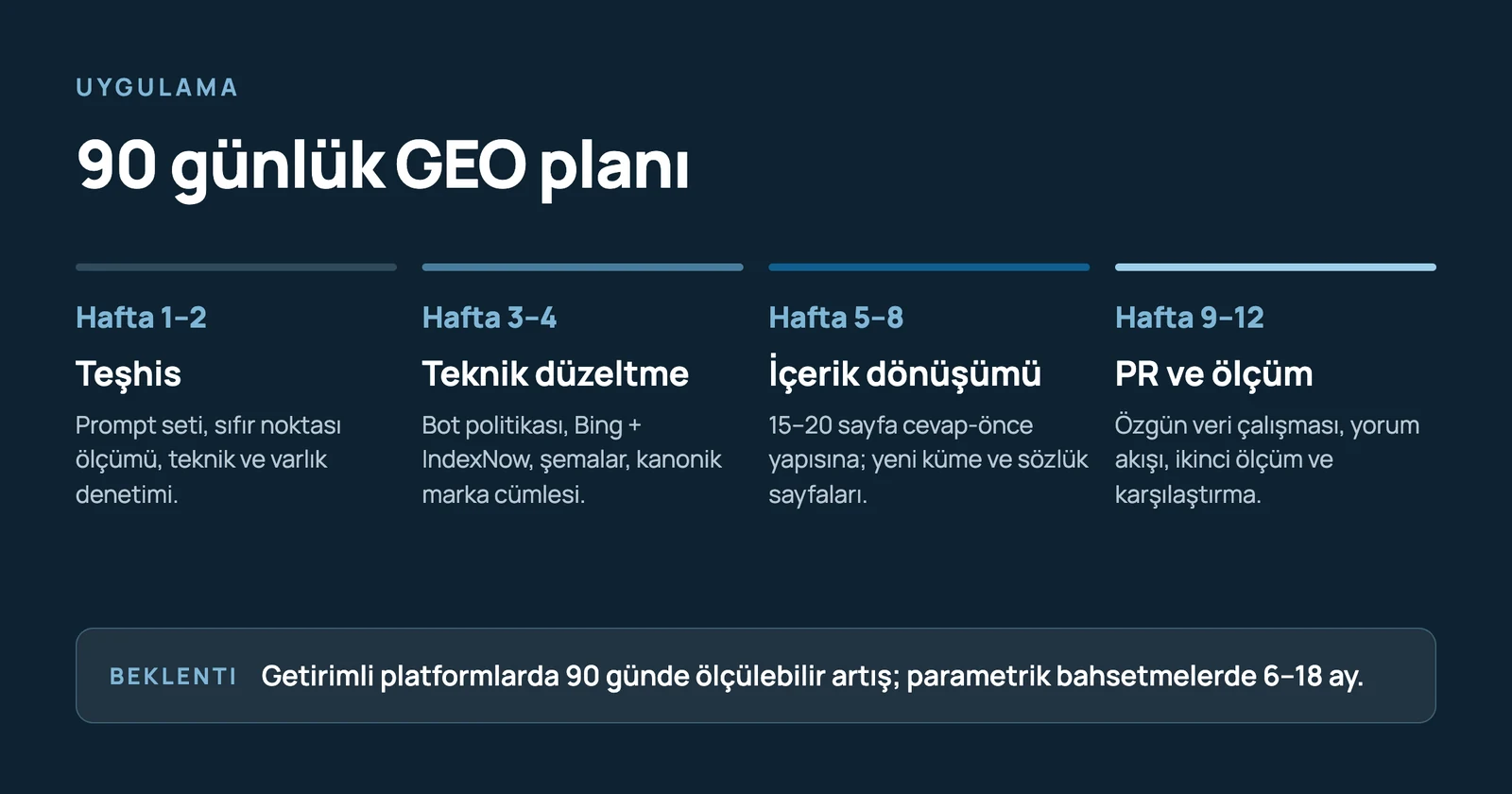
Weeks 1–2: Diagnosis
- Build your prompt set (30–50 questions) and take your first measurement. This is your baseline.
- Run a technical audit: robots.txt, WAF, Bing index, rendering, schema, speed.
- Run an entity audit: consistency of name, description, and category across all profiles, plus a list of missing profiles.
- Analyze your competitors: for which prompts, and from which sources, are they being mentioned?
Weeks 3–4: Technical fixes
- Crawler access policy, Bing Webmaster + IndexNow, Organization/Person schema, llms.txt.
- Write your canonical brand sentence and apply it across all profiles.
Weeks 5–8: Content transformation
- Convert 15–20 existing pages to an answer-first structure (see 7.5).
- Publish new cluster pages for the 5–8 questions your prompt set doesn't cover at all.
- Add a glossary page and at least one comparison page.
Weeks 9–12: Third-party presence and measurement
- Publish an original data study (a survey or benchmark) and pitch it to 10–15 media outlets and list authors.
- Launch your review collection flow and update your profiles on review platforms.
- Take your second measurement and compare it with your baseline. Build your Q2 plan based on the data.
On retrieval-based platforms (Perplexity, ChatGPT search, AI Overviews), a measurable increase in citation rate after 90 days is normal. For parametric mentions (ChatGPT "knowing you" with search turned off), you'll need 6–18 months of patience and ongoing third-party work.
13. Costs: DIY, Freelancer, Agency, In-House
This section is for decision-makers buying the service and professionals preparing quotes. It offers ranges based on 2026 market observations. Figures vary significantly depending on scope, industry competition, page count, and number of languages; before accepting a quote, always ask which of the four layers in this guide are included.
13.1 Turkey Market (TL)
| Service | Typical Range | Scope Note |
|---|---|---|
| One-time GEO audit | 8.000 – 15.000 TL | Technical + content + entity audit, prompt set, baseline measurement, prioritized action list |
| Monthly GEO consulting / retainer (SMB) | 18.000 – 30.000 TL | Monthly measurement, 4–8 pages of content conversion, technical monitoring, monthly report |
| Monthly GEO retainer (mid-size / competitive industry) | 30.000 – 55.000 TL | All of the above + new content production, digital PR, review management, multi-platform monitoring |
| Enterprise / multilingual programs | 55.000 TL and above | Multiple brands or languages, custom measurement infrastructure, team training |
| Freelance GEO specialist (hourly) | 1.500 – 4.000 TL/hour | Depends on experience and references; usually 10–20 hour monthly packages |
| Citable content (per page) | 4.000 – 15.000 TL | 1,200–2,500-word page with research, data, tables, schema, and expert input |
| Schema and technical implementation (project) | 10.000 – 40.000 TL | Depends on site scale and infrastructure flexibility |
| Monitoring tool subscription | 1.000 – 20.000 TL/month | Exchange-rate equivalent of USD-based tools; depends on number of prompts and platforms |
The ranges are based on publicly available price guides and market observations from agencies and consultants offering GEO services in Turkey in 2026; they exclude VAT and vary by quote.
13.2 Global Market (USD) — for Comparison
| Service | Typical Range |
|---|---|
| AI visibility monitoring tools (self-service) | 29 – 500 USD/month; enterprise plans 1.000 USD/month and above |
| One-time GEO audit | 2.000 – 15.000 USD |
| Freelance GEO consultant | 125 – 450 USD/hour; 1.500 – 6.000 USD per month |
| Agency retainer (starter) | 1.500 – 5.000 USD/month |
| Agency retainer (mid-size B2B) | 5.000 – 12.000 USD/month |
| Agency retainer (enterprise) | 12.000 – 50.000+ USD/month |
| Citation-focused content (per piece) | 800 – 3.000 USD |
| In-house specialist (US salary) | 70.000 – 110.000 USD/year + 6.000 – 10.000 USD tool budget |
13.3 Which Model Fits Whom?
| Model | Best When | Advantage | Risk |
|---|---|---|---|
| DIY (your own team) | Small business, single language, fewer than 50 critical pages, a marketer who can dedicate 5–10 hours a month | Nearly zero cost; the technical layer and content conversion can be fully handled in-house | Third-party mentions and PR require relationships; measurement discipline easily slips |
| Freelancer | Expert support on a specific layer (technical, content); limited budget | Flexible, fast, hourly | One person can't carry all four layers; capacity limits |
| Agency | Competitive industry, multiple platforms, PR needs, mandatory regular reporting | End-to-end execution, tooling infrastructure, media relationships | Unclear scope; risk of classic SEO being sold under the "GEO" label |
| In-house | 200+ pages, high content velocity, multiple brands/languages | Institutional knowledge, continuous improvement | Difficulty finding talent; tool and training costs |
| Hybrid (tool + freelancer/agency) | Most SMBs and growth-stage companies | Measurement in-house, execution outsourced; balanced cost | Coordination overhead |
13.4 10 Questions to Ask When Evaluating a Quote
- Who will build the prompt set, from which sources, and how many prompts will be tracked?
- Which platforms are in scope? (Saying only "ChatGPT" isn't enough; is there a distinction between search on and off?)
- Will the baseline measurement be shared before the contract is signed?
- How many pages will be converted or newly written each month; who will write them; where will expert input and data come from?
- Who will handle the technical implementation (schema, robots, rendering); what is expected from our developer team?
- Is third-party mention work in scope; how many placements are targeted; on which channels?
- Which monitoring tool will be used, and will we have access to the tool's raw data?
- How is success defined: "clicks" or "mention rate"?
- What are the contract term and exit conditions? (3 months is reasonable for platforms that deliver returns, 6+ months for parametric ones.)
- Can they show changes in mention rate for reference clients?
A "guaranteed #1 ranking" promise (there is no ranking in GEO); selling only a monitoring dashboard without doing implementation; offers to produce "hundreds of pages" with bulk AI content; pricing llms.txt alone as a service; not sharing the competitor set and prompt set with the client.
14. The 12 Most Common Mistakes
- Blocking bots without realizing it. Discovering months later that no assistant can see you because of WAF defaults or outdated robots.txt rules.
- Neglecting Bing. For ChatGPT and Copilot, the Bing index matters as much as Google's.
- Thinking at the page level. Long, well-ranked pages that contain no quotable passages.
- Empty openings. Paragraphs that begin with "In today's digitalizing world…" are noise to a model.
- Unsourced claims. Content without figures or references earns no trust score.
- Entity inconsistency. Five different company descriptions on five different platforms.
- Investing only in your own site. Without third-party mentions, you won't make it into recommendation lists.
- One-off measurement. Judging probabilistic answers from a single sample is misleading; repetition and regularity are essential.
- Mistaking a tool for a strategy. Dashboards measure; they don't change anything.
- Mass-produced AI content. Hundreds of near-identical pages with no original data reduce visibility in both Google and AI assistants.
- Abandoning SEO. The retrieval stage relies on the classic index; without an SEO foundation, GEO doesn't work.
- Impatience. Parametric knowledge changes over months; declaring "it didn't work" after 6 weeks is a premature verdict.
15. Frequently Asked Questions
Do I need a separate site or separate pages for GEO?
No. In most cases, improving the structure of your existing pages and the consistency of your entity is enough. A "separate page for AI" approach is both unnecessary and risks duplicate content.
Does allowing AI crawlers lead to my content being copied?
Whether to allow training crawlers (GPTBot, Google-Extended) is a policy decision, and some publishers rightfully block them. However, blocking search/retrieval crawlers (OAI-SearchBot, PerplexityBot, ChatGPT-User) removes you directly from today's answers. Think about the two separately.
I'm a small brand; can I be mentioned alongside big competitors?
Yes, especially for niche and local queries. Models don't pick the "biggest" source; they pick the one that gives the clearest answer to the question and is mentioned consistently. In a narrow category, content whose definitions and data come from you can be cited more often than big competitors' generic content.
Can my traditional SEO agency do GEO?
For the technical and content layers, largely yes; the concepts overlap. The difference lies in passage-level thinking, prompt set management, entity consistency, and measurement discipline. Ask your agency the questions in section 13.4 of this guide; if their answers aren't clear, you'll need to look for separate expertise.
How lasting are the results?
On retrieval-based platforms, visibility can change when competitors publish a better passage; that's why GEO is not a project but a program that requires continuity. Parametric mentions, on the other hand, are more durable once established, but they get reshaped with model updates.
Is Turkish content enough, or do I need English too?
If your audience asks in Turkish, Turkish content is enough; assistants choose sources based on the query language. If you're targeting export or international B2B, an English entity and content layer should be planned separately.
16. Conclusion and Checklist
Visibility in AI search is the sum of technical accessibility, quotable content, a consistent brand entity, and consensus across independent sources. None of these four layers is enough on its own, but none is out of reach either. For an industry used to fighting for a spot in a ranked list, the real mindset shift is this: you're no longer ranking a page; you're turning a claim, a definition, and a brand into something machines will confidently repeat.
Summary Checklist
- ✓ A deliberate access policy for AI crawlers and log verification
- ✓ Bing Webmaster Tools + IndexNow
- ✓ Organization, Person, Article, Product/FAQ schemas
- ✓ Canonical brand statement identical across all profiles
- ✓ A 30–100 prompt set and baseline (zero-point) measurement
- ✓ Answer-first structure, tables, numerical data, and sources on critical pages
- ✓ Pillar + cluster + comparison + glossary content architecture
- ✓ Review collection and review platform management
- ✓ At least 2 original data studies and a digital PR round per year
- ✓ Regular monthly measurement: mention rate, citations, tone, referral traffic
- ✓ Tracking AI agent traffic in server logs
- ✓ Maintaining your classic SEO foundation
Note: The price ranges in this article are based on publicly available market data and industry observations as of September 2026; they do not constitute a binding quote. Platform behaviors and crawler names may change over time; check the relevant platforms' current documentation before implementation.
Sources and references: Turkey GEO service pricing guides (2026), global GEO agency and tool pricing analyses (WebFX, Nutshell, Visibility Stack, Subscribe PR, 2026), platform crawler documentation, and field observations.