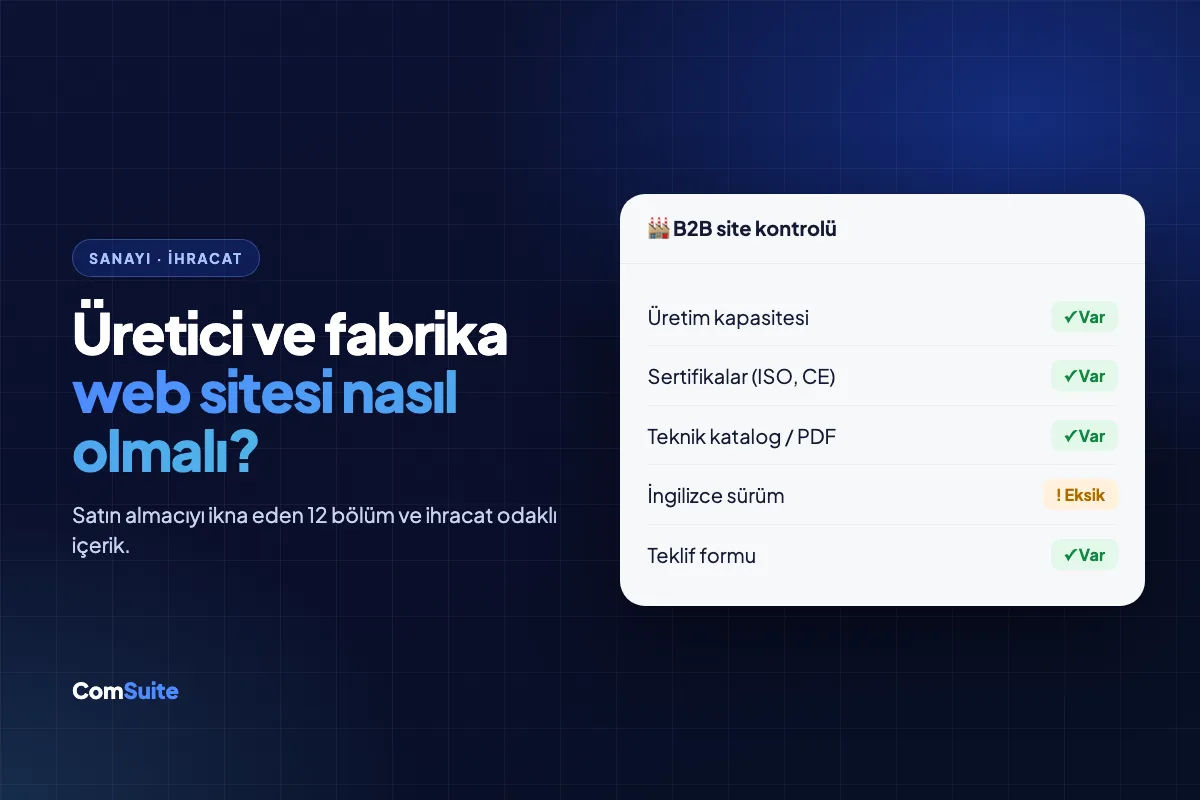
Short answer: A manufacturer's website has one job: to generate qualified quote requests (RFQs). That takes four building blocks: a filterable product catalog with technical detail; a quote form reachable from every product page; a multilingual structure for export markets; and the corporate proof that passes a buyer's trust check (production facility, certifications, capacity information). In 2026 a fifth layer has been added: overseas buyers now have ChatGPT and Perplexity do their initial supplier research — a manufacturer with no AI visibility doesn't make the shortlist.
This guide walks through the B2B site blueprint section by section, from small and mid-sized manufacturers to export-focused factories.
How a B2B Site Differs from B2C: How Does a Buyer Decide?
Consumers decide on emotion; corporate buyers decide by eliminating risk. When a purchasing manager lands on your site, they are looking for answers to three questions:
- Is this company really a manufacturer, or a middleman? (Facility photos, machine park, capacity information)
- Do they have the product in the specification I need? (A catalog with technical detail, size/material/standard information)
- Is working with this company risky? (Certifications, reference industries, export experience, founding year)
A manufacturer whose site doesn't answer these three questions within 2 minutes gets quietly closed in the buyer's 15-tab comparison. Most manufacturer websites in Turkey are still stuck at "About Us + 6 blurry photos + Contact" — which is a major opportunity for companies that want to stand out from their competitors.
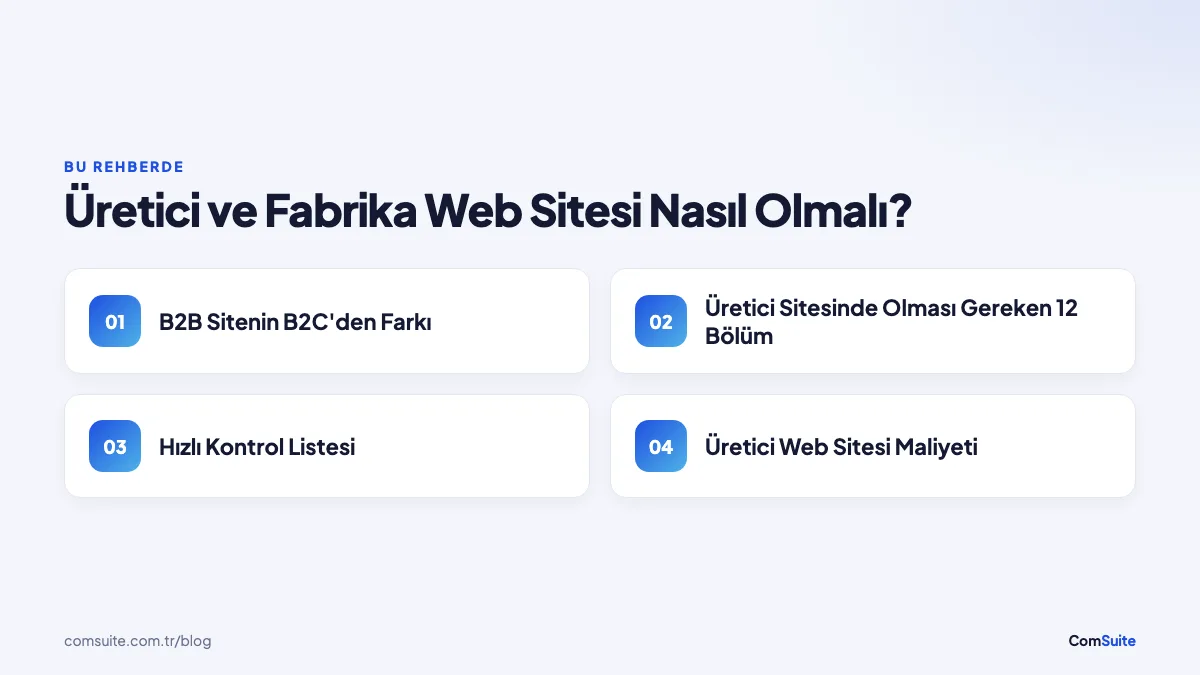
12 Sections Every Manufacturer Website Needs
1. Home Page: "What We Make and Who For" in 5 Seconds
Three things should appear on the first screen: what you manufacture ("Industrial crane and lifting equipment manufacturer"), who you sell to (industries), and proof of scale (production area, annual capacity, number of countries you export to). Skip the generic "quality and trust" slogans and use concrete numbers instead: "12,000 m² indoor facility · Exporting to 30+ countries · Since 1998".
2. Product Catalog: The Engine of Your Site
This is the most critical section, and the one most often done wrong. The rules:
- A separate page for every product group and every product — a link to a PDF catalog alone isn't enough; PDFs rank poorly on Google and are hard to read on mobile. Offer the PDF as a supplement, and make the main catalog HTML.
- Technical specification table: dimensions, materials, capacity, standards (TSE, EN, ISO, CE). Buyers search by specification: a page that says "5-ton monorail crane" will always outrank one that says "our crane types."
- Filtering: if you have more than 20 products, category and attribute filters are a must.
- A quote button on every product page: a buyer who finds a product shouldn't have to hunt for a separate contact page.
3. Quote Request Form (RFQ): Your Conversion Point
Not a generic contact form, but a form built specifically for requesting quotes: product (pre-filled automatically), quantity, target delivery dates, company name, country. It's critical that the form feeds into your CRM and instantly notifies your sales team — in B2B, an RFQ that isn't answered within 24 hours has already gone to a competitor. A WhatsApp Business line is the second channel that completes the form, especially in the domestic and Middle Eastern markets.
4. Multilingual Structure: A Prerequisite for Export
For a manufacturer targeting exports, an English set of pages is non-negotiable; depending on your target market, add German, Russian, Arabic, or French. Key details:
- Real translation, not an automatic translation widget — technical terminology errors look unprofessional in a buyer's eyes.
- A separate URL structure for each language (/en/products/...) and hreflang markup — this is what lets Google show the right language in the right country.
- International phone formatting in your contact details and an email line that can respond in English.
5. Production Facility and Machine Park Page
This answers the buyer's question: "Are they really a manufacturer?" Include facility photos, production line footage, a list of your machine park, indoor/outdoor area details, and your quality control process. A short facility video is pure gold on this page — an overseas customer can tour your factory without boarding a plane.
6. Certificates and Quality Documents
ISO 9001, CE, TSE, industry-specific certifications — presented not just visually but in a verifiable way: certificate name, scope, validity details. These documents are mandatory fields in corporate buyers' supplier pre-qualification forms; having them ready on your site speeds up the process.
7. Industries / Application Areas
The answer to "Who do you work with?": separate pages for each industry you serve (automotive supply industry, food plants, logistics warehouses...). Each page is its own SEO entry point for that industry's searches, and it gives buyers the confidence that "they know our industry."
8. Dealer / Partner Network
For manufacturers who sell through dealers: a dealer map, a dealership application form, and a dealer-only login area. Dealership applications are the second most valuable type of lead your site generates.
9. References and Case Studies
A logo wall is good; a short case study is better: "Racking system installation across 14 warehouses for logistics company X — delivered in 8 weeks." Three or four concrete stories, with customer permission, are more convincing than a wall of 40 logos.
10. Blog / Technical Knowledge Center
In B2B, content catches buyers during their research phase: "How do you calculate capacity when choosing a monorail crane?", "What should you watch for when importing CE-certified lifting equipment?" This content positions your company as the "one who knows" both on Google and in AI answers. Two technical articles a month is an investment your competitors in this industry almost never make.
11. Corporate Information and KVKK
Trade registry details, a ready-to-use corporate profile for bank references, a privacy notice, and cookie management, in line with Turkey's data protection law (KVKK). For export customers, GDPR compliance is also a trust signal.
12. AI Visibility Infrastructure (GEO)
The quiet revolution of 2026 is happening on the B2B side: overseas buyers now have Perplexity and ChatGPT build their supplier shortlists — with queries like "Turkish manufacturers of overhead cranes with CE certification". To be mentioned in those answers, you need Organization and Product JSON-LD schema, llms.txt, technically detailed HTML product pages, and depth of English content. This visibility can't be bought with ads, and for an exporter it's the lowest-cost customer channel in the world. Measure where you stand today with our free AI visibility test.
Quick Checklist
- The home page has concrete scale figures (m², capacity, export countries)
- Every product has its own HTML page with a technical table (PDF only as a supplement)
- Every product page has a quote (RFQ) button
- Quote forms feed into your CRM and the 24-hour response rule is in effect
- English (+ target market languages) is live with real translation and hreflang defined
- The facility/machine park page is ready with photos and video
- Certificates are listed in a verifiable way
- Industry-specific application pages are live
- Two technical articles are published every month
- Organization/Product schema and llms.txt are defined
Manufacturer Website Cost
A professional manufacturer website with a product catalog, quote form, and corporate pages can be built on a ready-made platform for around 28,000 – 40,000 TL (including bulk product import and setup service); if you add a multilingual export setup, the budget should be planned accordingly. For custom agency projects, budgets above 150,000 TL are common. For an itemized breakdown, see our Website Prices 2026 guide.
ComSuite Industry & Manufacturing solution: A product catalog, quote form, dealer network module, and multilingual structure come ready out of the box; with bulk product import, your existing catalog moves over quickly. Explore the Industry solution →