Short answer: A good law firm website doesn't advertise; it demonstrates expertise. The advertising ban in the legal profession restricts promotion aimed at soliciting business, laudatory statements, and anything that creates unfair competition — but nothing stops you from publishing informative content, presenting your practice areas, and being discoverable online. A well-built firm website does three things: it reflects professional seriousness, builds authority through legal articles, and gets a prospective client to make that first phone call to you.
In this guide, we break down every section of a law firm website that complies with advertising rules and wins clients.
How Do Clients Find You? (The 2026 Reality)
The attorney-client relationship still mostly begins with a referral — but the first step after a referral is now always the same: searching your name online. If the referred lawyer has no website, or one that looks like it's from 2015, trust is damaged before the phone is even picked up.
The second and growing channel is direct search: "Gebze employment law attorney," "divorce lawyer Kocaeli." The third and newest channel is AI — prospective clients are asking ChatGPT "I was fired, do I have a right to severance, and what kind of lawyer should I look for?" Across all three channels, the one asset that determines your visibility is your website.
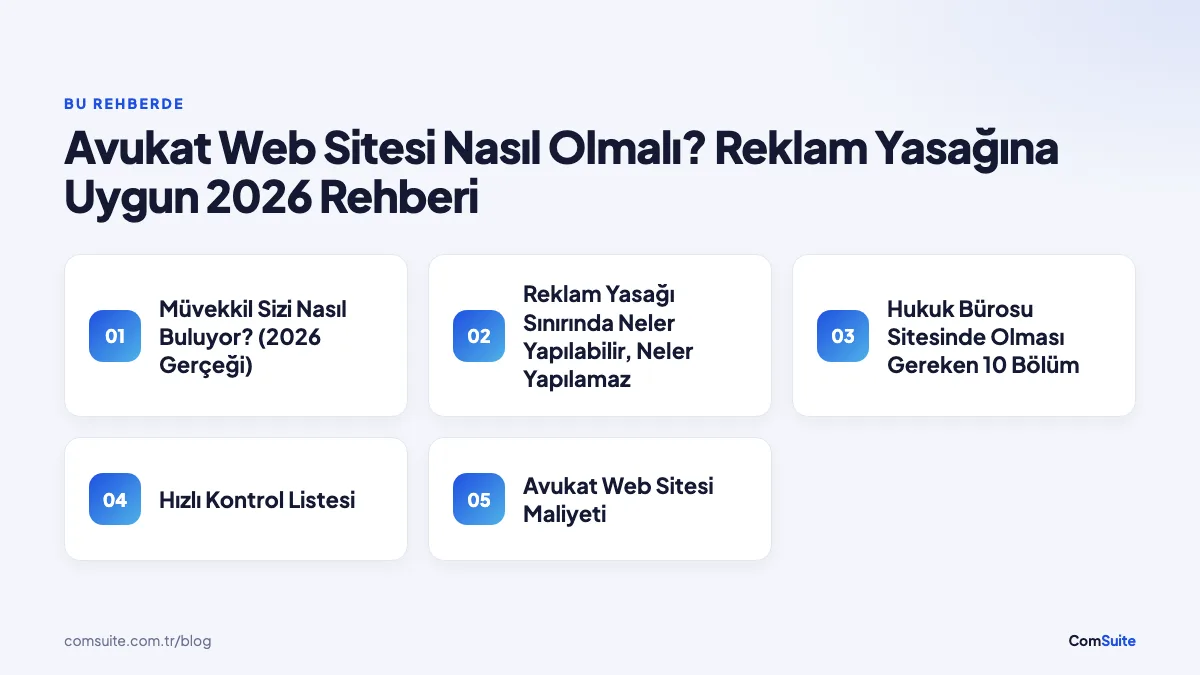
What You Can and Can't Do Under the Advertising Ban
The details are subject to your bar association's current regulations, but the general framework is clear:
Permitted (informational content):
- The firm's name, address, contact details, and practice areas
- Attorneys' résumés, education, and academic titles
- Informative articles on legal topics and assessments of current legislation
- Foreign language skills and academic publications
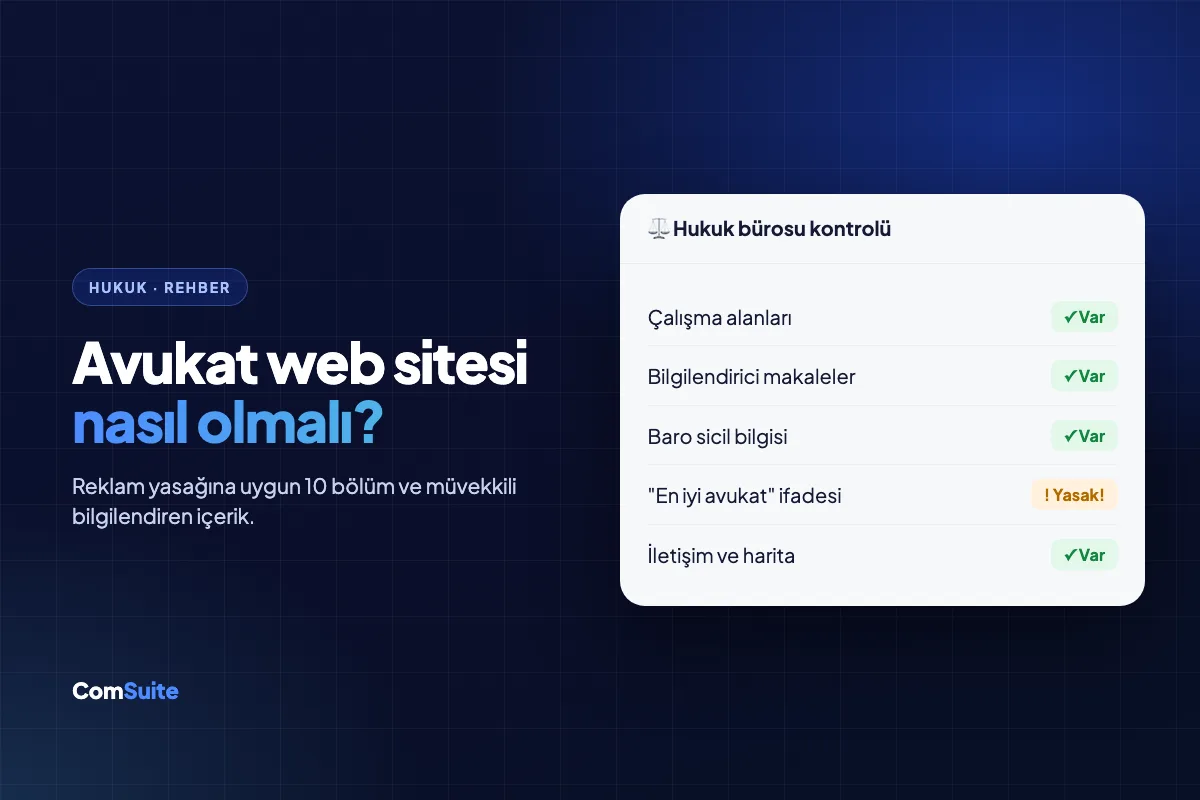
Not permitted (promotion aimed at soliciting business):
- Laudatory and comparative statements such as "the best," "most successful," or "wins cases"
- Success advertising, such as the number or rate of cases won
- Reference lists with client names and case outcomes
- Fee announcements, promotions, or discount language
- Solicitation advertising (including bidding on the word "lawyer" in Google Ads, which is a risky area)
This framework is actually not a disadvantage but the strategy itself: in a profession where you can't advertise, content is the only legitimate means of visibility. Since your competitors are bound by the same restriction, the firm that publishes articles consistently wins the rankings by a wide margin.
10 Sections Every Law Firm Website Should Have
1. A Homepage That Conveys Professional Credibility
On a law firm website, "sales page" aesthetics erode trust. Use clean typography, dark/navy tones, real photos of the firm, and a clear one-sentence description: "A law firm practicing labor law and commercial law." The phone number and contact form should be accessible on the first screen — not flashy "Call Now!" buttons; a dignified "Contact" is enough.
2. Practice Area Pages (The Most Critical SEO Decision)
Instead of a single page titled "Our Practice Areas," create a separate page for each area:
- /calisma-alanlari/is-hukuku
- /calisma-alanlari/bosanma-ve-aile-hukuku
- /calisma-alanlari/ticaret-hukuku
- /calisma-alanlari/ceza-hukuku
- /calisma-alanlari/kira-hukuku
Each page should answer the questions clients actually ask in that area, in an informative tone: the stages of the process, statutory deadlines, required documents. No praise, just information — this complies with regulations and also makes Google and AI engines more likely to cite the page as a "source."
3. Attorney Bios
Photo, education, any master's/doctorate, bar registration details, foreign languages, academic publications. Understated, verifiable, current. Clients want to see the face and background of the person they will entrust their case to.
4. Articles / Legal Analyses
This is the engine of your site. Publish 2-4 articles per month:
- "In which cases can severance pay not be claimed?"
- "How does the tenant eviction process work as of 2026?"
- "What should you look out for in an uncontested divorce protocol?"
These headlines are the queries of thousands of people who research before they ever reach the litigation stage. Someone who reads your article and comes to trust you will call you first when it's time to take legal action. Adding a note at the end of each article — "This content is for informational purposes only and does not constitute legal advice" — is both accurate and protective.
5. Process Page: "What Happens When You Contact Us?"
Most clients have never worked with a lawyer before and feel hesitant about the process. A page explaining "how the first meeting works, which documents to bring, and how to obtain a power of attorney" significantly lowers the barrier to picking up the phone.
6. Contact: Form + Phone + Location
The form should be short: name, phone, subject. Few clients will fill out a long form. Write the address as text, embed the map, and make the phone number tap-to-call on mobile. You can also add practical details such as proximity to the courthouse.
7. FAQ Section (with FAQPage Schema)
"How are attorney fees determined?", "What is legal aid?", "How long does a case take?" — these are among the most-asked questions on both Google and ChatGPT. An FAQ section marked up with FAQPage schema is the shortest path to having AI assistants cite your firm. On the fee question, rather than giving figures, saying "fees are determined according to the Turkish Union of Bar Associations Minimum Attorney Fee Schedule and the nature of the case" is both accurate and compliant with regulations.
8. KVKK and Privacy
A law firm website that isn't compliant with Turkey's data protection law (KVKK) is like a shoemaker walking around in torn shoes. The privacy notice, cookie management, and form consent mechanism must be flawless — this is also the first message of competence you send to a client.
9. Multilingual Support (If Needed)
For firms targeting foreign clients, an English page set (and Arabic/Russian if needed) is a significant channel, especially in real estate, citizenship, and commercial law.
10. AI Visibility Infrastructure (GEO)
LegalService-type JSON-LD schema, llms.txt, and a semantic content structure — this layer determines your chances of being mentioned when someone asks ChatGPT for "a law firm practicing labor law in Kocaeli." In a world where you can't run ads, having AI cite you as a source on its own is the most valuable form of visibility. You can measure where you stand today with a free AI visibility test.
Quick Checklist
- A separate, informative page created for each practice area
- No promotional/comparative language, success rates, or client testimonials
- Attorney bios are current and verifiable
- At least 2 legal articles published per month
- Articles include a "not legal advice" note
- FAQ section marked up with FAQPage schema
- KVKK privacy notice and cookie management active
- Phone number is tap-to-call on mobile
- LegalService schema and llms.txt in place
- Dignified design — far from sales page aesthetics
How Much Does a Law Firm Website Cost?
A professional law firm website with practice area pages, an article infrastructure, and KVKK-compliant forms can be set up on a ready-made platform for 18,000 – 28,000 TL. Custom agency-built designs often run above 80,000 TL. For a line-by-line breakdown, see our Website Prices 2026 guide. Our "near me" searches guide will also help with local visibility tactics.
ComSuite Legal & Consulting solution: Practice area structure, an article/blog module, KVKK tools, and professional templates come ready to use. Explore the legal solution →