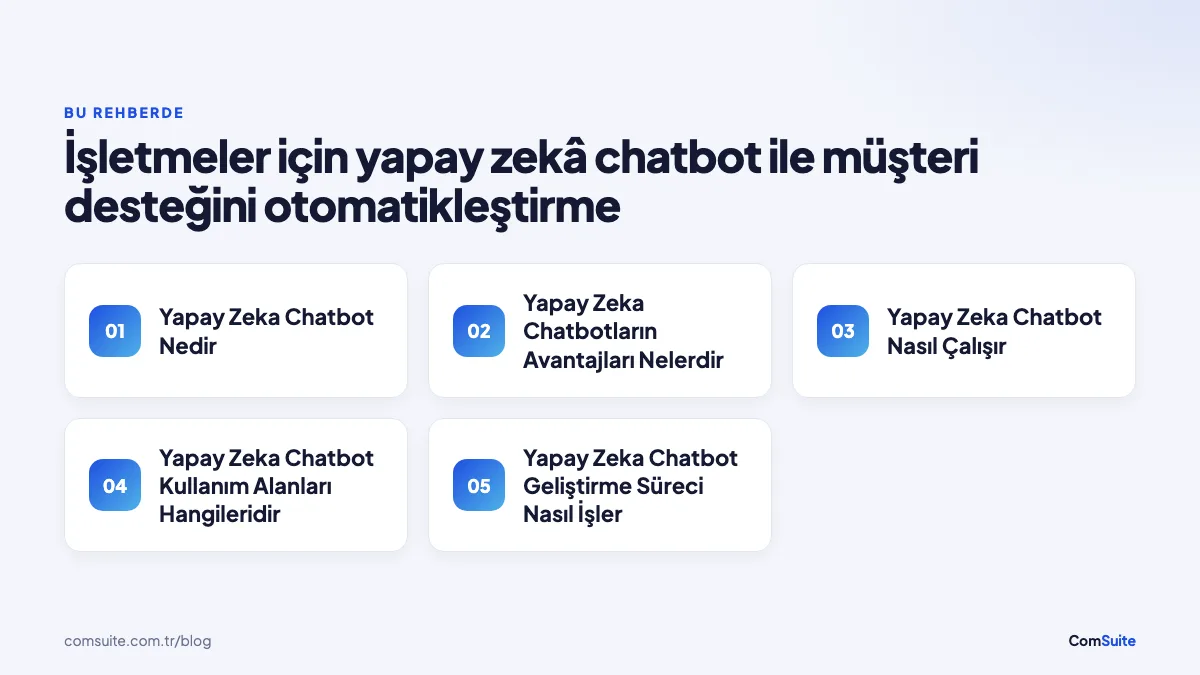
What Is an AI Chatbot?
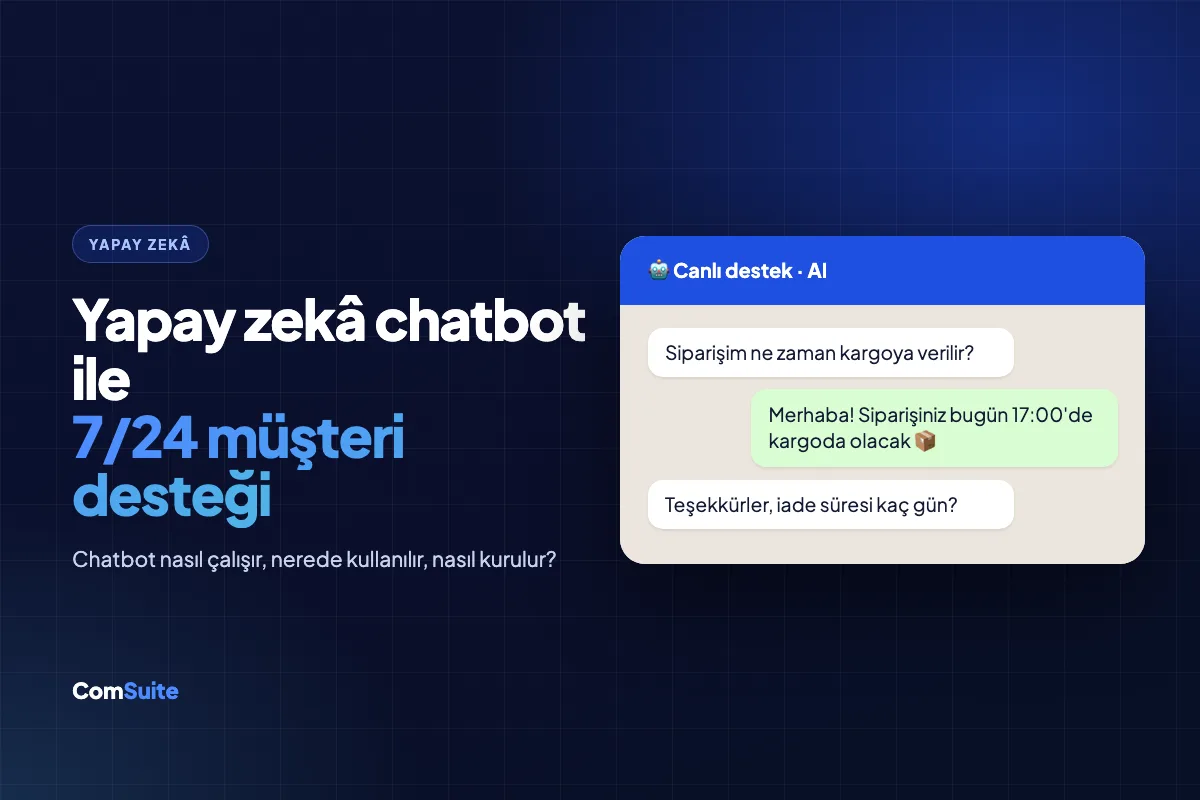
An AI chatbot is a software system that uses machine learning and language processing technologies to automatically chat with users in natural language. Rather than relying on predefined rules, an AI chatbot understands context and can generate instant, accurate answers to user questions. Businesses use this technology to provide round-the-clock customer support, reduce costs, and improve service quality.
How Did Chatbots Evolve Over Time?
The first chatbot was ELIZA, a program developed in 1966 by Joseph Weizenbaum at MIT. ELIZA worked through simple pattern matching and responded to users like a therapist. In the 1990s, rule-based systems became widespread, but they could only respond to specific commands. Starting in the mid-2010s, advances in deep learning and large language models (LLMs) turned chatbots into truly "AI"-powered tools. Today, chatbots built on GPT-based models, BERT, and similar architectures deliver an experience that comes remarkably close to human conversation.
What Are the Advantages of AI Chatbots?
Compared to traditional customer support models, AI chatbots deliver tangible, measurable benefits for businesses. According to most industry research, chatbot integration can significantly increase first-contact resolution rates while cutting average response times from several minutes to a few seconds.
- 24/7 support: Chatbots stay active at all times, regardless of business hours, and respond to customers immediately.
- Cost efficiency: By automating repetitive questions, they let human agents focus solely on complex cases.
- Scalability: They can hold thousands of conversations with users at the same time.
- Consistency: They give every user the same quality of answer, grounded in accurate information.
- Data collection: Data gathered from customer interactions directly informs product and service development.
What Role Do AI Chatbots Play in Customer Support?
In customer support, AI chatbots are no longer limited to answering FAQs. They can also autonomously manage processes such as order tracking, returns, complaint handling, and technical troubleshooting. According to Gartner's forecasts, a large share of customer service interactions is expected to be handled by AI-powered tools as of 2025. This makes chatbot integration on websites and mobile apps a strategic priority for businesses.
How Are Personalized Services Delivered?
Modern AI chatbots can deliver personalized service by analyzing a user's past interactions, purchasing behavior, and preferences. For example, an e-commerce chatbot can make recommendations based on the product categories a customer has previously browsed, or directly share campaigns that match their loyalty program status. This level of personalization is a key factor in boosting customer satisfaction and conversion rates.
How Does an AI Chatbot Work?
An AI chatbot processes text or voice input from the user and generates an appropriate response. This process consists of a few core components: natural language understanding (NLU), dialogue management, and natural language generation (NLG). The system detects the user's intent, retrieves the relevant information, and returns the answer in clear language.
What Is Natural Language Processing (NLP)?
Natural language processing (NLP) is the subfield of AI that enables computers to understand and interpret human language. NLP allows chatbots to correctly grasp the context, sentiment, and intent of a sentence. For example, even though "Where is my order?" and "When will my package arrive?" are phrased differently, an NLP engine can recognize that both carry the same intent. Google's BERT model and OpenAI's GPT series are among the most widely used NLP architectures today.
What Are the Use Cases for AI Chatbots?
AI chatbots have a wide range of uses across different industries. As the technology matures, its applications continue to expand every year.
How Are Chatbots Used in E-Commerce and Sales?
The e-commerce sector is among the biggest beneficiaries of AI chatbots. In this sector, chatbots take on the following functions:
- Guiding users through product search and comparison
- Sending instant reminders and incentive messages to reduce cart abandonment
- Providing real-time information about payment and shipping
- Automatically handling return and exchange requests
This way, customers get the information they need directly and instantly, while sales teams can focus on more strategic tasks.
What Are Chatbot Applications in Healthcare?
In healthcare, AI chatbots handle functions such as appointment scheduling, preliminary symptom assessment, and medication reminders. Patients can chat with a chatbot on a website or mobile app and be directed to the appropriate specialist department. One important note: healthcare chatbots cannot make medical diagnoses; they only provide guidance and, when necessary, hand the user off directly to a healthcare professional. In this field, compliance with data privacy regulations such as HIPAA (US) and KVKK (Turkey's data protection law) is critically important.
| Industry | Primary Use Case | Key Benefit |
|---|---|---|
| E-Commerce | Order tracking, product recommendations | Higher conversion rates |
| Healthcare | Appointments, symptom checking | Faster patient routing |
| Finance | Account inquiries, transaction notifications | 24/7 support availability |
| Education | Frequently asked questions, enrollment support | Reduced staff workload |
How Does the AI Chatbot Development Process Work?
Building an AI chatbot spans multiple stages, from choosing the technical infrastructure to designing the content. The process typically consists of needs analysis, data collection, model training, testing, and launch. To succeed with a chatbot project, businesses need to define their target audience, frequently asked questions, and the systems to be integrated in advance.
How Do You Choose the Right Tools and Technologies?
The tools you can use to build a chatbot vary depending on the scale of the project and your technical capacity. Common choices include:
- Dialogflow (Google): A platform with a strong NLP foundation, well suited to rapid prototyping.
- Microsoft Bot Framework: Enterprise-scale integration and a structure compatible with Azure services.
- Rasa: An open-source option that can run on-premise, ideal for businesses that prioritize data privacy.
- OpenAI API: The preferred solution for applications that require high-quality, GPT-based language generation.
When choosing a tool, it's important to consider not only technical features but also cost structure, data security requirements, and ease of integration with your existing systems.
Related guide: Live Chat Software: Human, AI, or Hybrid?
Frequently Asked Questions
What is an AI chatbot?
An AI chatbot is software that can interact with users, using natural language processing and machine learning technologies.
How does an AI chatbot benefit businesses?
An AI chatbot automates customer support processes, which lowers costs, speeds up response times, and provides 24/7 service.
How do you automate customer support with a chatbot?
A chatbot automates customer support by giving predefined answers to frequently asked questions and routing users' requests to the right place.
What are the advantages of an AI chatbot?
Its advantages include fast responses, fewer human errors, higher customer satisfaction, and more efficient use of business resources.
Does an AI chatbot have any disadvantages?
Yes. Its disadvantages include limited understanding, difficulty solving complex problems, and a lack of human interaction.
How can a business integrate an AI chatbot?
Businesses can integrate a chatbot by choosing a chatbot platform that fits their existing customer support systems, then using API integrations and training data.