What Is E-Commerce for SMEs?
The most affordable e-commerce platforms for SMEs include Shopify, WooCommerce, Ticimax, İdeasoft, and local solutions that compete with Shopify. E-commerce is a business model in which small and medium-sized enterprises (SMEs) offer their products and services for sale online and manage ordering, payment, and shipping digitally. Compared with a physical store, this model makes it possible to reach a wide customer base with a much lower startup cost.
Current plans: To see all ComSuite plans and pricing in a single table, visit our website pricing page.
In Turkey, SMEs make up more than ninety percent of all businesses. Moving these businesses to digital channels strengthens their competitiveness and opens up new revenue streams. Choosing the right platform is the most critical step in this process.
What Advantages Does E-Commerce Offer SMEs?
- Low startup cost: You can start selling without the rent and decoration expenses of a physical store.
- 24/7 selling: Your online store keeps taking orders outside business hours.
- Wide geographic reach: You're not limited to a single city; you can expand across Turkey or into international markets.
- Measurable marketing: Digital ads, conversion rates, and cart analytics help you make your budget more efficient.
- Easier inventory and order management: Most platforms automate product tracking and reporting.
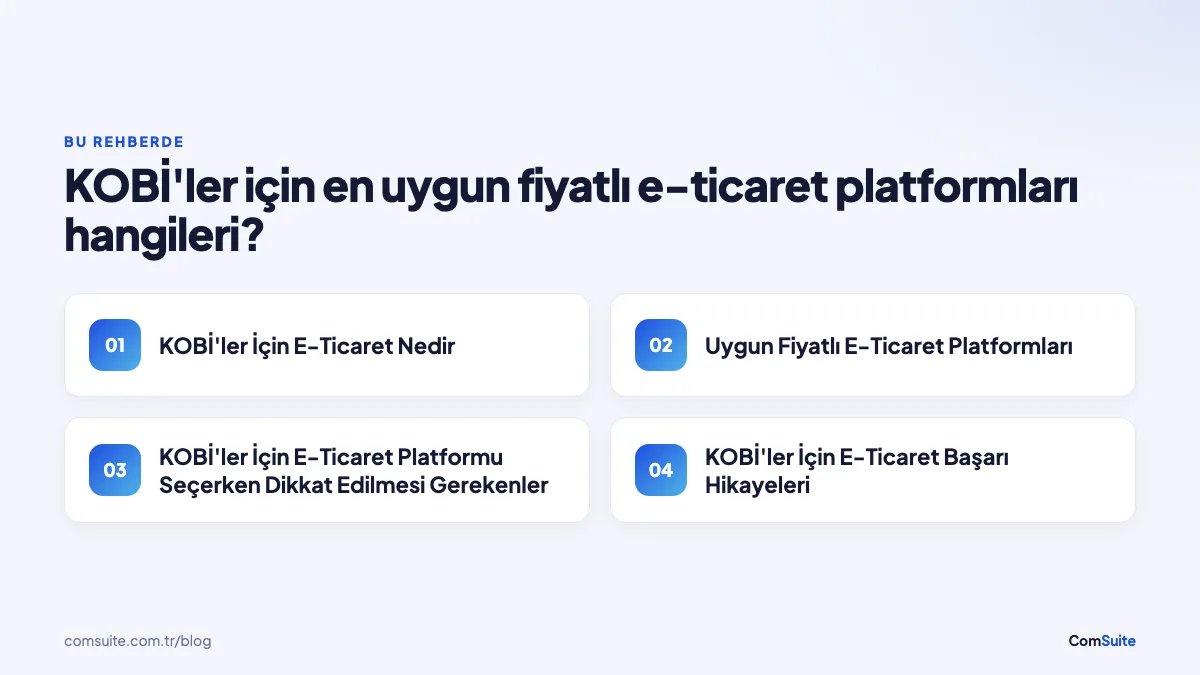
Affordable E-Commerce Platforms
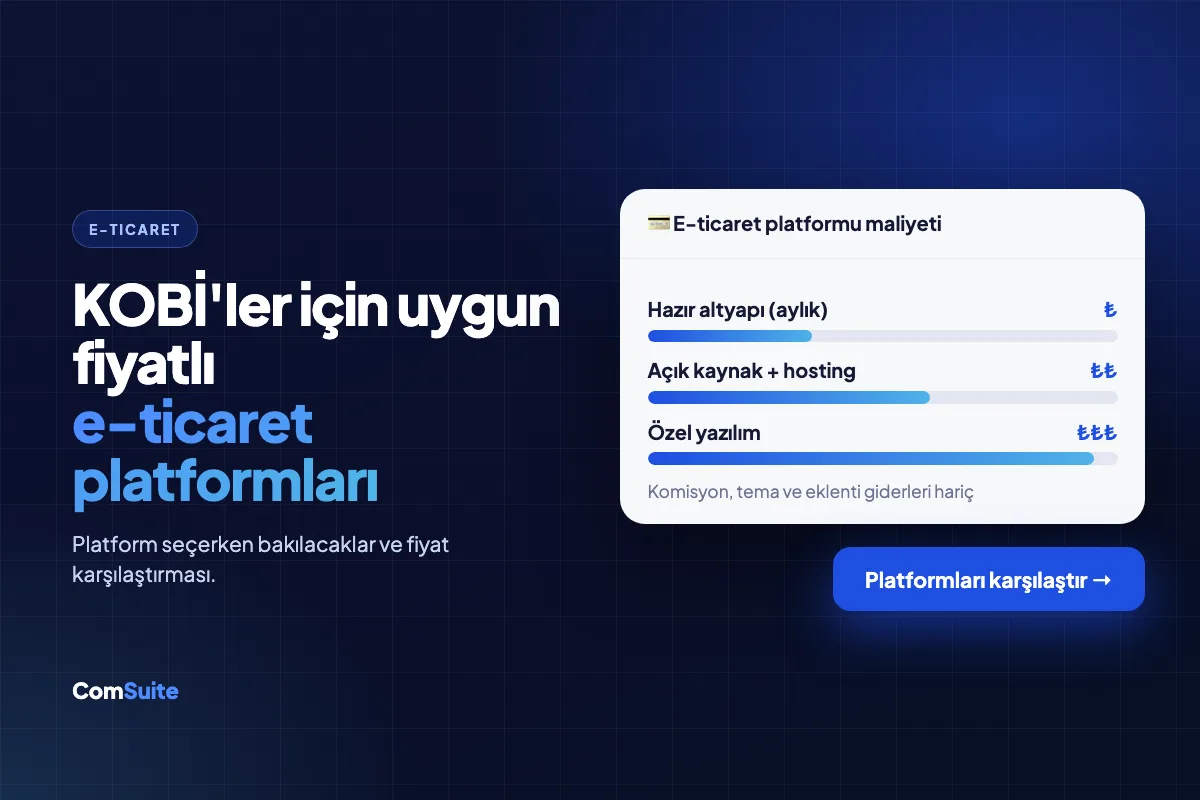
The cost of setting up an e-commerce site for an SME can range from a few hundred TL to several thousand TL per month, depending on the platform you choose and the features you need. Free open-source options are also available; however, technical support and hosting costs must be factored in separately.
What Are the Most Popular E-Commerce Platforms?
The table below compares the platforms SMEs choose most often in terms of core features and price ranges. Prices are approximate as of 2024 and may vary depending on the exchange rate.
| Platform | Monthly Starting Price | Free Plan | Turkish Support | Key Feature |
|---|---|---|---|---|
| WooCommerce | Hosting only (200–500 TL) | Yes (plugin) | Yes | WordPress integration, flexibility |
| Shopify | ~29 USD (Basic plan) | No (3-day trial) | Partial | Quick setup, powerful app marketplace |
| Ticimax | Starts at ~500 TL | No | Yes | Turkish payment and shipping integrations |
| İdeasoft | Starts at ~600 TL | No | Yes | Marketplace integration, technical support |
| Opencart | Hosting only | Yes (open source) | Yes | Low cost, extensive plugin ecosystem |
Local platforms such as Ticimax and İdeasoft are especially advantageous for SMEs in Turkey. These platforms integrate directly with Turkish shipping companies, local payment infrastructures, and Turkish-speaking technical support teams. Shopify, meanwhile, remains a strong option for businesses aiming to sell internationally.
Are There Free E-Commerce Options?
Yes, some platforms offer a free way to get started. However, the word "free" should be considered carefully; in most cases, paying for hosting, a domain name, and additional plugins is unavoidable.
- WooCommerce: Free as a WordPress plugin; you only pay for hosting and a domain. Because it requires technical knowledge, it can create a time cost for small teams.
- Opencart: Open source and free. It can be customized with different themes and plugins; however, security updates require manual tracking.
- Ecwid (free plan): Can be used to add an e-commerce cart to an existing website or social media account. The free plan limits the number of products.
- Shopify Starter: Offers a low-cost entry point for SMEs that want to sell through social media.
Experts emphasize that free platforms work well in the early stages, but SMEs with growth goals should move to paid, more comprehensive plans in the medium term.
What SMBs Should Consider When Choosing an E-Commerce Platform
Choosing the right platform directly affects long-term sales success. Rather than focusing on price alone, you should evaluate the criteria below as a whole.
What Should Payment Integrations Look Like?
On e-commerce platforms, payment methods are the most critical step in getting a customer to complete a purchase. For SMBs in Turkey, these are the core payment integrations a platform should support:
- Credit and debit cards: Payment infrastructures such as İyzico, PayTR, Stripe, and Garanti BBVA are widely used.
- Bank transfer (Havale/EFT): This method is still preferred, especially for B2B sales.
- Cash on delivery: This option builds consumer trust in Turkey and has a positive effect on conversion rates.
- Digital wallets: Support for fast payment methods such as Apple Pay, Google Pay, and BKM Express improves the mobile user experience.
- Installment options: Since the vast majority of Turkish consumers prefer to shop in installments, bank installment integration is critically important.
When choosing a platform, it's also important to compare the commission rates of payment integrations. Local solutions such as İyzico and PayTR generally charge between 1.5% and 3% per transaction, though these rates may vary depending on transaction volume.
Why Do Shipping and Logistics Solutions Matter?
The shipping process directly affects customer satisfaction and repeat purchase rates. The more advanced a platform's shipping integrations are, the more efficient your order management becomes.
- Automatic shipping label generation: Significantly reduces the manual workload during busy order periods.
- Multi-carrier support: Integration with different carriers such as Yurtiçi Kargo, Aras Kargo, MNG Kargo, and PTT Kargo lets you compare prices competitively.
- Real-time tracking: Sending customers automatic shipment tracking notifications reduces support requests.
- Returns management: An easy returns process increases customer trust and makes it simpler to comply with legal obligations.
Local platforms such as Ticimax and İdeasoft offer ready-made integrations with Turkey's major carriers, giving SMBs a significant advantage in this area.
How Should You Evaluate Technical Support and Reliability?
Technical support quality is often overlooked when choosing a platform. But technical issues during peak sales periods (campaign days, holidays) can lead to serious revenue losses. Here are the criteria to evaluate:
- 24/7 live support or a phone line
- Turkish documentation and video tutorials
- Server uptime guarantee (99.9% is considered standard)
- SSL certificate and PCI DSS compliance
- A regular backup policy
E-Commerce Success Stories for SMBs
Many SMBs in Turkey have managed to grow their sales volume in a short time after moving to e-commerce. According to reports published by KOSGEB and the Ministry of Trade, a significant share of SMBs that invest in e-commerce infrastructure are able to reach a new customer base within the first year.
Small businesses operating in categories such as handmade products, food, textiles, and home decor in particular are adopting a dual-channel sales strategy by launching their own e-commerce sites alongside marketplaces like Trendyol and Hepsiburada. This approach has a positive effect on both brand awareness and profit margins.
The common threads in successful transitions can be summarized as follows:
- Quality investment in product photos and descriptions
- Active management of customer reviews
- Integrated use of social media and the e-commerce site
- Keeping shipping times competitive with rivals
Related guide: How to Use CRM Software the Right Way: 6 Steps for SMBs
Frequently Asked Questions
How much does it cost to set up an e-commerce site for SMBs?
With open-source platforms (WooCommerce, Opencart), the only cost is hosting and a domain, around 200–500 TL per month. On local SaaS platforms (Ticimax, İdeasoft), monthly plans generally range from 500 TL to 2,000 TL. On international platforms like Shopify, the basic plan starts at roughly 29 USD per month. If you commission custom software development, the upfront cost can be much higher.
Which e-commerce platforms offer the best technical support?
When it comes to Turkish-language technical support, Ticimax and İdeasoft stand out. Both platforms offer Turkey-based support teams and a Turkish help center. While Shopify's technical support infrastructure is strong, Turkish-language support can be limited. With WooCommerce, support relies largely on community forums and third-party agencies.
Is it possible to manage marketplaces and your own e-commerce site together?
Yes. Platforms like Ticimax and İdeasoft offer integrations with marketplaces such as Trendyol, Hepsiburada, and N11. This lets you manage inventory, pricing, and orders for multiple channels simultaneously from a single panel. This feature saves significant time and money for SMBs that adopt a multichannel sales strategy.
Frequently Asked Questions
What are the most affordable e-commerce platforms for SMBs?
Among the most affordable e-commerce platforms for SMBs are Shopify, WooCommerce, Wix, Trendyol, N11, and Hepsiburada.
Is Shopify a good fit for SMBs?
Yes, Shopify is a solid option for SMBs thanks to its user-friendly interface and range of pricing plans.
What are the advantages of WooCommerce?
Because it is open source, WooCommerce offers flexibility and is ideal for SMBs looking for a low-cost e-commerce solution.
How good an option is the Wix e-commerce platform for SMBs?
With its easy visual design tools and affordable plans, Wix is an attractive e-commerce platform for SMBs.
What advantages do Trendyol and N11 offer SMBs?
With their large customer bases and low startup costs, Trendyol and N11 give SMBs an opportunity to start selling.
How does Hepsiburada support SMBs?
Hepsiburada simplifies e-commerce processes for SMBs through special campaigns and support services.