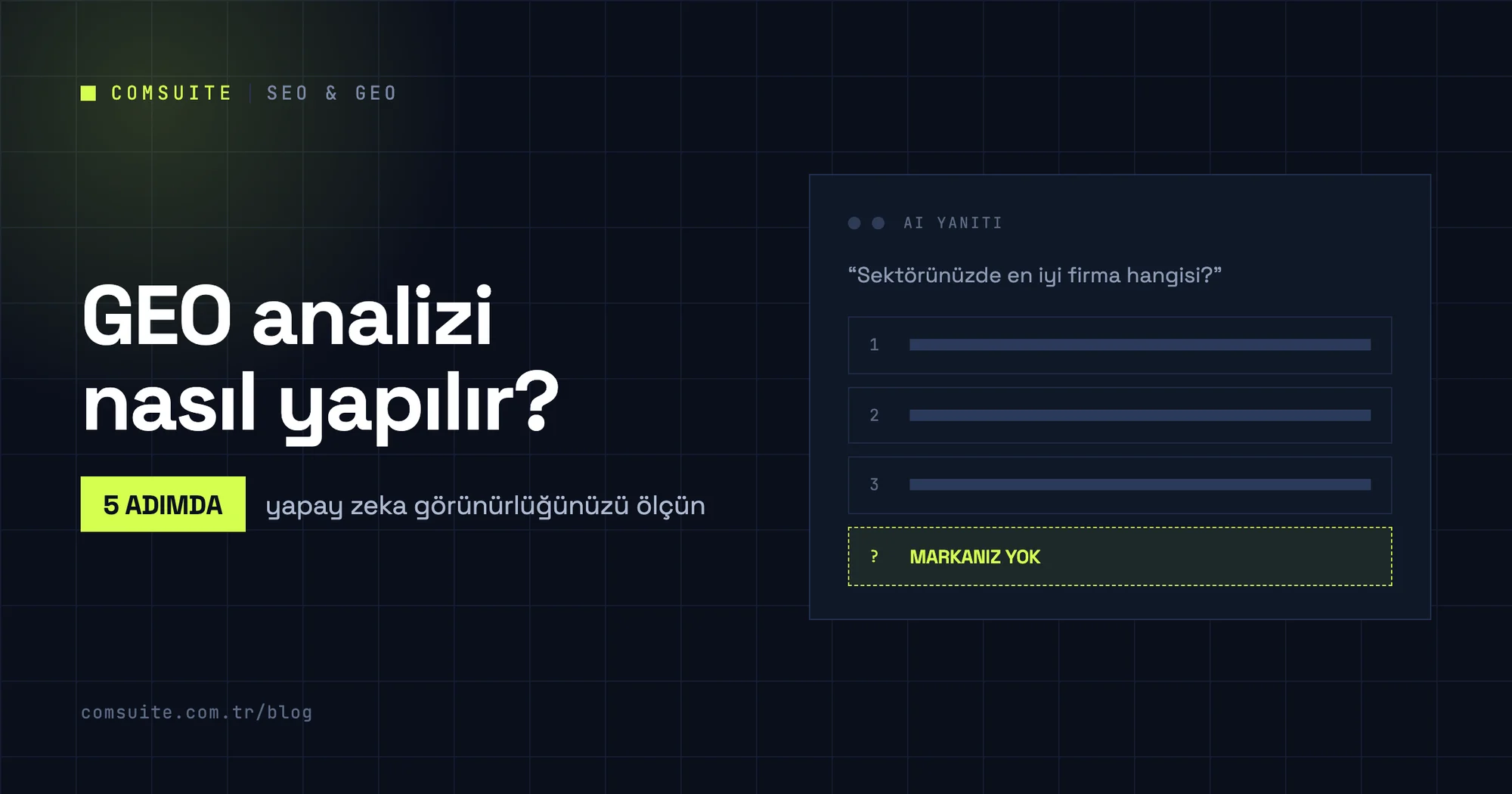
Last week we were talking with one of our e-commerce clients. They ranked on page one of Google for most of their target keywords, and their traffic wasn't bad at all. Then we asked ChatGPT a "best of" question about their industry. The answer listed five competitors — and not a single mention of them. That was the moment the need for a GEO analysis became real: being visible on Google doesn't mean being visible in AI.
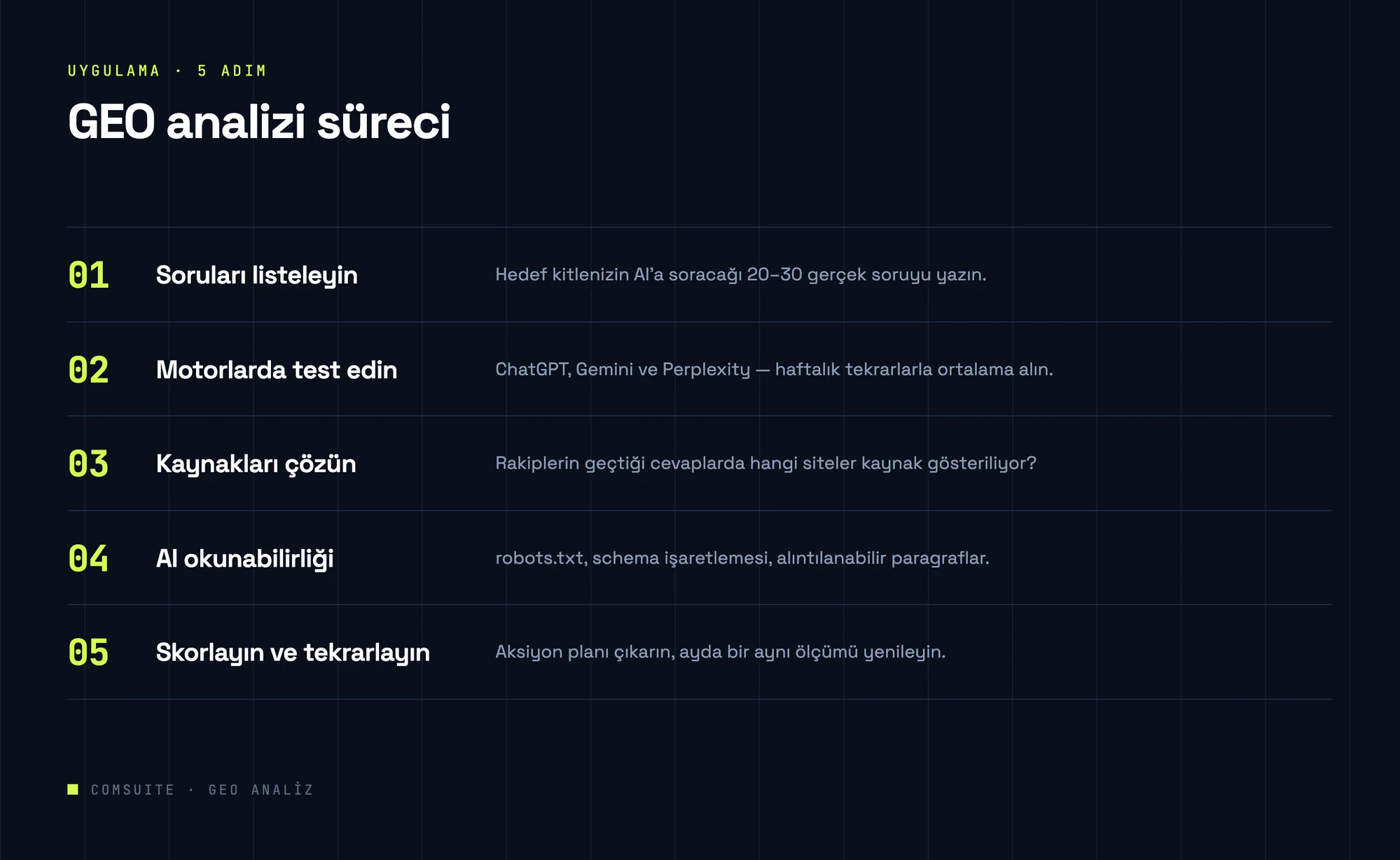
In this article, we walk you through a practical 5-step GEO analysis process you can apply to your own site today. If you just want to see where you stand in a few minutes, you can measure your score right away with the free GEO Analysis Tool at the end of the article.
Before You Start: What Are We Measuring?
A GEO (Generative Engine Optimization) analysis relies on three core metrics. These three measures largely determine how reliable your GEO analysis is:
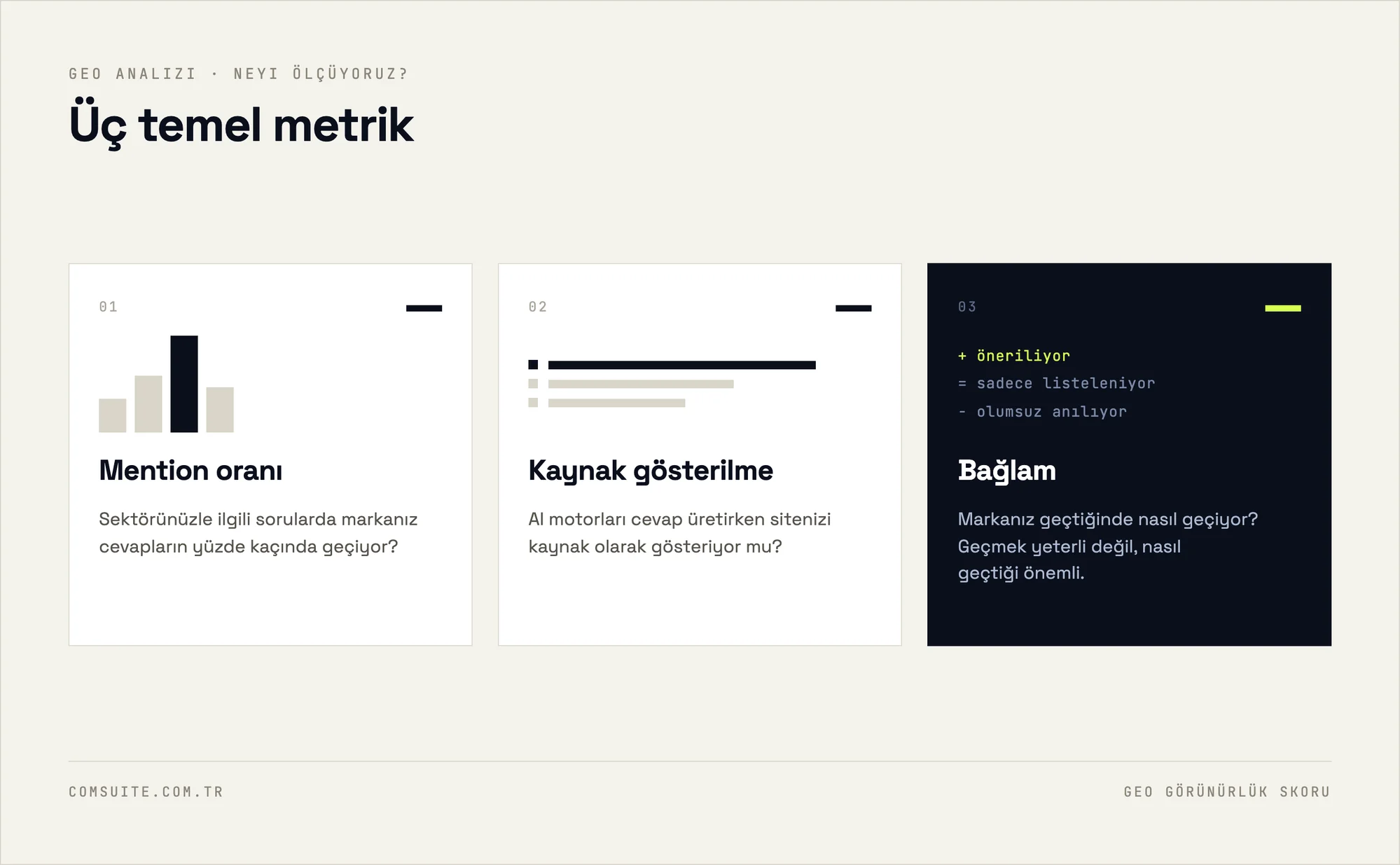
- Mention rate: In what percentage of answers to questions about your industry does your brand appear?
- Citations: When AI engines generate answers, do they cite your site as a source?
- Context: When your brand is mentioned, how is it mentioned — recommended, merely listed, or referenced negatively?
Step 1: List the Questions Your Customers Will Ask AI
Open a spreadsheet and write down 20–30 questions your target audience might ask ChatGPT or Gemini. The patterns are predictable:
- "What is the best [product/service category]?"
- "Which company is recommended for [service] in [city]?"
- "How much does [product] cost?"
- "[Brand A] or [Brand B]?"
Tip: Add the questions your sales team receives and the question-style queries from Google Search Console to this list. Real customer language is always more valuable than the language you guess at.
Step 2: Test the Questions Across Different AI Engines
Ask every question in at least three engines: ChatGPT, Gemini, and Perplexity. Log each answer in your spreadsheet: was your brand mentioned, in what position, which competitors appeared, and which sources were cited.
One important detail: ask the same question again at different times and with different wording. AI answers are not deterministic, so a one-off measurement can be misleading. Calculate an average from weekly repeats.
Step 3: Analyze the Source Pool
Engines like Perplexity and Copilot show their sources openly. Look at which sites are cited in the answers where your competitors appear. You will usually see industry guides, comparison and listing sites, news sites, forums, and glossaries.
This list is your roadmap: getting your brand featured in those sources is the shortest path into AI answers.
Step 4: Audit Your Site's AI Readability
If AI engines can't crawl or understand your site, even your best content stays invisible. Run through this checklist:
- Does your robots.txt file block AI crawlers such as GPTBot, Google-Extended, or PerplexityBot? (Don't block them unless it's a deliberate choice.)
- Are your Organization, Product, FAQ, and Article schema markups complete?
- Does your content include clear, quotable paragraphs that answer the question directly? AI engines don't quote content that beats around the bush.
- Is the information on your About, Contact, and service pages consistent and up to date?
Step 5: Score, Prioritize, and Measure Again
Turn the data you've collected into a simple score: mention rate + citations + technical readiness. Then build an action plan starting with the highest-impact gaps, and repeat the same measurement once a month. GEO isn't a one-time task; it's a process that requires regular tracking.
If You'd Rather Not Do It by Hand
The process above is valuable, but it takes time. If you want a quick look at where your site stands, you can measure your score in a few minutes with our free GEO Analysis Tool; for a comprehensive competitor comparison and a prioritized roadmap, check out our professional GEO analysis service. Take five minutes and find out your brand's real visibility in the age of AI.

Instant GEO Analysis on Any Page with the Chrome Extension
If you want to run the analysis without ever leaving your browser, you can install the free ComSuite SEO & GEO Analysis Chrome extension. Once added, you can see the SEO and GEO score, structured data (schema), and AI readability status of any site you visit with a single click. Especially when reviewing competitor sites — as in the source pool analysis in Step 3 — it lets you do a quick preliminary assessment without leaving the page.
Frequently Asked Questions
How do you run a GEO analysis?
A GEO analysis takes five steps: (1) list the questions your target audience would ask AI, (2) test those questions in ChatGPT, Gemini, and Perplexity, (3) analyze the pool of sources behind the answers where your competitors appear, (4) audit your site's AI readability (robots.txt, schema, quotable content), and (5) turn your findings into a single score, prioritize fixes, and re-measure once a month.
Which metrics are measured in a GEO analysis?
Three core metrics are measured: mention rate (the percentage of answers in which your brand appears), citation (your site being given as a source), and context (whether your brand is actually recommended or merely listed).
Can a GEO analysis be done for free?
Yes. You can see your basic GEO score in seconds, free of charge, with the ComSuite GEO Analysis Tool. A comprehensive analysis that includes a prompt set, multi-engine scanning, and competitor comparison is part of the professional service.
How often should a GEO analysis be repeated?
We recommend once a month. AI answers change over time and as models are updated; regular measurement lets you see the impact of your improvements and stay ahead of your competitors.