Last updated: September 20, 2026
As of 2026, ChatGPT has become more than the world's most widely used AI assistant. It has also become an advertising channel. OpenAI's ChatGPT Ads platform lets businesses show ads against real needs that surface during a conversation. This guide brings the entire process together on a single page, from opening an account to budget planning, targeting logic, and conversion measurement, and explains clearly what businesses in Turkey can do today.
What is ChatGPT Ads?
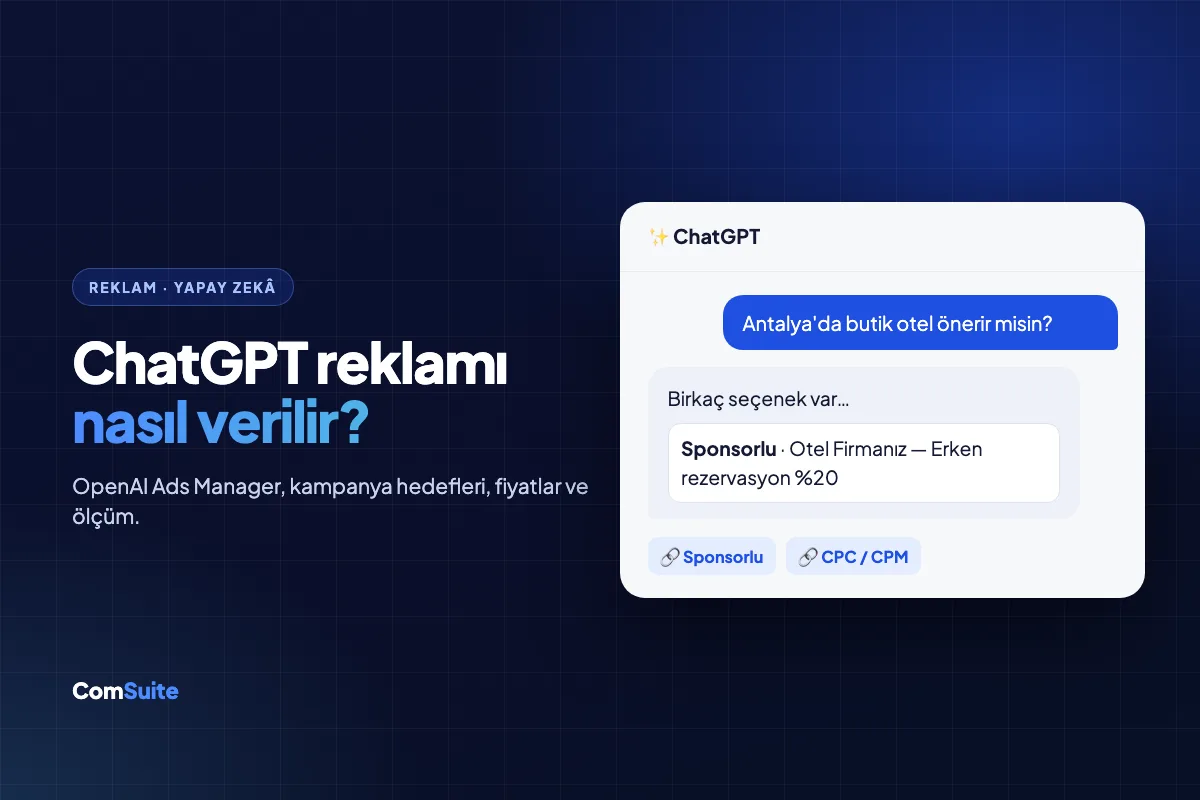
ChatGPT Ads is an advertising platform operated by OpenAI that lets businesses show their ads to ChatGPT users. Ads are not mixed into ChatGPT's answer itself; they appear below the answer and are clearly labeled as "sponsored."
| Component | Description |
|---|---|
| Advertiser name | The brand's display name |
| Logo / favicon | A small image for brand recognition |
| Headline | A short, clear value proposition |
| Description | Text explaining what the product does |
| Destination URL | The landing page |
| Image | A product/service image |
| Sponsored Agent (test) | After a click, a conversation with the brand's own AI agent |
The most critical point: Running ads does not make ChatGPT recommend you in its organic answers. OpenAI states clearly that its ad system operates entirely separately from its answer system, and that advertisers cannot buy or alter ChatGPT's responses. Organic visibility (GEO) and paid visibility (Ads) are two different channels.
Who sees the ads?
Under OpenAI's current policy, ads are shown only to users on the Free and Go plans. There are no ads on the Plus, Pro, Business, Enterprise, and Edu plans. Ads are also not shown on accounts identified as belonging to users under 18. In addition, the goal is to avoid showing ads near conversations about sensitive topics such as health, mental health, and politics; political ads are not permitted.
The key difference from Google Ads and Meta Ads: intent and context
Google Search advertising is built on keywords: a user types "e-commerce software," and the advertiser targets that keyword. Meta Ads is built on audiences and interests. ChatGPT Ads is built on conversation intent.
"I have a 15-person sales team, we keep our quotes in Excel, and I'm looking for an affordable CRM that can also track WhatsApp and phone conversations."
In this single sentence, company size, the current problem, the use case, and price sensitivity are all visible at once. The strength of ChatGPT Ads comes from its ability to match an ad to this rich context.
| Feature | Google Ads | Meta Ads | ChatGPT Ads |
|---|---|---|---|
| Targeting basis | Keyword | Audience / interest | Conversation context and intent |
| User signal | 2–4 word search | Demographics and behavior | Long, descriptive phrasing |
| Ad placement | Search results | Feed, Stories, Reels | Labeled area below the answer |
| Pricing | Auction | Auction | Relevance-weighted second-price auction |
| After engagement | Redirect to site | To site / to message | To site or Sponsored Agent chat |
| Maturity | Very high | Very high | Beta, evolving fast |
Step by step: Creating an ad account in OpenAI Ads Manager
Campaigns are managed through OpenAI Ads Manager at ads.openai.com. The process has four stages.
Step 1 – Create an Ads Manager account
The information required at sign-up includes: business name and website, logo, industry, country, currency, time zone, and billing details. At this stage, OpenAI performs business and advertiser verification.
Step 2 – Set up a billing profile
Before running ads, you define your company/invoice details, billing email, address, and credit card. The system works on a postpaid model: spend accrues as your ads run and is charged to your saved payment method.
Step 3 – Choose your campaign objective
Impressions, clicks, or conversions.
Step 4 – Create your ad group and ads
At the ad group level, you define the maximum bid and context hints; at the ad level, you enter the headline, description, image, and URL. Ads Manager now also offers copy and image suggestions based on your landing page and campaign objective. You can also now create, update, and analyze campaigns using commands written in plain language.
Can you run ChatGPT ads from Turkey?
This is the most frequently asked question in this guide, and the answer is clear: As of September 17, 2026, Turkey is among the countries where OpenAI has opened self-service Ads Manager access. That means businesses in Turkey can now run ChatGPT ads directly.
OpenAI opened ChatGPT ads in more than 30 European countries in August 2026, and as of September 17, 2026, it has added Turkey to the self-service Ads Manager list. Turkey now joins the US, UK, Germany, France, Italy, Spain, the Netherlands, Switzerland, Canada, Australia, Brazil, and Japan among the markets open to advertisers. Ads are shown only to users on the Free and Go plans; for USD accounts, the minimum daily budget is 25 USD.
Three practical scenarios for businesses in Turkey:
- Businesses focused on the Turkish market: You can now launch campaigns directly with a business account registered in Turkey. All you need to do is set up your billing profile and create your first campaign.
- Turkish brands selling abroad: You can build separate campaigns for Turkey and your target markets, adapting currency, budget, and context hints to each market.
- Beginners: The healthiest approach is to launch a test campaign with a small daily budget (25 USD), optimize your context hints and creatives, and then scale. Running GEO (organic AI visibility) work in parallel will improve your ad relevance score.
Update · September 17, 2026: This section has been updated following the launch of ChatGPT Ads access in Turkey.
Campaign goals: CPM, CPC, and conversions
Impressions (CPM)
For brand awareness and reach. You're charged per 1,000 impressions.
Clicks (CPC)
For driving visitors to your website. You pay for each valid click. It's the most common starting model for e-commerce, SaaS, and service businesses.
Conversions (oCPC / oCPM)
For increasing actions such as purchases, form submissions, and sign-ups. An important detail: a conversion goal does not mean you're charged per conversion. The system optimizes the campaign for conversions, but billing is still based on clicks or impressions.
| Situation | Recommended goal |
|---|---|
| Not enough conversion data on your site, new account | Start with CPC |
| New brand, awareness is the priority | CPM |
| Pixel installed, 30+ conversions per month | Conversions (oCPC) |
| E-commerce, catalog connected | Conversions (oCPM/oCPC) |
ChatGPT ad prices and minimum budget
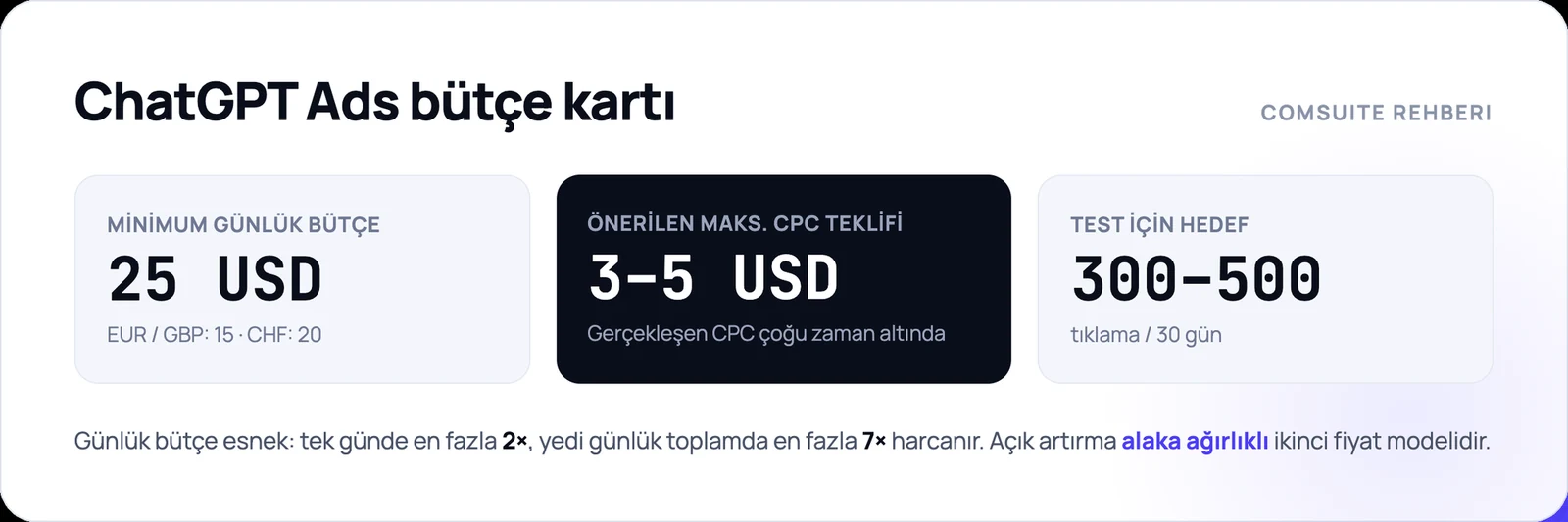
ChatGPT ads don't have a fixed price per click or impression. Pricing is set by auction, competition, and relevance, just like on Google and Meta. For CPC campaigns, OpenAI recommends starting with a maximum bid of 3–5 USD; the actual CPC often ends up below this ceiling.
| Currency | Minimum daily budget |
|---|---|
| USD | 25 |
| EUR | 15 |
| GBP | 15 |
| CHF | 20 |
| CAD | 25 |
| AUD | 25 |
The daily budget is flexible: on a single day you can spend up to 2× your daily budget, and up to 7× across a seven-day total. OpenAI picks among eligible ads using a relevance-weighted second-price auction; having the highest bid alone isn't enough, and building strong relevance through context and ad copy can win you placements even with a low bid.
As of September 17, 2026, OpenAI's official ads page shows a 500 USD ad credit for 500 USD in spend promotion. Promotions like this are seasonal and vary by country.
Cost calculation: CPC, CPM, CPL, CAC, and ROAS
For a business, the real question isn't "how much per click?" but "how much per customer?"
| Metric | Formula |
|---|---|
| CPC | Ad spend / Clicks |
| CPM | (Ad spend / Impressions) × 1,000 |
| CTR | (Clicks / Impressions) × 100 |
| CPL | Ad spend / Leads |
| CAC | (Marketing + sales costs) / Customers won |
| ROAS | Revenue from ads / Ad spend |
Example: SaaS lead campaign
- Actual average CPC: 3 USD · Daily budget 100 USD → 3,000 USD over 30 days
- Clicks: 1,000 · Site conversion rate 7% → 70 leads
- CPL: 42.86 USD · Lead-to-customer 20% → 14 customers
- CAC: 3,000 / 14 = ~214 USD
If this customer brings in 1,000 USD in gross profit per year, the campaign is highly profitable; if they bring in only 100 USD, you're losing money. Break-even ROAS = 1 / Gross profit margin; with a 40% margin, break-even ROAS is 2.5.
Targeting: not keywords, but "context cues"
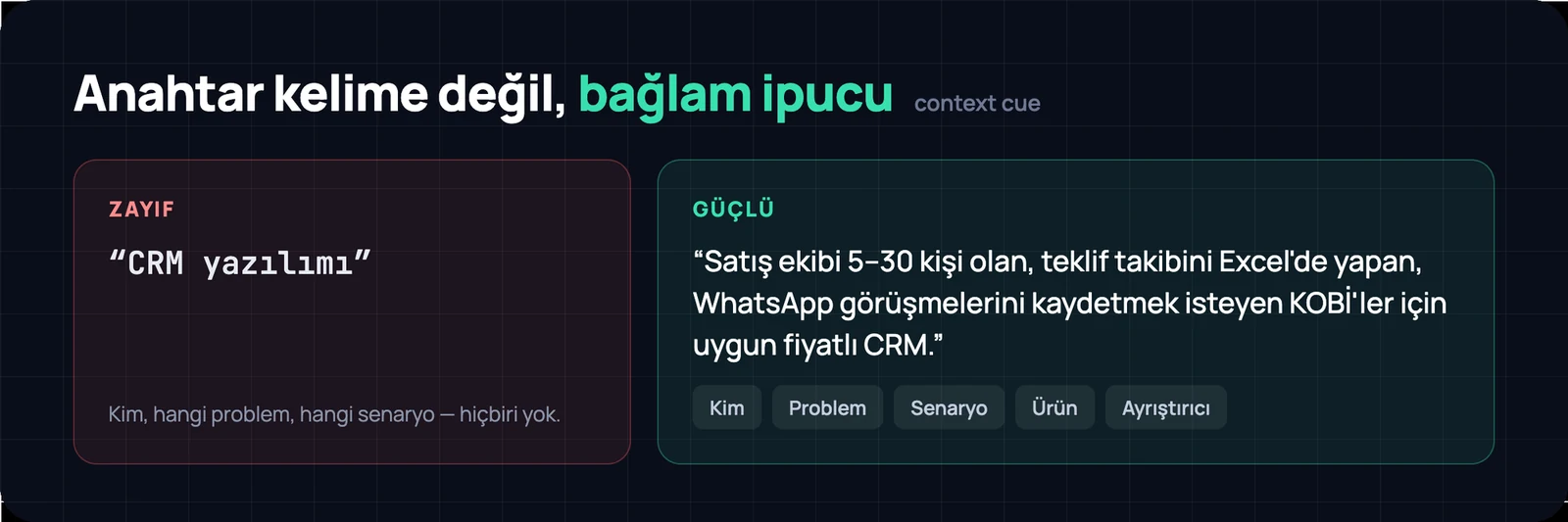
In ChatGPT Ads, you write context cues instead of keywords. Bad example: "CRM software." Good example: "Affordable CRM for small and midsize businesses with a 5–30 person sales team that tracks quotes and customers in Excel and wants to log WhatsApp and phone conversations."
A good context cue includes the following:
- Who: The target user profile
- Problem: The issue they're facing
- Scenario: The situation in which they're searching
- Product: What you offer
- Differentiator: What sets you apart, such as price, speed, or integrations
A smart way to start is to define 3–5 different context cues for each ad group and track which one performs best.
Preparing ad copy and creatives
Weak: "The e-commerce revolution begins!" — it doesn't tell users what you do. Strong: "Build your online store, integrate it with your marketplaces, and manage all orders from a single dashboard." — it conveys the product, the need, and the benefit in one sentence.
OpenAI recommends creating multiple variations for the same product, each addressing a different user need:
| Segment | Ad angle |
|---|---|
| Beginners | "Build your first online store in minutes." |
| Marketplace sellers | "Manage Trendyol, Hepsiburada, and your own site from a single dashboard." |
| Growing brands | "A scalable infrastructure built for high order volumes." |
| B2B companies | "Custom pricing, accounts, and an order system for your dealers." |
With the new opt-in feature in Ads Manager, your headlines and descriptions can be adapted to the context of the conversation and automatically translated into the user's language. Also, if your ad copy and landing page don't match, conversions collapse; creating a separate landing page for each ad angle matters even more in ChatGPT Ads than on Google.
Conversion tracking: OpenAI Pixel and Conversions API
OpenAI Pixel: A code snippet added to your website that measures purchase, form, and sign-up events after an ad click. Conversions API: Server-side measurement that isn't affected by browser blockers or cookie restrictions.
OpenAI uses a click reference called oppref on ad clicks (like gclid at Google or fbclid at Meta). Having your CRM store this parameter is essential for lead-level attribution. The chain you need to track is: Impressions → CTR → CPC → Conversion rate → CPL → CAC → ROAS. Looking only at click counts is the most expensive mistake.
Sponsored Agents, HubSpot, and Shopify integrations
Sponsored Agents
After clicking an ad, users can chat with the brand's supported AI agent in a separate, clearly labeled window ("Will this table fit a 20 m² living room?", "How many days does delivery to Istanbul take?"). The feature is currently being tested only with select advertisers in the US. What brands should prepare now: what will your agent know, what won't it answer, and where will it hand off the sale?
HubSpot integration
HubSpot is OpenAI's first CRM partner. HubSpot users can connect their ChatGPT Ads account, create campaigns, monitor performance, and track incoming leads alongside their CRM data.
Shopify integration
Shopify is the first e-commerce partner. The free ChatGPT Ads app automatically syncs your product catalog, sets up conversion measurement, and lets you manage campaigns from your store dashboard. It launched first for US sellers; starting September 23 it is rolling out to the other markets where ChatGPT Ads is available. Critical warning: catalog sync is automatic, so a missing description or placeholder image will be served directly as an ad. Clean up your catalog before integrating.
Use cases by industry
| Industry | Typical chat context | Ad approach |
|---|---|---|
| E-commerce software / SaaS | "Which platform should I use for a new e-commerce site?" | Segment-based angles, demo/trial CTA |
| Online store | "Recommend an ergonomic office chair" | Catalog integration, product imagery |
| Travel | "5-day Cappadocia itinerary in October" | Package tailored to dates and budget |
| Education / courses | "I want to learn Python from scratch" | Course ads by level and goal |
| Local services | "Teeth whitening price in Kadıköy" | Location + service context, appointment CTA |
| B2B / manufacturing | "Stainless steel industrial kitchen supplier" | Technical specs and quote form |
The closer the chat context is to the "decision stage," the higher the ad's likelihood of converting.
Common mistakes
- Copying your Google Ads keyword list. Context hints call for scenarios, not keywords.
- Starting with a single ad. Without 3–5 variations describing different needs, the system can't learn.
- Launching without installing the Pixel. You lose data from day one.
- Sending traffic to the homepage. A user coming from a specific context expects a specific page.
- Looking only at clicks. If you don't track CPL and CAC, you can't know your profitability.
- Expecting results with a minimum budget. Aim for at least 300–500 clicks in 30 days for a test.
- Trying to buy placement with a high bid. The auction is relevance-weighted.
- Assuming ads will influence the organic answer. They won't.
- Setting up the Shopify integration without cleaning your catalog.
- Evaluating results in the first week. Allow 2–3 weeks for the learning period.
GEO or ChatGPT Ads? How do they work together?
| GEO (organic) | ChatGPT Ads (paid) | |
|---|---|---|
| How does it appear? | Recommended within ChatGPT's answer | In a sponsored area below the answer |
| Cost | Investment in content and authority | Pay per click/impression |
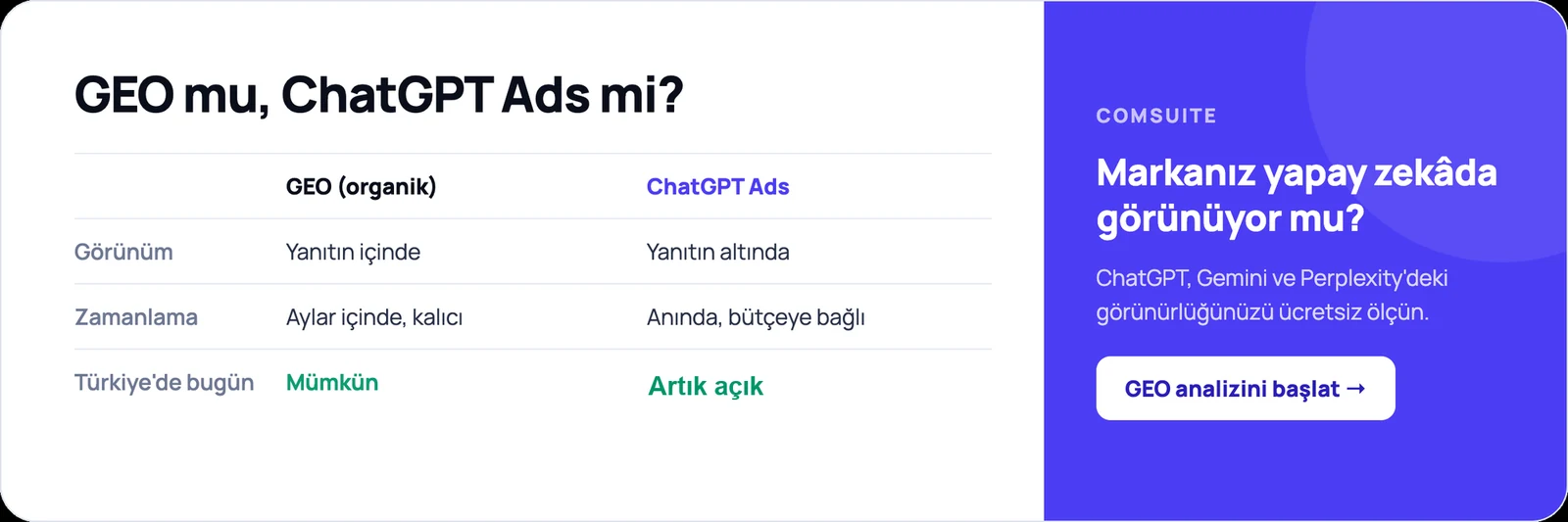
| Timing | Builds over months, lasting | Starts instantly, stops when the budget runs out |
| Perceived trust | High (independent recommendation) | Medium (clearly an ad) |
| In Turkey today | Possible | Open (since September 17, 2026) |
These two channels aren't alternatives to each other; they complement each other. In Turkey, both are now available: brands that invest in GEO start their ChatGPT Ads campaigns with both lower costs and higher relevance scores, because organic visibility directly strengthens an ad's trust and conversion performance.
Preparation plan for businesses in Turkey
- Measure your AI visibility. Is your brand being recommended in ChatGPT, Gemini, and Perplexity? ComSuite's GEO analysis tool runs this measurement regularly with industry-specific queries.
- Prepare your website to be readable by AI. Clear product/service descriptions, structured data (Schema), FAQ sections, and up-to-date pricing and delivery information.
- Write your ad angles and context hints now. "Who, which problem, which scenario" statements for each segment.
- Set up your measurement infrastructure. Google Tag Manager, server-side measurement, and click parameter logging in your CRM.
- Open your Ads Manager account and set up your first campaign. Turkey is now on the rollout list; set up your billing profile and launch a test campaign with a small budget.
- Clean up your product catalog. Missing descriptions, placeholder images, and inconsistent titles cause problems in both GEO and catalog integrations.
- Check OpenAI's country list monthly.
Pre-Campaign Checklist
- ☐ Is my country on the self-service list?
- ☐ Ads Manager account and business verification complete
- ☐ Billing profile and card set up
- ☐ Campaign objective selected (CPC/CPM/conversion)
- ☐ 3–5 context cues written for each ad group
- ☐ Separate ad angle and variations ready for each segment
- ☐ Landing pages ready for each ad angle
- ☐ OpenAI Pixel and/or Conversions API installed and tested
- ☐ oppref parameter is being saved to your CRM
- ☐ Break-even ROAS and target CAC calculated
- ☐ Test budget large enough to generate at least 300–500 clicks
- ☐ Evaluation schedule set (2–3 week learning period)
Glossary
- CPC: Cost per click.
- CPM: Cost per 1,000 impressions.
- oCPC / oCPM: CPC/CPM optimized for conversions.
- CTR: Click-through rate.
- CPL: Cost per lead.
- CAC: Customer acquisition cost.
- ROAS: Return on ad spend.
- LTV: Customer lifetime value.
- Context cue: A phrase that defines which conversation contexts an ad is relevant to.
- oppref: OpenAI's ad click reference parameter.
- Sponsored Agent: A brand-backed AI agent that opens after an ad click.
- GEO (Generative Engine Optimization): Optimization for organic visibility in AI assistants.
Conclusion
ChatGPT Ads is a new model that ties advertising not to keywords but to what people are trying to do. Google's Search → Ad → Site chain becomes Conversation → Need understood → Ad → Agent → Purchase in ChatGPT. The platform is still in beta; the safest approach is to start with small tests, measure, and increase your budget where results are proven.
Summary as of September 17, 2026: ChatGPT Ads is a usable advertising platform; CPM, CPC, and conversion optimization are supported; the minimum daily budget on USD accounts is 25 USD; OpenAI recommends a starting bid of 3–5 USD for CPC; Sponsored Agents are being tested in the US; HubSpot and Shopify integrations are now available. Turkey was added to the self-service list as of September 17, 2026; before launching a campaign, the best starting point is to strengthen your organic visibility with GEO work. To measure your brand's visibility in AI, get in touch with us.
Frequently Asked Questions
Can you advertise on ChatGPT?
Yes. Campaigns can be created through OpenAI Ads Manager (ads.openai.com); access varies by country.
How much does a ChatGPT ad cost?
There is no fixed price. CPC and CPM are determined by auction. For CPC campaigns, OpenAI recommends a starting maximum bid of 3–5 USD.
Can you advertise on ChatGPT from Turkey?
Yes. As of September 17, 2026, Turkey has been added to the countries where OpenAI Ads Manager self-service advertising is open. You can launch campaigns directly with a business account based in Turkey; ads are shown to users on the Free and Go plans, and the minimum daily budget is 25 USD.
Does ChatGPT Ads work with keywords?
No. Matching is based on context cues and user intent; there is no exact-match keyword targeting.
Does advertising make ChatGPT recommend me?
No. The ad and organic response systems are separate. Organic visibility requires GEO work.
Which users see ads?
Only users on the Free and Go plans. Ads are not shown on paid plans or on accounts for users under 18.