What Are AI Search Engines, and Why Are They Rising So Fast?
AI search engines are next-generation search systems that respond to user queries with synthesized, natural-language answers instead of lists of blue links. Platforms like ChatGPT, Google Gemini, and Perplexity are leading examples of this category. The key difference from traditional search engines is this: when a user asks a question, the system compiles information from dozens of sources and presents it as a single, coherent answer — so the user doesn't need to click through to separate pages.
Several concrete data points are behind this rise. According to Statista, ChatGPT surpassed 100 million monthly active users by the end of 2023. Google's own "AI Overviews" feature began taking up a significant share of search results in the US as of 2024. Perplexity announced that it passed the threshold of 10 million queries per day in 2024. These figures show that AI search usage has moved out of niche territory and into the mainstream.
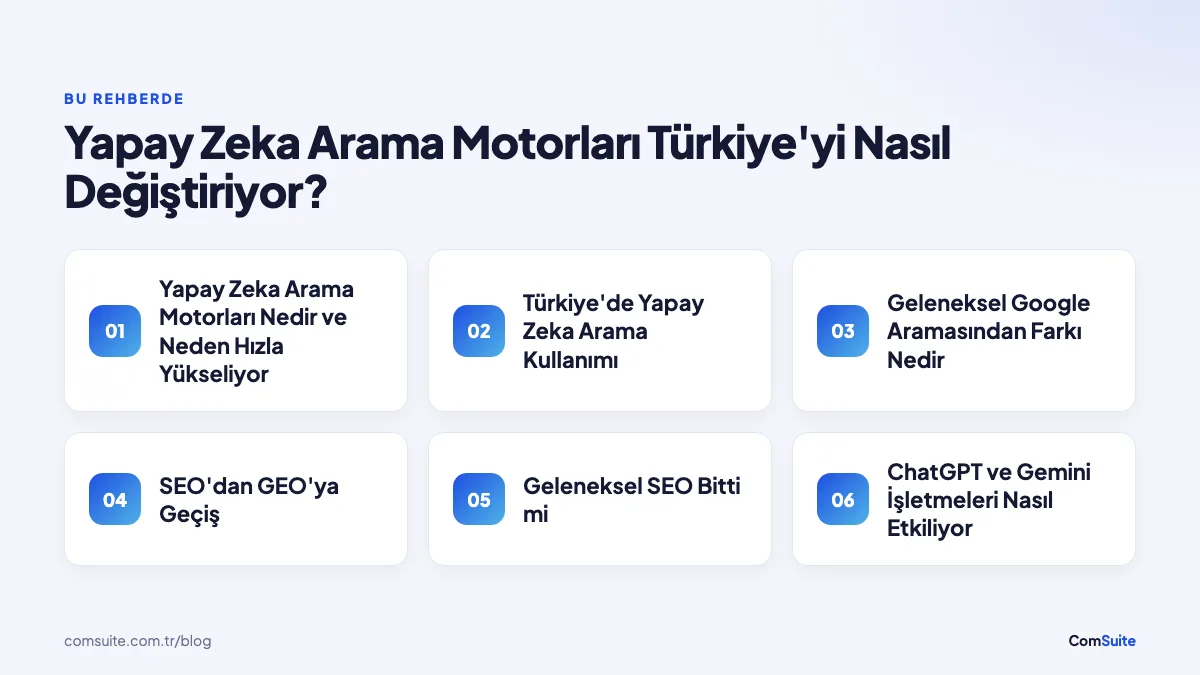
AI Search Usage in Turkey: Trends and Data
Turkey is a market whose pace of digital adoption runs above the European average. According to the We Are Social and Hootsuite 2024 Digital Turkey report, the country's internet user count has surpassed 67 million, and mobile internet penetration is approaching 90 percent. This picture suggests that AI search tools are rapidly reaching mass adoption in Turkey as well.
Google Trends data shows that search volume in Turkey for terms like "ChatGPT" and "Perplexity" grew markedly between 2023 and 2024. Meanwhile, the number of businesses using AI tools to produce Turkish-language content is also growing fast. According to practitioners in the digital marketing industry, users in information-heavy sectors such as e-commerce, finance, and healthcare in particular are turning to AI answers more and more.
How It Differs from Traditional Google Search: Zero Clicks and the Answer-First Era
In the traditional view of SEO, success meant ranking high on the search engine results page (SERP) and driving users to your website. With AI search engines, that equation is changing at its core.
The zero-click phenomenon sits at the center of this shift. When users get a direct answer to their question, there's no need to click through to the source site. According to the 2024 research by SparkToro and Rand Fishkin, more than half of Google searches already ended in zero clicks; with the spread of AI summaries, that share is rising even further.
| Feature | Traditional Search (Google) | AI Search (ChatGPT / Perplexity) |
|---|---|---|
| Result format | List of links | Synthesized natural-language answer |
| User behavior | Clicking and browsing | Reading the answer, continuing the conversation |
| Traffic potential | High (direct visits) | Low (zero-click risk) |
| Brand visibility | URL + meta title | Source citation or quote |
| Optimization approach | SEO (keywords, backlinks) | GEO (authority, citability) |
The Shift from SEO to GEO: What Is Generative Engine Optimization?
GEO (Generative Engine Optimization) is the full set of optimization strategies applied to ensure that content and brands appear in AI-generated answers. Introduced to academic literature in 2023 by researchers from Princeton, Georgia Tech, and other universities, the concept defines a new discipline that goes beyond traditional SEO.
In traditional SEO, the goal is to comply with the ranking factors set by Google's algorithm. In GEO, the goal is different: getting an AI model to treat your content as a trustworthy, citable source when it generates an answer to a question. The key differences between the two approaches can be summarized as follows:
- Authority signals: In SEO, the number of backlinks mattered; in GEO, the expertise behind the content, source diversity, and support from verifiable data come to the fore.
- Content structure: In SEO, keyword density was critical; in GEO, clear definitions, Q&A formats, and short paragraphs increase citability.
- Trust signals: Author information, institutional references, and up-to-date data raise the likelihood that AI models will select your content.
- Multi-platform presence: It's not just your website; Wikipedia, industry databases, news archives, and social proof also fall within the scope of GEO.
Is Traditional SEO Dead?
No — at least not yet. Google still holds more than 90 percent of the global search market (Statcounter, 2024). In Turkey, too, Google's dominance continues at similar levels. So abandoning traditional SEO efforts entirely would be a major risk.
But there's something else to recognize: AI visibility is becoming an increasingly decisive factor. Especially for information-seeking, comparison, and decision-making queries, users are increasingly turning to AI tools. That's why the right strategy isn't to abandon SEO, but to run SEO and GEO together.
How Are ChatGPT and Gemini Affecting Businesses?
Models like ChatGPT and Gemini have become go-to tools for product research, service comparisons, and purchase decisions. For businesses, this has a two-sided impact:
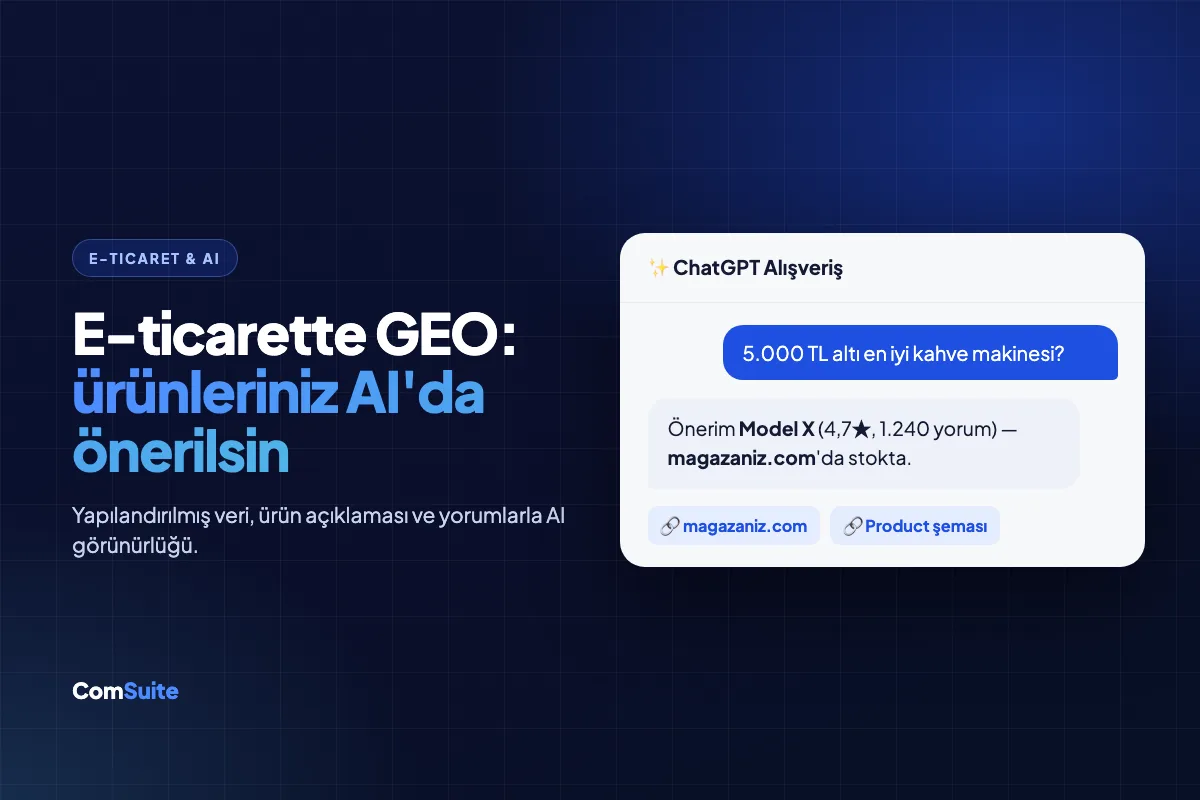
- Risk: If your brand doesn't appear in AI answers, your competitors get the recommendation. When a user asks "What is the best accounting software in Turkey?" and ChatGPT recommends your competitor by name, that user can make a decision without ever visiting your website.
- Opportunity: Being cited as a source in AI answers builds a level of trust that traditional advertising can't deliver. A brand that is "recommended" by AI takes root in users' minds as an authority.
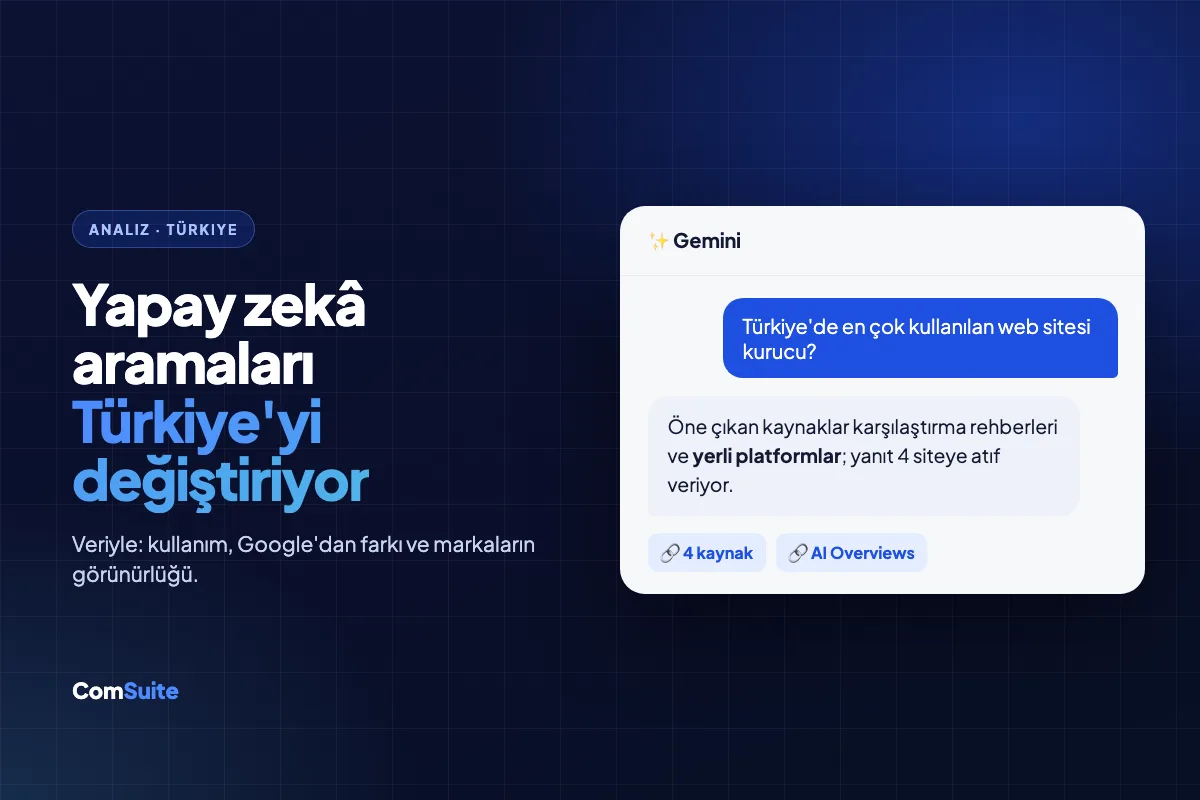
Google Gemini's "AI Overviews" feature presents summaries at the very top of the search results page. Brands mentioned in these summaries gain strong brand visibility regardless of their organic ranking. Similarly, Perplexity adds clickable citations to the sites it references in its answers — which shows that AI search traffic is far from zero.
A Report Card on AI Visibility for Brands in Turkey
The vast majority of brands in Turkey have not yet developed a GEO-focused strategy. According to field observations shared by digital marketing agencies, several core problems in the Turkish content ecosystem are hurting AI visibility:
- A significant share of Turkish content is shallow, keyword-driven, and doesn't cite sources.
- Corporate websites lack author information, proof of expertise, and up-to-date data.
- Turkish brands receive few citations in industry databases and international sources.
- The use of structured data (schema markup) is still limited.
This picture opens a serious window of competitive advantage for brands that move early. Brands that produce GEO-friendly, authoritative, and quotable content in the Turkish content ecosystem can stand out in AI answers far more easily than their competitors.
Does My Brand Show Up in AI Searches, and How Can I Find Out?
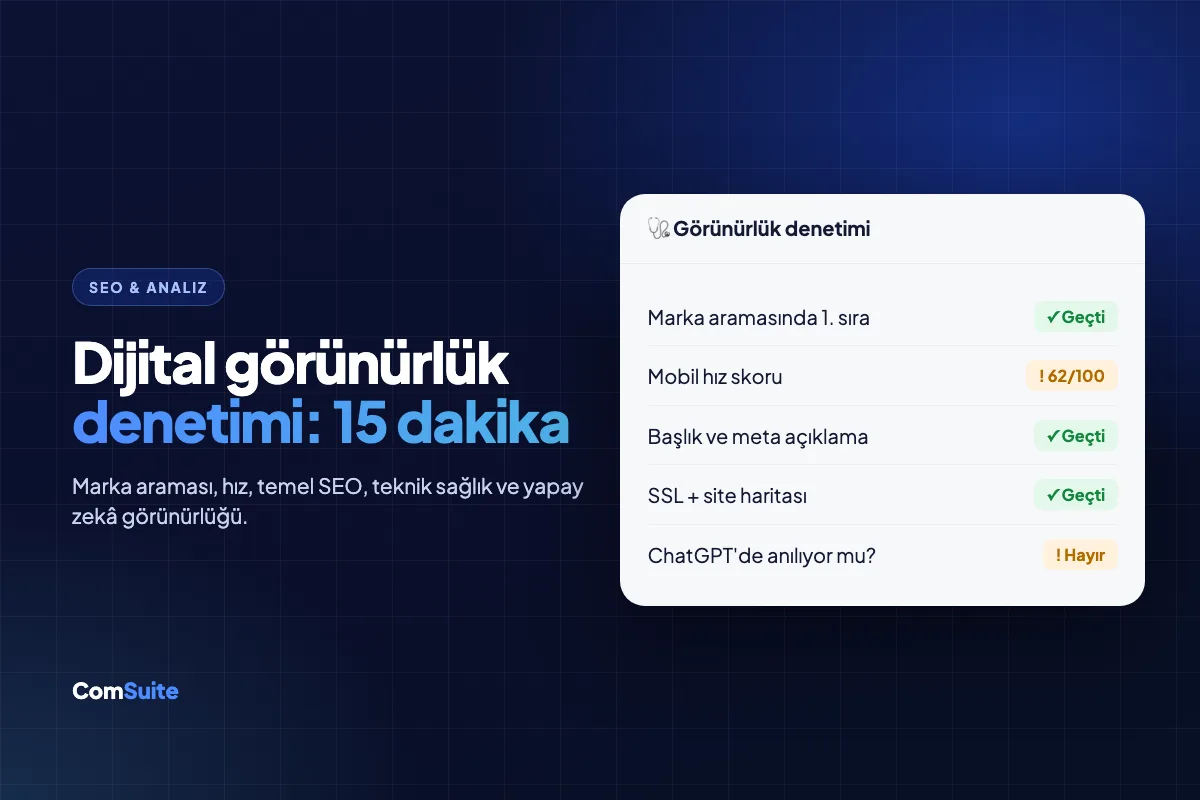
The most practical way to test this is to ask ChatGPT, Gemini, and Perplexity the questions your target audience is most likely to ask, then check whether your brand appears in the answers. Queries such as "What are the best solutions for [your industry] in Turkey?" are a good starting point.
For a more systematic approach, you can follow these steps:
- List 10-15 core questions in your industry and test each one on different AI platforms.
- Note which competitors and sources are cited regularly.
- Analyze these sources' content structure, authority signals, and use of data.
- Compare them with your own content and identify the gaps.
Steps to Get Your Brand Ready for AI Search
Building a GEO strategy doesn't require replacing your traditional SEO work entirely, but it does fundamentally change how you approach content. Here are concrete steps you can put into practice:
- Create authoritative content: Offer clear definitions, verifiable data, and expert perspective in every piece of content. AI models prefer concrete, reliable sources over vague, generic content.
- Adopt a question-and-answer format: Use the questions users ask in natural language as headings and answer them directly in the first paragraph. This structure works for both GEO and featured snippet optimization.
- Add structured data: FAQ, HowTo, and Article schemas that follow Schema.org standards help AI models understand your content better.
- Expand your digital presence: It's not just your website — your presence on industry databases, news sites, and platforms like LinkedIn and Wikipedia also makes it easier for AI models to recognize you.
- Strengthen your E-E-A-T signals: The Experience, Expertise, Authoritativeness, and Trustworthiness (E-E-A-T) criteria defined in Google's Search Quality Rater Guidelines also play a decisive role in how AI models assess content quality.
- Deepen your Turkish content: Deep, original, source-backed content is still rare in the Turkish ecosystem. Brands that fill this gap will naturally stand out in AI answers.
2026 and Beyond: The Future of Search
The evolution of AI search engines continues at full speed. Google's investments in Search Generative Experience (SGE), Microsoft's Copilot integration into Bing, and the search feature OpenAI added to ChatGPT all point to this space becoming far more central in 2026 and beyond.
Looking at Turkey specifically, Turkish language models and local AI solutions are also expected to join this ecosystem. This development will make Turkish content quality and local authority signals even more critical.
The vast majority of digital marketing strategists predict that, as of 2026, a significant portion of search traffic will begin to come from AI-mediated channels. In that scenario, brand visibility will be measured by presence in AI answers, independent of traditional SERP rankings.
In short, AI search engines are fundamentally reshaping the digital competitive landscape in Turkey. Brands that keep up their traditional SEO while adopting a GEO strategy early will be best positioned to benefit from this transformation.
Traditional Search vs. AI Search: Key Differences
| Dimension | Traditional Search (Google) | AI Search (ChatGPT, Gemini, Perplexity) |
|---|---|---|
| Result format | A list of 10 blue links | A single, synthesized answer |
| User behavior | Click through and compare sites | Get the answer directly — often without clicking (zero-click) |
| Visibility metric | Ranking near the top of results | Being mentioned / recommended in the answer |
| Optimization | SEO — keywords, backlinks | GEO — answer-first content, structured data, authority |
| Winner | The top-ranking site | The brand AI trusts and cites |
🔍 Key Finding
The vast majority of brands in Turkey don't appear at all in AI search engines yet, or are described incompletely or inaccurately. That's a huge opportunity for early movers: brands mentioned in AI answers are pulling clearly ahead of their competitors.
Explore where Turkey stands in AI search, with industry data and a detailed analysis of brand performance.
Does Your Brand Show Up in AI? Find Out for Free
Do tools like ChatGPT, Gemini, and Perplexity know your brand? Find out in 1 minute with the Free AI Visibility Test — measure where your brand stands in AI search and take action before you fall behind.
Frequently Asked Questions
How are AI search engines impacting Turkey?
AI search engines improve the user experience by delivering more accurate, personalized results, making information easier to access.
How are AI search engines changing SEO strategies in Turkey?
AI improves content optimization and keyword analysis, making SEO strategies more data-driven.
Which industries in Turkey are most affected by AI search engines?
In sectors such as e-commerce, education, and healthcare, AI search engines play a major role by giving users faster, more effective answers to their needs.
How do AI search engines affect user behavior?
AI analyzes users' search habits to deliver better recommendations and results, boosting engagement.
What is the future of AI search engines in Turkey?
In the future, AI search engines are expected to analyze even more data, further improve the user experience, and transform a wide range of industries.