

What Is GEO for E-Commerce, and How Is It Different from Classic Product SEO?
E-commerce GEO is the process of optimizing your product pages so that ChatGPT, Perplexity, Google AI Overviews, and similar AI assistants cite and recommend them. Unlike classic SEO, generative engine optimization (GEO) isn't about earning a ranking position — it's about being included in the answer an AI model generates.
In classic product SEO, the goal is to rank near the top of search results for a query like "red sneakers." In e-commerce GEO, the goal is for your product to be offered as a concrete recommendation when a shopper asks an AI assistant, "Which shoes should I buy for runs of up to 30 kilometers?"
Here are the key differences between the two approaches:
| Criterion | Classic SEO | E-Commerce GEO |
|---|---|---|
| Goal | SERP ranking | Product recommendation in the AI answer |
| Success metric | Click-through rate, position | Citations, number of mentions |
| Content style | Keyword density | Clarity, trust, structured data |
| Technical foundation | Backlinks, meta tags | JSON-LD, Product schema, entity clarity |
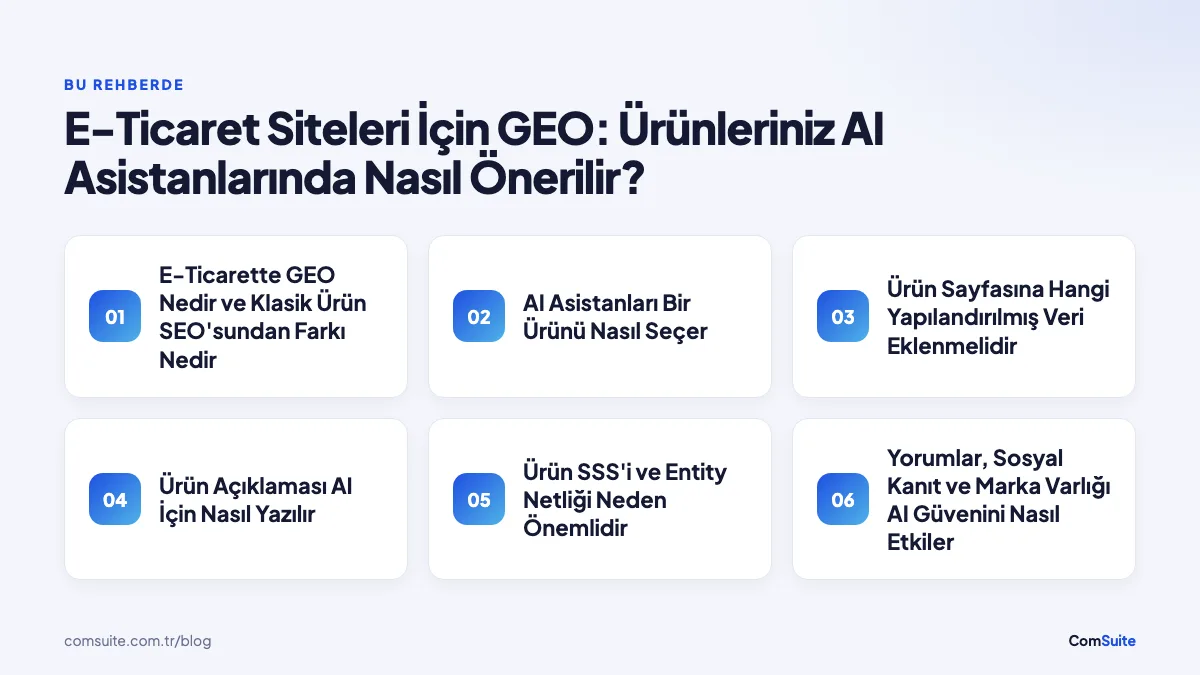
How Do AI Assistants Choose a Product?
When AI assistants recommend a product, they focus on three core criteria: trust, clarity, and the quality of your structured data. None of these is enough on its own; all three are weighed together.
Trust: Does Your Product Look Like a Reliable Source?
When generating ChatGPT shopping recommendations or Perplexity product results, the model synthesizes information from multiple sources across the web. A product that is mentioned consistently across several independent sources earns more "AI trust." Editorial reviews, independent comparison sites, and customer reviews are the main ingredients that build that trust.
Clarity: Does Your Product Information Leave Room for Doubt?
AI models avoid citing vague content. Instead of abstract claims like "a great product," they favor descriptions with concrete, verifiable facts such as "500 mAh battery, 48-megapixel main camera, IP68 water resistance." A clear product name, brand, model number, and compatibility information are also part of this clarity criterion.
Structured Data: Machine Readability
Structured data lets machines interpret your content directly. A product page marked up with Product schema spells out price, availability, and rating, which allows AI systems to use that information with confidence.
Which Structured Data Should You Add to a Product Page?
The core structured data standard for product pages is Product schema, as defined by Schema.org. Google's official developer documentation supports this schema and lists the required fields for product rich results.
These are the main fields we recommend implementing in JSON-LD format:
- name: The product's full name (including brand + model)
- description: A description of at least 150 words that covers technical specs
- brand: The brand name and, if available, a link to the brand page
- sku / mpn / gtin: Product identifiers; critical for entity matching by AI models
- offers: Price, currency, availability (InStock / OutOfStock)
- aggregateRating: Average rating and review count
- image: URL of a high-resolution product image
The gtin (Global Trade Item Number) field is especially important because it lets AI systems match the same product across different sources. If it's missing, the model may confuse your product with a competitor's — or ignore it altogether.
If you also use a product feed (such as Google Merchant Center or Meta Catalog), the data quality in those feeds must be consistent with your product schema. Inconsistent pricing or stock information hurts AI trust.
How Do You Write a Product Description for AI?
Product descriptions that AI assistants will cite should be structured to serve both the shopper and the model. A good product description opens with a first sentence that answers the question directly.
The Answer-First Structure
The first sentence of a product description should state clearly what the product does. For example: "The X Model Running Shoe is a carbon-fiber-plated performance shoe designed to support your feet on long-distance runs of up to 40 km." This structure makes it easy for an AI model to quote the description directly.
Translate Technical Specs into Plain Language
A spec table alone isn't enough. Rather than just "500 mAh battery," a description like "its 500 mAh battery delivers up to 8 hours of music playback on a single charge" matches both the questions shoppers ask and the format of AI-generated answers.
Compatibility and Use Cases
AI assistants frequently answer questions like "Is product X compatible with device Y?" or "Which product should I use in situation Z?" If your product description clearly states compatibility details (which devices, which operating systems, which conditions of use), your product stands out for those questions.
Writing Mistakes to Avoid
- Subjective, unverifiable claims ("the best in the world," "unmatched quality")
- Long, meaningless sentences built on keyword repetition
- Unnecessary mentions of competitor product names
- Burying price or stock information in the description (these should be marked up separately with schema)
Why Do Product FAQs and Entity Clarity Matter?
Product FAQ sections on product pages are one of the most effective tools in an e-commerce GEO strategy. FAQs marked up with FAQPage schema set the stage for AI models to use that content directly as a source when answering question-style queries.
Which Questions Belong in the FAQ?
- Questions about the problem the product solves ("Does this headset have noise cancellation?")
- Compatibility questions ("Does it work with iPhone 15?")
- Comparison questions ("What's the difference between model X and model Y?")
- Conditions of use ("Is it waterproof — can I wear it swimming?")
- Warranty and return questions
Entity Clarity: Make Your Brand and Model Identity Unambiguous
Entity clarity means AI models can tell your product apart from other products. Your brand name, model number, and product category should be used consistently, with no conflicting information anywhere on your site. For example, if one page says "Model A Pro" and another says "A Pro Model," AI may treat them as two different entities.
Having your brand defined in Wikidata or the Google Knowledge Graph is another major factor in strengthening entity clarity. This is a particularly practical strategy for larger brand owners.
How Do Reviews, Social Proof, and Brand Presence Affect AI Trust?
AI assistants don't work only with the information on your product page — they draw on data from across the web. That's why brand presence and social proof directly affect how much AI trusts your product.
The Role of Customer Reviews
A large number of highly rated reviews increases the likelihood that AI models will present your product as a reliable option. In most cases, products with an average rating of 4.0 or higher and at least 50 reviews appear more often in AI recommendations. Marking up reviews with aggregateRating schema passes this data directly to the model.
Independent Reviews and Third-Party Sources
When your product appears in independent blog posts, comparison sites, or editorial reviews, AI can verify it against multiple trusted sources. This is a deciding factor especially for source-driven AI assistants like Perplexity.
Strengthening Your Brand Presence
When your brand is described consistently across social media profiles, industry publications, and encyclopedic sources, AI models trust it more. This strategy isn't just for big brands — it applies equally to small e-commerce businesses operating in niche categories.
Product Feeds, Comparisons, and Getting Into AI Sources
An often-overlooked side of e-commerce GEO is making sure your products actively appear in the sources AI systems crawl.
Why Product Feeds Matter
Product feeds uploaded to Google Merchant Center are one of the core data sources behind Google's shopping-focused AI features (including the Google Shopping Graph). The title, description, category, and attribute data in the feed must be consistent with the product page for AI systems to recommend the product with confidence.
Comparison Content
Product comparison pages you publish on your own site (for example, "Model A or Model B?") are one of the content types AI assistants draw on when answering comparison questions. If these pages present the strengths and weaknesses of both products objectively, they're more likely to be cited by AI.
Presence on Industry Comparison Sites
Price comparison sites, product review platforms, and industry-specific buying guides are sources AI models crawl frequently. Listing your product on these platforms with up-to-date, accurate information supports your visibility in AI recommendations.
How Do You Test Whether AI Recommends Your Product?
To measure the effectiveness of your e-commerce GEO work, set up a systematic testing and improvement loop. Mature tooling for this process doesn't exist yet, but the methods below offer a practical starting point.
Manual Query Testing
Test likely shopper questions about your product in ChatGPT, Perplexity, and Google AI Overviews. For example:
- "What's the best [product type] for [category]?"
- "Can you recommend a [product type] for [use case]?"
- "What do you think of the [Brand] [Model]?"
Repeat these tests at regular intervals (monthly, for example) and record the results.
Citation and Source Tracking
In AI assistants that show their sources, like Perplexity, check whether your product page or brand is listed as a source. An increase in traffic from Perplexity or ChatGPT in your site analytics can be read as a positive signal.
Structured Data Validation
Use Google's Rich Results Test and the Schema.org Validator to regularly confirm that your Product schema implementation is error-free. Broken or incomplete schema leads AI systems to misinterpret your product data.
The Improvement Loop
Based on your test results, follow these steps:
- Rewrite descriptions for products that aren't being recommended using the answer-first structure
- Fill in missing schema fields (especially gtin and aggregateRating)
- Build a social proof strategy for products with few reviews
- Update product FAQ sections based on real customer questions
- Bring product feeds in line with your product pages
E-commerce GEO isn't a one-time technical fix; it's a strategy that requires continuously improving content quality, structured data, and brand credibility. Because standards in generative engine optimization are still maturing, keeping this loop running regularly is the most reliable way to build a competitive advantage.
Classic Product SEO vs. E-Commerce GEO: The Core Difference
| Dimension | Classic Product SEO | E-Commerce GEO |
|---|---|---|
| Goal | Ranking high on Google | Getting AI to recommend your product BY NAME in its answer |
| User behavior | Clicks a link, browses the site | Asks AI, gets a direct recommendation |
| Key unit | Keyword + backlink | Entity clarity + structured data + trust |
| Winning content | Long, keyword-heavy page | Clear, quotable, evidence-backed product information |
| Measurement | Rankings, click-through rate (CTR) | Share of visibility/recommendations in AI answers |
Why Should an AI Assistant Recommend Your Product? 4 Decision Signals
Can someone tell at a glance what it is, which brand/model it is, and what it does? AI won't recommend an ambiguous product.
Are price, stock, rating, and brand machine-readable via Product schema? Structured data = a source AI trusts.
Are there reviews, ratings, technical specs, and usage details? AI quotes EVIDENCE, not claims.
Are your brand name, contact details, and product information the same across the web? Contradictions erode trust.
Product Page Structured Data: The Format AI Trusts
Add Product schema to every product page. It makes price, stock, rating, and brand machine-readable for AI. Example:
{
  "@context": "https://schema.org/",
  "@type": "Product",
  "name": "Stainless Steel Industrial Sink 60x50",
  "brand": { "@type": "Brand", "name": "Inoxate" },
  "sku": "INX-EV-6050",
  "description": "Single-bowl industrial sink in grade 304 stainless steel...",
  "aggregateRating": { "@type": "AggregateRating", "ratingValue": "4.8", "reviewCount": "37" },
  "offers": {
    "@type": "Offer",
    "priceCurrency": "TRY",
    "price": "4250",
    "availability": "https://schema.org/InStock"
  }
}
This block is added to the page as an application/ld+json script tag. On the ComSuite storefront system, product pages generate this schema automatically — your job is to write clear descriptions and specs.
Writing Product Descriptions AI Will Quote
"Quality sink. Great price. Order now! We have the best."
"A 60x50 cm single-bowl industrial sink made from grade 304 stainless steel. Ideal for restaurants and commercial kitchens; highly resistant to acid and rust, with a 1.0 mm gauge that stands up to impact. Drain trap and mounting hardware included."
The difference: The second one answers what it is, who it's for, and which concrete features it has. When a shopper asks for a "durable stainless sink for a restaurant," AI can quote that clarity.
E-Commerce GEO Checklist (For Every Product)
☐ Product schema: are price, stock, brand, and rating machine-readable?
☐ Does the description answer what it is, who it's for, and which concrete features it has?
☐ Are the brand and model names clear and used consistently?
☐ Is there a product FAQ (compatibility, use, care)?
☐ Are real reviews and ratings visible on the page?
☐ Are technical specs in a table (data, not speculation)?
☐ Are images in WebP with descriptive alt text?
☐ Is your brand information (contact, about) consistent across the web?
Are Your Products Being Recommended by AI? Measure First
GEO isn't a one-off task — it's a measurement loop. Ask ChatGPT, Gemini, and Perplexity about your brand and product category: are they recommending you, or your competitor? That's hard to track by hand.
Measure how your brand shows up in AI search in 1 minute — see which engines know you and how they describe you.
Frequently Asked Questions
What is GEO for e-commerce sites?
GEO for e-commerce sites is a method that uses geographic location data to offer product recommendations tailored to users' local needs.
How do AI assistants recommend products on e-commerce sites?
AI assistants analyze users' location data, search history, and preferences to recommend the most suitable products.
What advantages does GEO targeting offer e-commerce sites?
GEO targeting boosts customer satisfaction and lifts conversion rates by delivering customized offers for local markets.
How is GEO data collected on e-commerce sites?
E-commerce sites collect geographic location data through users' IP addresses or GPS data.
How do you integrate GEO with AI assistants?
AI assistants are integrated with e-commerce platforms to analyze user data and make recommendations based on that data.