
The Importance of Keyword Research
Keyword research is the process of determining which words and phrases you should target so your website can rank at the top of search engines. Put simply: SEO work done without targeting the right keywords is like trying to find your way without a compass. All search engines, Google first among them, analyze users' search queries to surface the most relevant content. That's why knowing which terms are searched for, how often, and how competitive they are is the cornerstone of a successful digital strategy.
Why Should We Do Keyword Research?
The most fundamental reason to do keyword research is to get inside your target audience's head. Understanding the words people use when searching for a product, service, or piece of information directly shapes your content strategy. Here are the main reasons keyword research is so critical:
- Reaching the right audience: By learning your target audience's search habits, you can deliver exactly the content they're looking for.
- Growing organic traffic: Content that targets the right keywords draws steady, lasting organic traffic from Google.
- Understanding the competition: You can see which keywords are highly competitive and which ones still offer open opportunities.
- Content planning: It gives you a solid foundation for developing new content ideas and optimizing existing content.
- Increasing conversion rates: By targeting keywords with purchase intent, it becomes easier to turn visitors into customers.
In short, content created without keyword research may never reach its target audience. This process is both the starting point of SEO and a dynamic component that needs to be updated continuously.
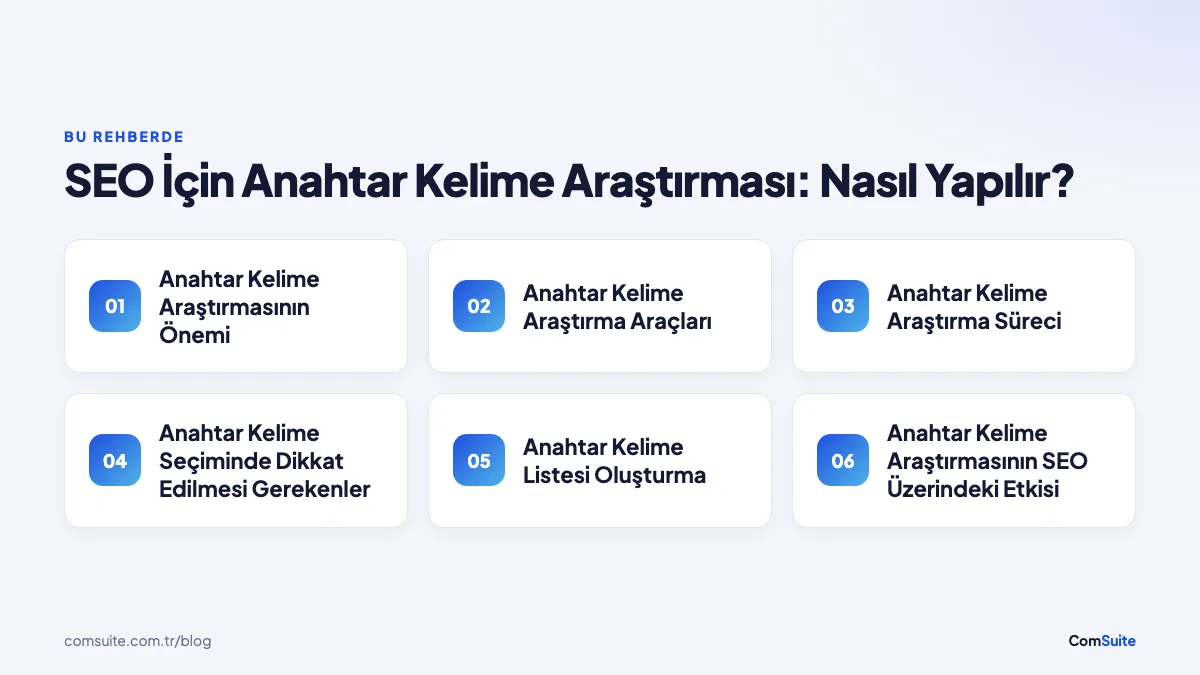
Keyword Research Tools
Using the right tools makes a big difference when you want to do effective keyword research. There are many free and paid tools on the market, each with its own unique strengths.
Free and Paid Tools
The tools you can use for keyword research fall into two main categories:
- Google Keyword Planner: This free tool, accessible with a Google Ads account, provides search volumes, competition levels, and new keyword suggestions. Because it uses Google's own data, its reliability is high.
- Google Search Console: This free tool shows which queries your website is already getting impressions for, making it ideal for optimizing your existing keywords.
- Ubersuggest: Developed by Neil Patel, this tool offers search volume, SEO difficulty, and content ideas on its free plan.
- Ahrefs: Although it's a paid tool, it's an industry standard offering comprehensive competitor analysis, backlink data, and detailed keyword reports.
- SEMrush: A paid platform with powerful features for both keyword research and competitive analysis.
- Moz Keyword Explorer: A user-friendly tool that measures keyword difficulty and organic click potential.
If your budget is limited, the combination of Google Keyword Planner and Google Search Console is a very helpful way to get started. For more advanced analysis, investing in paid tools pays off significantly in the long run.
The Keyword Research Process
Keyword research is a multi-step process that requires a systematic approach. Following a data-driven method rather than picking random words leads to far better results.
Step-by-Step Keyword Research
By following the steps below, you can carry out comprehensive and effective keyword research:
- 1. Identify seed keywords: List the core concepts related to your business, product, or service. For example, if you run an e-commerce site, broad terms like "sneakers" or "running gear" could be your seed keywords.
- 2. Check search volumes: Use tools to find the monthly search volumes of your chosen keywords. Targeting rarely searched terms won't bring traffic, while ranking for highly searched but highly competitive terms is difficult.
- 3. Analyze your competitors: Look at which keywords competing websites in your industry rank for. This can reveal opportunities you may have overlooked.
- 4. Understand search intent: Behind every keyword is a user intent. Users looking for information, comparing products, or ready to buy all use different words. Align your content with that intent.
- 5. Expand with related keywords: Google's "Related Searches" section and the suggestion features of keyword tools help you discover new keywords related to your main terms.
- 6. Prioritize and list: Bring all the data together and prioritize keywords based on search volume, competition level, and alignment with your business goals.
What to Consider When Choosing Keywords
Not every keyword is equally valuable. Looking at search volume alone isn't enough to choose the right ones; you need to weigh several factors together.
Competition Analysis and Traffic Potential
Competition analysis plays a critical role in keyword selection. If a keyword has high search volume but also faces heavy competition, ranking for it can be extremely difficult for a new or mid-sized website. Here are the factors you should pay attention to:
- Keyword Difficulty (KD): This metric, provided by SEO tools, shows how hard it is to reach the first page for a given keyword. Low-difficulty keywords make better starting points for new sites.
- Cost Per Click (CPC): Keywords with a high CPC are usually the ones with high commercial value. Targeting them with organic content can pay off as well.
- SERP Features: Check whether Google shows special search result features for your target keyword, such as featured snippets, knowledge panels, or local packs.
- Seasonality: Some keywords are searched far more often at certain times of the year. Google Trends is a helpful tool for spotting this.
The ideal keyword has reasonable search volume, low to medium competition, and a strong connection to your website's content. Finding this balance is at the heart of a successful SEO strategy.
Building a Keyword List
Turning the data you gather during research into an organized list is the first step toward putting your content strategy into action. A well-organized keyword list makes it clear which content you need to create.
Related Keywords and Long-Tail Keywords
Keywords generally fall into two categories: short-tail (head) and long-tail keywords. Short-tail keywords usually consist of one or two words and have very high search volume, but competition is just as high. Long-tail keywords are more specific phrases made up of three or more words.
Long-tail keywords offer several important advantages:
- Lower competition: Because they're so specific, competition for these keywords is usually much lower, which makes ranking easier.
- Higher conversion rate: A user searching for "lightweight women's running shoes size 42" instead of "women's running shoes" is much closer to buying.
- Alignment with search intent: Long-tail keywords show exactly what the user is looking for, letting you match your content to that intent.
- Voice search compatibility: As voice search grows, long-tail keywords written in natural language are becoming increasingly important.
Including both your main keywords and their related long-tail variations in your list helps you build a comprehensive, balanced content strategy. Grouping related keywords into topic clusters helps each page build authority around a specific subject.
The Impact of Keyword Research on SEO
Well-executed keyword research fundamentally changes your SEO performance. This process does more than determine which words to use; it also shapes your website's overall structure, content hierarchy, and user experience.
Driving More Traffic and Conversions
The contributions of keyword research to SEO produce concrete, measurable results. Websites that target the right keywords and weave them naturally into their content earn sustainable organic traffic by ranking higher on Google. The quality of that traffic matters just as much: visitors who land on content that matches their search intent stay on the page longer, view more pages, and are more likely to convert.
The contributions of keyword research to your content strategy can be summarized as follows:
- Identifying content gaps: Discover topics where your competitors rank but you haven't yet created content.
- Optimizing existing content: Breathe new life into older content by adding fresh keywords.
- Building a pillar-cluster structure: Strengthen your site's authority by creating content clusters organized around main topics and subtopics.
- Capturing seasonal opportunities: Spot search trends that rise at certain times in advance, and publish content right on time.
Ultimately, keyword research is not just an SEO technique; it's a strategic process that helps you better understand your target audience, create content that truly adds value for them, and grow your website over the long term. Repeating this process regularly is essential to keep up with changing search trends and stay ahead of the competition.
Frequently Asked Questions
What is keyword research?
Keyword research is the process of identifying the most suitable keywords to use to reach your target audience.
How is keyword research done?
Keyword research is done by using keyword tools, analyzing competitors, and understanding users' search intent.
Which tools are used for keyword research?
Tools such as Google Keyword Planner, SEMrush, and Ahrefs are widely used for keyword research.
What does keyword density mean?
Keyword density is a ratio that expresses how often a specific keyword appears within a piece of text.
What are long-tail keywords?
Long-tail keywords are more specific search terms, usually made up of three or more words, and they can be targeted with less competition.
What is the impact of keyword research on SEO?
Identifying the right keywords helps your website rank better in search engines and reach your target audience more effectively.